Monday, 13 December 2021

FIRSTS (We all start somewhere)


Mazzy Adams

Like any worthwhile endeavour, becoming a writer begins with firsts.

Lots and lots of firsts.

First sentence, first rhyme, first story, first chapter, first re-write, first risky reveal, first rejection, first encouraging response, first submission, first blog post … 

(Speaking of which, have you considered joining the CWD blog roster yet? Note: I’m smiling sweetly, dusting my ulterior motive as a member of the CWD Admin team with optimistic innocence. 😊)

Firsts. We all start somewhere.

Strangely enough, becoming a confident writer begins with …

More firsts. Lots of ‘em. 

And the willingness to embrace those frustrating, fiddly, finicky, fickle, sometimes foolhardy, but always brave, seconds, fourths, fifths or fiftieth factors and phases which facilitate and finesse one’s development as a writer. I acknowledge that confidence will always be an elusive beast—it’s in the nature of writers to doubt and second guess themselves and their work—but please don’t let that stop you because, ultimately, the rewards are amazing and often unexpected.

For some of us, the first of our writing firsts happened way back when we were children.  

I wrote my first truly memorable sentences in Year Five: 

Montague Meringue was a quiet but intelligent fellow, small of stature, with an olive complexion and hazel-brown eyes. Around his oval face was a mop of shiny black hair, and his button nose was just like that—a button.
I use the term ‘truly memorable’ because, fifty years later, I can still remember those two sentences verbatim. I doubt my year five teacher gave them a second thought once she’d left her tick at the end of the story—which my ten-year-old self considered a masterpiece of ingenuity when, after numerous failed attempts, Montague, my intrepid scientist discovered the cure for hypervitaminosis after a storm smashed the window of his laboratory and blew a Moreton Bay Fig (the fruit, not the tree) into his test tube. I’ll admit my conclusion lacked plausibility but, at 2:55pm with the school bell about to ring, I needed a quick exit strategy for both story and me.

We all start somewhere.

My first brief flash of poetic brilliance arrived when I was in Year Seven:

Rushing, like a fiery dragon,
Tongues of flame leaping from its mouth,
Stronger than Orion with his mighty bow and arrows,
Conqueror of Leo the Lion,
Swallowing the stars and the moon,
Chasing the darkness away,
Dawn has come.

With some trepidation, I showed this to my older sister. Rose had, for years, thrilled me with her own creative writing (my favourite being a scripted ‘radio play’ where the listener’s faulty radio randomly flipped between channels, creating a hilarious compilation of absurd sentences like … ‘My heart bleeds for / Parsley.’ 

Given my undisputed admiration for her writing skills, receiving her tick of approval was a massive encouragement. Sadly, my secondary school writing efforts produced more spurious, ignominious results. 


 Compilation of StockUnlimited Images ID2047567 and ID1891056 (Licensed)

Like the day we had to write a song parody and an epitaph during a Year Nine English class; I came up with:

How tasteth that froggy in the dinner? (Croak Croak)
The one with the waggly chin, (Croak Croak)
To put that dear froggy in the dinner, (Croak Croak)
Is little better than a sin. (Croak Croak croaked!)

And:

Here lies my English teacher.
Before she died, she had the hide
To ask me to write an epitaph. 

Not my finest work, or hour, I admit, though my English teacher (whom I adored) did stifle a grin. When it comes to spontaneous creativity, my first drafts (then and now) have been decidedly hit-and-miss. I choose to see my firsts as steppingstones; the shakiest ones invite a dunking, but others lead me (even precariously) towards a delightful destination.

We all start somewhere.

James A Michener, author of over forty books, said, “I'm not a very good writer, but I'm an excellent rewriter.” Considering his first book, Tales of the South Pacific was adapted as the popular Broadway musical South Pacific, by Rodgers and Hammerstein—one of my all-time favourites—I’m glad he kept writing, and rewriting, many firsts. 

It took me decades to discover I had a knack for writing song lyrics, drama skits and puppet plays which opened opportunities to rope in and nurture budding performers of all ages within our church. 


When an acquaintance from the local Speech and Drama Teachers Association pressed me to compete in a local bush poetry competition to boost competitor numbers, I agreed to have a go, had a lot of fun, and met an affable, genuinely encouraging group of Aussie bush poets from all walks of life who welcomed me into their fold. Even the most competitive among them took time to befriend, encourage and nurture the newbies. When you’re starting out, a little derring-do, and a spark of encouragement, can ignite a roaring fire if you’re willing to give it some passion, time and nurture. To my surprise, later that year, the Australian Bush Poets Association included Welcome to the Brotherhood—a poem I’d written commending the good-humoured camaraderie of the writers and performance artists I’d met—in their magazine. Literary larrikins one minute, serious purveyors of powerful words the next; those contemporary balladeers continue to break new ground whilst keeping the Aussie spirit alive.

Like I said, we all start somewhere. Even when we doubt our own preparedness to put our words out there, God can, and does, use our willingness to try, to bless others. Yes, we need to hone our skills, but the sharpest sword, if left in its scabbard, remains ineffective. Edward George Bulwer-Lytton has been called “one of the worst writers in history”*, his most notorious example being the opening line, “It was a dark and stormy night ...” Yet we're inspired by his (oft-quoted) line from Act II, Scene II of Richelieu: “The pen is mightier than the sword.”
 
More than a decade after my bush poetry dalliances, I started formal degree studies in creative writing externally through Tabor Adelaide. The encouragement of Christian lecturers cemented my passion for literature and creative writing. In 2012, my submission to Tabor’s “Christmas Tales” anthology (Pantaenus Press) was accepted and Twelve Miles to the Sea, a rhymed and metered ballad inspired by my eldest sister’s recollections, was published in a hold-in-your-hand, real life print anthology. That was an exciting first.

Then in beach clothes dressed and ready and excitement high and heady
‘n Grandad driving, slow and steady, they’d set out upon their way,
though the road was dirt and dusty and the car was old and rusty
and the springs of that old trailer had seen brisk and better days.

... 


So they splashed and sploshed and spluttered while the beach umbrella fluttered
with the Grand-ums and Aunt Lottie perched precariously underneath,
wearing long sleeves, hats and stockings, (was it melanoma mocking?)
in the tradition of the English, never minding Queensland’s heat. 

(From Twelve Miles to the Sea; Stanzas four and six of twelve)

Thanks to sporadic but timely early encouragement, the ongoing, mutual encouragement of writerly friends, several slightly more forceful and persistent nudges from a true friend, and the often-dull-but-daily decision to nurture the call and persevere, I'm still tackling firsts. And fiftieths. My novel edits have probably exceeded that number; blurb is still a first to be facilitated. Firsts are still scary. But …

Start here. Go there. We all start somewhere! Or we go nowhere.

While it’s exciting to hold a printed book in your hand, online opportunities give writers other ways to reach an ever-increasing audience. Our CWD blog roster provides opportunities for both guest bloggers and regular contributors who are active, engaged members of the Christian Writers Downunder Facebook group to make a positive difference. (Nudge, nudge.)
 
I added my first tentative contribution to this blog, Writers are Artists, in November, 2013 (before I adopted my pen name). As a naïve newbie daring to join bloggers with greater skills and experience and wisdom and knowledge than I, I needed a solid nudge. I’m glad Nola Passmore (who was, at that time, a CWD co-ordinator) nudged, because it is a privilege and a blessing to contribute to this encouraging writing community. It’s a privilege to share words that inform, inspire, and encourage others to grow in their writerly gifting and pursuits. It is a grace empowered by the knowledge that it is not our perfection (or lack of it) that matters most, but our heart’s desire to diligently pursue our God-given calling to write and be a blessing to others. 

Is this a privilege, a blessing, a grace you’re ready to receive and use? If so, please let us know by commenting below or in the Facebook group; we really do want others who share the vision and values of Christian Writers Downunder to join our blog roster as guests and regulars. 600 - 1000 words. That's all it takes. No need to be longwinded (as I've been today - reputedly one of Bulwer-Lytton's worst faults). 

As for those ‘firsts’, anyone else dare to share some of their famous, or infamous, writerly blunders and beauties in the comments? Go on. After all, we all started somewhere. 😉

* see http://www.thisdayinquotes.com/2010/03/pen-is-mightier-than-sword.html


Mazzy Adams
Author, Genre Rebel
Intrigue and Inspiration with an Upmarket DownUnder Vibe
A contented Aussie wife, mother, grandmother, business manager, creative and academic writing tutor, and encourager, Mazzy maintains her passion for words, pictures, and the positive potential in people.
maz@mazzyadams.com


Monday, 6 December 2021

CWD Member Interview – Sara Powter

From time to time we interview one of the members of Christian Writers Downunder – to find out a little bit more about them and their writing/editing goals. 

Today’s interview : Sara Powter 


Question 1: Tells us three things about who you are and where you come from. 


Recently retired, Ministers wife. We live on the NSW Central Coast and are waiting to see what project the good Lord has for us next. 

 Question 2: Tell us about your writing (or editing/illustrating etc). What do you write and why? 


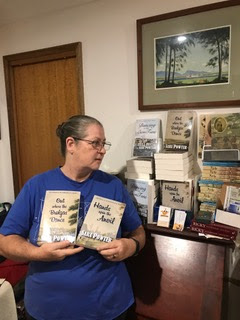
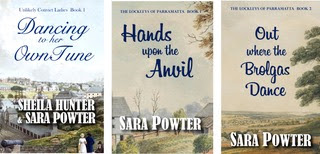
I only started writing Sept 2020. One of the ‘duties’ I had during the 1st Covid lockdown was being a person, locked down and lonely people could ring. Calls were often long. During one such call which lasted over three hours, I was flicking through my computer and saw a story that mum had written and given to me before she died. ( I had already had 3 of her books printed and knew she had another one part written. I had intentionally never read it.) So, to see if I could one day finish it, I decided to write one myself. So, I started ... ‘Hands Upon the Anvil’ was born.
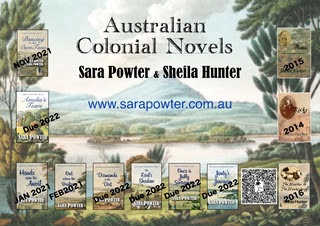
I write Australian Colonial stories. And they are Sagas- so all over 100k words:- Bk 1 is 150k; Bk 2 is 170k words and the co-authored one is 110k. 

Question 3: Who has read your work? Who would you like to read it? 


If you like Australian History, like Eleanor Dark’s the Timeless Land; or EV Timms, Forever to Remain; Catherine Gaskin’s Sara Dane or Marcus Clarke’s, For the term of his natural life, then that’s what mine are like – but with a Christian Flavour, then hopefully you’d love there. 

They are a step back in time sort of story, but with a touch of romance. I have given copies to some of our parishioners and friends. Although they were only proofs they loved them, I’m now to this become my passion – I’m on to #9 

Question 4: Tell us something about your process. What challenges do you face? What helps you the most? 


 My stories ( now on book 9 – and yes I finished mum’s book) are often inspired by our family histories. I have four convicts in my family and Hubby has three. And then there are all the free settlers. Finding a story line is not hard. Stopping writing is! My biggest challenge is slight dyslexia, but for some reason writing these stories just seem to flow. My spelling is abysmal, and my grammar is worse, but I manage. Finding a professional Editor who knows what she’s doing has been great.

Question 5: What is your favourite Writing Craft Book and why? I don’t what that is? 


If you mean who triggered this? Then it was when I was reading Carolyn Miller’s books, I realised I could tell a series of stories. As to who I refer to – then being dyslexic – I’ve battled with words most of my life. Reading aloud is a killer, though I found reading helped with writing. I now devour books. I don’t have a reference set of books, but I have found that my editing is still dismal. Grammarly Pro is my 2nd help. I have to often look up what things like Syntax are. I’m learning. My novels actually include a bibliography as they are historical novels, and so I use TROVE and the online Biographical Dictionary a lot. 

Question 6: If you were to give a shout-out to a CWD author, writer, editor or illustrator – who would they be? 


 I’m loving so many of them, but Carolyn Miller is great. I have all of her historical ones. There are others too, but she’s been a great encouragement too. 

Question 7: What are your writing goals for this year? How will you achieve them? 


I have three books already out. My first two and the co-authored one with mum. I have four more backlogged at the editor, one more in the pre edit stage and another partially written. 2022 will see at least four more out- possibly even more. I do all the graphics, covers and lay out myself. Until I get a multi-million movie deal, I don’t think I’ll be making much money out of it. But I love writing the stories.


Question 8: How does your faith impact and shape your writing? 


 So much of our colonial history is told from either the Government or ‘bad’ convicts point of view. Mine are told from the view of those wanting to make something of their lives. They have normally come from squalor and are determined to help others. This is in fact what my family did. Faith has always been vital to their lives. Even before their arrival in the colony they were trying to make a difference. My faith is interwoven into many if not most of my characters. I am today who I am because of them. Their faith was strong, and they taught the importance of a firm belief in Jesus.
 

Thursday, 2 December 2021

Shut Doors, Open Doors – by Ruth Bonetti

The times are a-changing sang 70’s folk singers. Fifty years later, we're buffeted by tidal waves crashing mayhem into our lives. How can we ride them rather than flounder and sink? 

Writers can express words of hope for the many who struggle around Australia, the globe. 

Fellow authors encourage

Did you sign up for NaNoWriMo? Did you meet the goal to write 50,000 words? For the uninitiated, like-minded writers group in a digital ‘cabin’ to encourage each other, joke, support and share emojis of chocolate and coffee. 


November is the cruellest month for tired teachers drowning in end of year concerts, student exams, reports. Plus their own performances. So I knew there was slim chance I’d meet the word count but hey, I enjoy the friendship. This year, I produced a teensy 670 words. But so what? Just to articulate a project prompts subconscious planning. My WriMo version can evolve over the next two months when teaching and performing halt. 


Other writing counts

There are many forms of writing besides that novel or screenplay. Emails to politicians, letters to the editor of a newspaper. Heartening messages to uplift those who share their despair on social media. Many dread uncertain futures. How can we reassure them–ourselves–that even as doors shut, others will open? 


The Light of the World William Holman Hunt

Active vs. passive shutting

As I clear out my teaching studio for the year (maybe forever?) I'm heartened by a gospel spiritual that never seemed appropriate for primary school students:


Shut de door, keep out de devil

Shut de door, keep de devil in de night.

Shut de door, keep out de devil

Light a candle, everything’s alright. 


The Light of the World

The Holman Hunt painting reminds us to open our heart and life doors to Christ. 


One opening door is opportunities to share Christ's light with hurting, fearful people. To encourage those facing doors slamming on their career, business, mortgage – and life. 


Edicts from our rulers threaten that those who resist will be barred from public buildings. 


Was my November performance with Noosa Orchestra my last ever? The program included The Lark Ascending for solo violin and orchestra. I poured my heart into the supporting clarinet solos. 


The lark circles higher, soars, surmounts the ugliness of the present world. 

So, also we must lift up our hearts. 


'For I know the plans I have for you,' declares the Lord, 'plans to prosper you and not to harm you, plans to give you hope and a future.' (Jeremiah 29:11)


Keep looking up. 


ABOUT Ruth Bonetti

Ruth's many earlier books give practical support for confident performance of words and music, drawing on a lifetime of experience as a musician and educator. Her Trilogy Midnight Sun to Southern Cross has won awards including the CALEB Nonfiction prize. In coming writing, Ruth is open to a genre transition...


Blog (occasional!)

Facebook


Monday, 29 November 2021

A Story of Life


Recently I was asked, as a representative of Omega Writers, to attend the awards ceremony of the Stories of Life writing competition.

 It was a blessing to see the South Australian writers present in person and know that interstate writers were able to watch online.

Stories of Life is a great competition, giving opportunity to writers at any stage of development to apply themselves to tell a story that encourages, inspired by real life events. A number of people I know from this network and other connections were published in the anthology that resulted, and it was great to read their stories.

I have a real-life story of my own I’d like to share. It is about the love of God in a difficult situation.


It’s a true story, a little bit funny, a bit sad, but it’s an inspirational story. It started Easter 2015, on Good Friday to be exact.

As is often the case on Good Friday, I found myself part of the Good Friday church service. I was playing the piano, and my husband (the pastor at that time) had arranged, among other things, that I would play the old hymn ‘When I Survey the Wondrous Cross’ as a background accompaniment while three people read pieces of Scripture. I needed to get a scanned copy of the music as I couldn’t find my old hymn books. I had it all sorted and I’d practiced it, and it was all good. The service went along as planned, and it was inspirational and a little bit stirring, as all Good Friday services should be.


 At the end of the service my husband did one of his special spontaneous moments that he is famous for, and announced to the congregation that he would get his wife (that’s me) to come back to the piano and sing ‘The Old Rugged Cross’. I’m sort of used to these surprise put-you-on-the-spot ideas that pop up from time to time, and I can usually fumble about and make something happen, but I honestly hadn’t played ‘The Old Rugged Cross’ in years. I couldn’t remember half the words, was not sure which key it should be played in so that I didn’t find myself shattering the glass windows with notes that were too high. AND you know with old hymns, they are notorious for throwing in odd chords outside the usual easy progression. I just wasn’t sure if I could actually do it on the spot with no opportunity to practise first. But the congregation had their eyes turned towards me in expectation. My husband magnanimously says: “Is that all right?” He'd already told the congregation I’d do it, so it had to be all right, didn't’t it? I shrugged my shoulders and said weakly, “I guess so...”


I got to the piano and took a guess at the key, and hoped for the best. I spotted another singer who is like me (from times past and should know ancient hymns) and invited him to join me, especially since I wasn’t sure of the words. If I was going to fall flat on my face, better to have someone else go down with me. So off I launched.

 ‘On a Hill, far away, stood an old rugged cross, the emblem of suffering and shame, and I love that old cross, where the dearest and best, for a world of lost sinners was slain...’

 I’m pleased to say we got the right key, there were no awkward and difficult elusive chords, and the computer operator found the words and threw them up on screen. Crisis averted. Job done.

After the service my husband came to me aside, and he was really quite cross. He said to me: “Why did you have to make such a fuss about playing that hymn?”

I was a little annoyed myself, as I thought I’d done a sterling job under pressure and said so, pointing out how many obstacles I’d had to overcome without practise or music to guide me.

“But you’d just played it earlier in the service!” he said, prepared to continue the argument.

“No!” I replied. “That was ‘When I survey the Wondrous Cross’. It’s a completely different hymn!”

“That’s what I wanted you to play,” he said.

“Well that’s not what you said!”

 “Yes it was. I said, ‘When I survey the Wondrous Cross’.”

“No, you said, ‘The Old Rugged Cross’!”

 “Did I?”

 “Yes, you did!”

I waited for the humble apology, which might or might not have emerged, but instead something miraculous happened.

 A lady by the name of Julie came up to my husband, beaming and full of enthusiasm.

“That is my favourite hymn”, she said. “I was so cross with my family this morning, because they were so slow getting ready for church, we missed the singing at the beginning, and I said to them, if I miss out singing ‘The Old Rugged Cross’, I’ll be very upset. I’m so glad you kept it until the end.”


Several months later, Julie passed away after battling a long illness.

 That Easter morning eight months earlier was the first time I had met Julie as she was new to the church. In the following eight months I got to know her really well as she travelled the journey of battling cancer. 

In that time I never saw her that she didn’t say how blessed she was because God had done something for her. Even when she was weak and really quite sick, you never really knew it, because her whole outlook was God is in this moment. He is blessing me all the time. 

That Good Friday morning there had been no plan to sing ‘The Old Rugged Cross’. No preparation, no thought of it, and my husband didn’t even mean for it to be sung. But God did. He knew it would be Julie’s last Easter Friday, and that hymn was special to her.

I know this is a bit long, but I just wanted to honour God, because when I spoke to Julie four days before she died, she said to me, all I want to do is see God glorified.

 Even when things aren’t supposed to happen sometimes, they do, but if Julie was commentating on it, she would very definitely have said: ‘It was God.’


If you have something in your heart inspired by a real-life event, check out Stories of Life and perhaps you’d like to enter the writing competition for next year.

I'd like to wish all the CWD readers a blessed Christmas season, and hope that as you spend thoughtful time you may recall that story that needs to be shared. 

Click here for more information on Stories of Life


Meredith Resce

Author of the new Luella Linley - License to Meddle series and The Heart of Green Valley series


Thursday, 25 November 2021

Behind the Scenes: Kin Seeker by N R Eccles-Smith

Today we go "behind the scenes&"; as Jeanette (Jenny) O'Hagan interviews the fabulous Naomi Eccles-Smith.


Jenny: Congratulations on the recent completion of your series and the audio version of your novel Kin Seeker. What inspired you to write the Dragon Calling series?

Naomi: Thanks, Jenny; it’s such a big personal accomplishment to have the Dragon Calling series completed. And the audiobook of Kin Seeker is a long-desired dream come true! As for inspiration, I was actually working on a completely different story at the time (it still had dragons in it though, ;) ). While world-building for that story (establishing creatures, traditions, lore and the like) a legend of a dragon began to unfurl; a dragon famous in history for … something. At the time I didn’t know why this dragon was famous, and what deeds he accomplished that made him a legend. But I was super curious, and soon my desire to find out more about this dragon outstripped all my ideas and aspirations for the original story. I wanted to follow this dragon, and write his story. And an entire five-part series grew from that.


Jenny: Wow, our stories can have minds of their own. Such fun to see where they take us :)  Tell us more about the series. Which book was the hardest to write and why?

Naomi: Dragon Calling is a five-part epic fantasy adventure, and follows the story of a young dragon named Laeka’Draeon as he embarks on an epic and perilous quest to find the others of his kind.

The series follows similar veins as Emily Rodda’s Deltora Quest, Peter Beagle’s The Last Unicorn, Tui T. Sutherland’s Wings of Fire series, and Tolkien’s works. Its intended audience is the Upper Middle Grade bracket (ages 10+). I wanted the story to be accessible to a younger audience, whilst offering a meatier literary experience than standard chapter books, but keeping the overall experience wholesome.

The hardest book to write … well Kin Seeker (Book One) certainly had its challenges as I was a fledgling writer, still flailing about trying to find my writer’s voice whilst also learning the art of writing itself—especially the technical and structural side. But The Last Calling (Book Five) was probably the hardest due to the enormity of pulling an entire series together, making sure all the plots and threads found their way to a satisfactory end, and just wrangling with the intensity of the story itself and all the characters involved in the dynamic and life-threatening events imposed upon them. Fortunately, by the time I had to write the final book I’d accumulated years of creative writing experience, so I was able to handle its daunting load.

Jenny: I remember similar challenges with my Book Five, Caverns of the Deep, pulling all the threads together to a satisfying series finale. What do you enjoy most about writing fantasy fiction?

Naomi: I love how I can write about any and all of the universal motives and themes found in other genres, but I can also have monsters, mythical beasts and magic, and such things be a perfectly reasonable addition.


Jenny:  Yes! I'm with you with fantasy. How did you go about making Kin Seeker into an audiobook? What challenges did you face?

Naomi: First, I did a lot of research into the methods and avenues available for creating audiobooks. There’s a smorgasbord of instructive information found via blogs and websites, and all of it free! Research is vital for something like this. Also, knowing exactly what you want for your audiobook project; listening to audiobooks in genres similar to your own can help with inspiration and ideal narrator accents and styles etc.

For Kin Seeker, I wanted two narrators, male & female, and I wanted them to dual narrate the story (alternate between chapters) but be assigned specific characters. I also wanted thematic music added to the start of each chapter, for atmospheric effect.

If I was going to have an audiobook done, I wanted a dynamic, professional, cinematic feel. It was the main reason why it’s taken years to get it done—it was going to be an expensive project!
I was listening to one of Merphy Napier’s (a book/ reader influencer) vlogs and discovered her top five audiobook narrators. From there, I researched them myself, before getting in contact with Kate Reading & Michael Kramer (a juggernaut duo of fantasy audiobooks). And while Kate considered that she and Michael might have voices too mature for what I wanted, she proposed I contact their son, Henry Kramer and his girlfriend, Jenna. I began correspondence with them, received voice samples, and realised I’d found the perfect duo for my story!

While I didn’t do the hardest part of the project (the voice acting), there was still a lot to be involved with. I needed to provide breakdowns of character profiles and voice ideas, as well as samples and suggestions. I also needed to compile pronunciation guides for all the fantastical terms and names.

I think the trickiest part was working out the contracts and payments. Both narrators are American, so there were conversion rates to content with, as well as Henry being part of a union, while Jenna wasn’t. The payments being large also required going through a specific international money transfer company—which required additional rigmarole. We’d also agreed to a Shared Royalty between the three of us to help lessen the initial commission costs (on my end); this required an additional contract made and signed.


Then there was the music; I eventually went with the AudioHub to acquire extended licenses for exclusive music pieces. That required dozens upon dozens of hours searching and listening, compiling, and assigning to chapters.

Finally, I chose an Australian audiobook studio to do the full audio editing (to save on having to go through more conversion rate and bank fiascos). Luckily a found a company relatively quickly; Brisbane-based, that specialised in music editing too!

It was definitely a much larger and more involved project than I originally thought (and took around 11 months from start to finish). But the final project is absolutely fantastic and worth every hour and effort poured into its creation. Now … to find the time and funds to do the rest of the series!

Jenny:  I don't generally listen to audiobooks, but now I want to hear Kin Seeker. It sounds fantastic. All the best getting the rest of the series done. You are also an accomplished artist as well as a wonderful writer. How does your art intersect with your writing? Which is the hardest to do? Which is the most fun?

Naomi: Thank you for the compliments! My art and my writing are like two sides of the same coin; both are an integral part of my creative expression. I am able to bring my characters (and scenes) to life through illustrations—in addition to descriptions—which is quite advantageous, especially since my artistic style tailors toward the same audience as my series (people who love anime and animations as much as written fantastical stories). 

As for which is the hardest? Well, I suppose more often than not writing is the harder of the two. Although I’ve done comics before, and they’re definitely the hardest since they’re essentially a combination of the two. And the most fun? Probably the art—since the projects take less time to do and so the ‘gratification buzz’ turn-over is more regular. But in saying that, writing probably gives me the most satisfaction, once completed.


Jenny: I love how the two talents work together, complimenting each other. Now that you’ve finished your series, do you have any other books or projects in mind? Will they be related to the Dragon Calling world or a different fantasy world or maybe even in a different genre?

Naomi: The way Dragon Calling ended left the possibility of a sequel story taking place. And one of the underlying arcs within the story offers the opportunity to expound upon an important historical event (in the form of a prequel). But I don’t feel the need to touch the world of Valadae and its timeline at this stage. Leaving it as a possibility is enough for me.

As for other projects, I do have an extensive illustrated Companion Guide I want to finish for the series, but it’s a slow WIP (and a big one) so I’ll be working on other things in and around it.

I do have plans to start a new story next year! It will be completely separate from my Dragon Calling series. In fact, it will slot into a completely different genre; at this stage it’s shaping up to be a supernatural thriller/ mystery. I’m really excited to see how it unfolds and am especially enamoured with the characters, even though I’m still only at the concept and pondering stage of the writing process.


Jenny: Something to look forward too :) Thank you, Naomi, for taking the time to share about your books and experiences.


Naomi confesses that the best word to describe her is: whimsical. Forget about “the girl next door” and think more along the lines of “the girl from the next galaxy over” and you’d be closer to the correct personality categorization. She is an unequivocal day-dreamer, anime enthusiast, partisan of fantastical things, and unshakable devotee to story-telling.

When not immersed in her written and illustrative projects, Naomi can be found wandering the worlds created by others, either between the pages of a book or across the sweeping digital scapes of console games. Part geek, part monster-slayer, with a heart for the pure and the wondrous, Naomi endeavours to remind us that a little bit of beautiful strangeness is a good thing to have in this crazy world.

Currently, she lives on the Gold Coast, Australia, with an assortment of cats and family members.