Showing posts with label poetry. Show all posts

Thursday, 12 March 2026

Creative Seasons


I know it's autumn here in the Southern Hemisphere - but in the creative space, I feel like I'm emerging from a long winter. Not a Brisbane winter, where the trees keep their leaves, and wattle and poinsettia splash flamboyant colour against the cloudless cobalt blue of the sky. More a Melbourne winter, with grey low skies, dizzling rain and the cold that seeps deep into your bones. 

The main reason for this long winter over the last few years, where everything seems an effort and motivation is hard to come by, was grief due to family drama (which I won't go into). It was hard to focus on the complexity of my characters' journey and intricate plots when my heart was dealing with the jagged edges of emotional pain.

Thank God for short stories - that keep the creative juices going - and poetry. And time and healing and mending.

Short stories are bite sized - though mine tend to be giant-sized bites - with simplier arcs and shorter timelines. Poetry is even more condensed, where every word can matter - and can express emotion in a way prose can struggle to do.

Despite a hiatus of a couple weeks travelling, I participated in the Month of Poetry again this January - with a special challenge each Saturday - ranging from ekphrastic poems inspired by an art work (sculpture, painting, photograph etc), writing a poem inspired by or in the voice of a favourite book character, writing a compunctual poem (two poems interlaced in interaction with each other - hard to do), a poem inspired by a line of poetry you admire, and finally, a poem about what poetry means to you (Five Saturdays in January this year). 


I also went to my very first Genre-Con this year - on the theme of Inklings - and it was particularly inspiring. Apparently even after 15 years of seriously pursuing writing and getting a Masters in writing, there are indeed new things to learn. I loved the Manga stream under Professor Belne from Japan with a hands-on workshop. The three golden nuggets I took away from the weekend (as Lori-Jay Ellis encouraged us to look for)
1 ) the comparion of the 3 Act Hero's Journey popular in the West with both the lesser known Heroine's Journey and the 4 Act Eastern Kishōtenketsu (with a unexpected asteroid-sized shift in Act 3) (Thanks Belne, Queenie Chan, Genieve Flynn and L.E. Daniels).
2) Scott Wilson's enthuiasm was uplifting as he explained the making of the Indigiverse - and how the powers of his superheros are based on the character and strengths of his great-grandmother, mother, and other people important in his life.
3) I also enjoyed Michelle Birrell's demonstration of using mind-maps to take an idea of a story to one with legs (or rather characters, conflict and context).

And the whole weekend was so much better sharing it with a friend.

Filling the creative well helps keep the creatve spark alive (to mix metaphors).

Though, in many ways, it's also time and God's healing presence that mends. 

I prefer to avoid pain, like things to be easy - yet life isn't easy and sometimes it can break you. God walks with us even when we can't feel his presence, maybe especially then. And it's often in those dark winter fallow times when nothing (or very little) seems to be happening, that the soil is broken up and enriched and the seed grows.

The steadfast love of the Lord never ceases:
his mercies never come to an end;
they are new every morning;
great is your faithfulness.
Lamentations 3:22-23, ESV*

Have you experienced fallow times - what has helped renew your creativity?

P. S. here's two of my poems form MOP (I resisted the urge to share a third) - the first on the stillness of cats, the other an acrotic on inspiration. Enjoy.


The Stillness of Cats


The stillness of cats
a movable feast of perfected rest
stretched out trapeze like to impossible length,
curled pretzel close, nose to tail,
spine twisted in unlikely spiral,
or paws curled in post-mortem pose
not a whisker or a muscle twitching
as still as death, yet replete with curled up life
a fracture in reality and time.

The stillness of cats, majestic, magical, mystical
suspends time, tears at the curtain of reality
triggering inexplicable yearning
like the infinite arch of the blue, blue sky
the effortless stretch of the restless ocean
the song of the wind dancing between the leaves,
whistling whistling across country,
the slow sink of the sun, the rise of the plump fullfaced moon
the exuberant splatter of stars against the purple-black sky
the wonder and thisness of the world
stirring emotions hard to name, an unspoken promise
unreachable perfection wrapped in eternity
the great beyond calling, calling, calling
further up and further in.

28 January ©  Jeanette O’Hagan


Inspiration - an Acrostic

Inhale the shy sparks of imagination
Nourishment for mind and soul
Simmering, swirling, unspooling
Percolating in quiet places and the routine
Incubating in dreams, in the shower, on walks
Reverberating with rhyme and rhythm and rhetoric
Activating, unannounced, in media res, bums on seats
Torrents of creation causing creek banks to overflow
Incited by the everyday, the minutiae of living
Outrageous too, sparked by the weird, the wonderful
New emerging like phoenix from the cinders of the old. 

2 Jan 2026 ©  Jeanette O’Hagan


Jeanette O'Hagan has spun tales in the world of Nardva from the age of eight. She enjoys writing fantasy, sci-fi, poetry. Her Nardvan stories span continents, millennia and cultures. Some involve shapeshifters and magic. Others include space stations and cyborgs.

She has published over forty stories and poems, including the Under the Mountain Series (5 books), Akrad's Children and Rasel's Song, the first two books in the Akrad’s Legacy series and more recently, Rise of the Consortium. Her story in Stepping Sideways, 'In a League of Her Own' won the 2024 Aurealis Award for YA Short Stories & 'Anomalies at Prospero Base' (in Rise of the Consortium) was shortlisted in the 2025 Aurealis Awards.

Jeanette has practised medicine, studied communication, history, theology and writing. She loves reading, painting, travel, and pondering the meaning of life. She lives in Brisbane.


*Scripture quotations are from the ESV® Bible (The Holy Bible, English Standard Version®), copyright © 2001 by Crossway Bibles, a publishing ministry of Good News Publishers. Used by permission. All rights reserved.


Thursday, 6 April 2023

Easter Perspectives


Jesus is the main protagonist in the Easter story, and we should be filled with awe every time we hear how he died for our sins and rose again. However, it’s easy to  become complacent. We’ve heard it all before. Another Easter, another sermon. We know how the story goes.


Changing Perspectives

But what if we changed perspective? Jesus is the star of the show, but there’s a large supporting cast. Peter, John, Judas, Caiaphas the high priest, Pontius Pilate the Roman governor, Joseph of Arimathea, Simon of Cyrene, Barabbas, Mary the mother of Jesus, Mary Magdalene, Salome, the Roman soldiers, the Jewish mob, the two prisoners crucified with Jesus, the Pharisees and Sadducees, and more. What part did they play? How did they respond to the events around them? By considering their motivations and reactions, we’re not taking anything away from what Jesus has done. Instead, we’re gaining a fuller and perhaps deeper appreciation of the meaning of Easter.


Writing From a Different POV

As writers and readers, we’re used to looking at different points of view. So why not do that with the Easter story? After all, the four gospels record the events of Jesus’ life, death and resurrection from slightly different perspectives. I've written a piece of flash fiction in which a young woman travels back in time to the day of the crucifixion. She sets out wanting to find an artefact that will win her a competition, but ends up meeting Salome, one of the women who followed Jesus. You can read the story here.

I’ve also had a poem published that looks at events from the point of view of Barabbas. The Bible doesn’t say much about him, but I tried to imagine what he may have felt when he was released instead of Jesus. You can read the poem and a bit of the background here.

I’ve also tried to imagine how Simon of Cyrene may have felt when the Roman soldiers forced him to carry Jesus’ cross. You can read that poem below.


Try It

Why not try writing a poem, short story, devotion or piece of creative non-fiction from the perspective of one of the secondary players in the Easter story. God might give you and your readers a fresh insight into something you hadn’t thought of before. And I pray the grace and peace of Christ will envelop you this Easter as you meditate on all that Christ has done for you.


The Load


A father harbours dreams
for his sons;
the aching so potent
I even journeyed from Cyrene
to secure their futures.
But dreams can take different forms
and confront your senses
in unexpected ways.

The realisation assaulted me that day,
penetrating the boundaries of my world
and orienting me to
rabble shouts and wails,
the chaotic backdrop of a drama
being played out near Jerusalem’s walls.
I drew closer,
shoved my way through the mob

and then I saw him

buckling under his load,
stumbling with the weight of it.
I reached out
and they seized me,
thrust the rough-hewn cross on my back.
Pain scorched my shoulder blades,
splinters jammed into skin,
tyrants forcing a foreigner
to carry another man’s sins.

But he held my gaze,
compassion in suffering,
resolution in despair,
and I knew I could do this for him
my sacrifice nothing
compared to his.

Vertebrae grating beneath flesh,
ragged steps forging ruts
in blood-stained soil,
my children’s futures nailed to his
at the place where ‘It is finished’

and begins.


Sources

The Load was previously published in Hope Whispers, Poetica Christi Press, 2017, pp.102-103.

Featured photo by Emmanuel Mendez on Pixabay.


Author Bio

Nola Lorraine has a passion for faith and social justice issues, and loves weaving words that inspire others with courage and hope. Her inspirational historical novel Scattered was published in 2020, and was one of three finalists in the 2021 CALEB Awards. She has also co-edited the Christian charity anthology Glimpses of Light with Jeanette O’Hagan. She has more than 150 short publications, including fiction, poetry, devotions, true stories, magazine articles and academic papers. She and her husband Tim also run a freelance writing and editing business, The Write Flourish. She’d love to connect with you through her website: www.nolalorraine.com.au

Monday, 13 December 2021

FIRSTS (We all start somewhere)


Mazzy Adams

Like any worthwhile endeavour, becoming a writer begins with firsts.

Lots and lots of firsts.

First sentence, first rhyme, first story, first chapter, first re-write, first risky reveal, first rejection, first encouraging response, first submission, first blog post … 

(Speaking of which, have you considered joining the CWD blog roster yet? Note: I’m smiling sweetly, dusting my ulterior motive as a member of the CWD Admin team with optimistic innocence. 😊)

Firsts. We all start somewhere.

Strangely enough, becoming a confident writer begins with …

More firsts. Lots of ‘em. 

And the willingness to embrace those frustrating, fiddly, finicky, fickle, sometimes foolhardy, but always brave, seconds, fourths, fifths or fiftieth factors and phases which facilitate and finesse one’s development as a writer. I acknowledge that confidence will always be an elusive beast—it’s in the nature of writers to doubt and second guess themselves and their work—but please don’t let that stop you because, ultimately, the rewards are amazing and often unexpected.

For some of us, the first of our writing firsts happened way back when we were children.  

I wrote my first truly memorable sentences in Year Five: 

Montague Meringue was a quiet but intelligent fellow, small of stature, with an olive complexion and hazel-brown eyes. Around his oval face was a mop of shiny black hair, and his button nose was just like that—a button.
I use the term ‘truly memorable’ because, fifty years later, I can still remember those two sentences verbatim. I doubt my year five teacher gave them a second thought once she’d left her tick at the end of the story—which my ten-year-old self considered a masterpiece of ingenuity when, after numerous failed attempts, Montague, my intrepid scientist discovered the cure for hypervitaminosis after a storm smashed the window of his laboratory and blew a Moreton Bay Fig (the fruit, not the tree) into his test tube. I’ll admit my conclusion lacked plausibility but, at 2:55pm with the school bell about to ring, I needed a quick exit strategy for both story and me.

We all start somewhere.

My first brief flash of poetic brilliance arrived when I was in Year Seven:

Rushing, like a fiery dragon,
Tongues of flame leaping from its mouth,
Stronger than Orion with his mighty bow and arrows,
Conqueror of Leo the Lion,
Swallowing the stars and the moon,
Chasing the darkness away,
Dawn has come.

With some trepidation, I showed this to my older sister. Rose had, for years, thrilled me with her own creative writing (my favourite being a scripted ‘radio play’ where the listener’s faulty radio randomly flipped between channels, creating a hilarious compilation of absurd sentences like … ‘My heart bleeds for / Parsley.’ 

Given my undisputed admiration for her writing skills, receiving her tick of approval was a massive encouragement. Sadly, my secondary school writing efforts produced more spurious, ignominious results. 


 Compilation of StockUnlimited Images ID2047567 and ID1891056 (Licensed)

Like the day we had to write a song parody and an epitaph during a Year Nine English class; I came up with:

How tasteth that froggy in the dinner? (Croak Croak)
The one with the waggly chin, (Croak Croak)
To put that dear froggy in the dinner, (Croak Croak)
Is little better than a sin. (Croak Croak croaked!)

And:

Here lies my English teacher.
Before she died, she had the hide
To ask me to write an epitaph. 

Not my finest work, or hour, I admit, though my English teacher (whom I adored) did stifle a grin. When it comes to spontaneous creativity, my first drafts (then and now) have been decidedly hit-and-miss. I choose to see my firsts as steppingstones; the shakiest ones invite a dunking, but others lead me (even precariously) towards a delightful destination.

We all start somewhere.

James A Michener, author of over forty books, said, “I'm not a very good writer, but I'm an excellent rewriter.” Considering his first book, Tales of the South Pacific was adapted as the popular Broadway musical South Pacific, by Rodgers and Hammerstein—one of my all-time favourites—I’m glad he kept writing, and rewriting, many firsts. 

It took me decades to discover I had a knack for writing song lyrics, drama skits and puppet plays which opened opportunities to rope in and nurture budding performers of all ages within our church. 


When an acquaintance from the local Speech and Drama Teachers Association pressed me to compete in a local bush poetry competition to boost competitor numbers, I agreed to have a go, had a lot of fun, and met an affable, genuinely encouraging group of Aussie bush poets from all walks of life who welcomed me into their fold. Even the most competitive among them took time to befriend, encourage and nurture the newbies. When you’re starting out, a little derring-do, and a spark of encouragement, can ignite a roaring fire if you’re willing to give it some passion, time and nurture. To my surprise, later that year, the Australian Bush Poets Association included Welcome to the Brotherhood—a poem I’d written commending the good-humoured camaraderie of the writers and performance artists I’d met—in their magazine. Literary larrikins one minute, serious purveyors of powerful words the next; those contemporary balladeers continue to break new ground whilst keeping the Aussie spirit alive.

Like I said, we all start somewhere. Even when we doubt our own preparedness to put our words out there, God can, and does, use our willingness to try, to bless others. Yes, we need to hone our skills, but the sharpest sword, if left in its scabbard, remains ineffective. Edward George Bulwer-Lytton has been called “one of the worst writers in history”*, his most notorious example being the opening line, “It was a dark and stormy night ...” Yet we're inspired by his (oft-quoted) line from Act II, Scene II of Richelieu: “The pen is mightier than the sword.”
 
More than a decade after my bush poetry dalliances, I started formal degree studies in creative writing externally through Tabor Adelaide. The encouragement of Christian lecturers cemented my passion for literature and creative writing. In 2012, my submission to Tabor’s “Christmas Tales” anthology (Pantaenus Press) was accepted and Twelve Miles to the Sea, a rhymed and metered ballad inspired by my eldest sister’s recollections, was published in a hold-in-your-hand, real life print anthology. That was an exciting first.

Then in beach clothes dressed and ready and excitement high and heady
‘n Grandad driving, slow and steady, they’d set out upon their way,
though the road was dirt and dusty and the car was old and rusty
and the springs of that old trailer had seen brisk and better days.

... 


So they splashed and sploshed and spluttered while the beach umbrella fluttered
with the Grand-ums and Aunt Lottie perched precariously underneath,
wearing long sleeves, hats and stockings, (was it melanoma mocking?)
in the tradition of the English, never minding Queensland’s heat. 

(From Twelve Miles to the Sea; Stanzas four and six of twelve)

Thanks to sporadic but timely early encouragement, the ongoing, mutual encouragement of writerly friends, several slightly more forceful and persistent nudges from a true friend, and the often-dull-but-daily decision to nurture the call and persevere, I'm still tackling firsts. And fiftieths. My novel edits have probably exceeded that number; blurb is still a first to be facilitated. Firsts are still scary. But …

Start here. Go there. We all start somewhere! Or we go nowhere.

While it’s exciting to hold a printed book in your hand, online opportunities give writers other ways to reach an ever-increasing audience. Our CWD blog roster provides opportunities for both guest bloggers and regular contributors who are active, engaged members of the Christian Writers Downunder Facebook group to make a positive difference. (Nudge, nudge.)
 
I added my first tentative contribution to this blog, Writers are Artists, in November, 2013 (before I adopted my pen name). As a naïve newbie daring to join bloggers with greater skills and experience and wisdom and knowledge than I, I needed a solid nudge. I’m glad Nola Passmore (who was, at that time, a CWD co-ordinator) nudged, because it is a privilege and a blessing to contribute to this encouraging writing community. It’s a privilege to share words that inform, inspire, and encourage others to grow in their writerly gifting and pursuits. It is a grace empowered by the knowledge that it is not our perfection (or lack of it) that matters most, but our heart’s desire to diligently pursue our God-given calling to write and be a blessing to others. 

Is this a privilege, a blessing, a grace you’re ready to receive and use? If so, please let us know by commenting below or in the Facebook group; we really do want others who share the vision and values of Christian Writers Downunder to join our blog roster as guests and regulars. 600 - 1000 words. That's all it takes. No need to be longwinded (as I've been today - reputedly one of Bulwer-Lytton's worst faults). 

As for those ‘firsts’, anyone else dare to share some of their famous, or infamous, writerly blunders and beauties in the comments? Go on. After all, we all started somewhere. 😉

* see http://www.thisdayinquotes.com/2010/03/pen-is-mightier-than-sword.html


Mazzy Adams
Author, Genre Rebel
Intrigue and Inspiration with an Upmarket DownUnder Vibe
A contented Aussie wife, mother, grandmother, business manager, creative and academic writing tutor, and encourager, Mazzy maintains her passion for words, pictures, and the positive potential in people.
maz@mazzyadams.com


Thursday, 7 May 2020

CWD Member Interview – Pamela Heemskerk


Most Thursdays this year we will be interviewing one of the members of Christian Writers Downunder to find out a little bit more about them and their writing/editing goals.

Today’s interview: Pamela Heemskerk

Question 1: Tells us three things about who you are and where you come from.

Queensland, New South Wales, Queensland, in that order – almost exactly one third of my life in each. I have happily never moved back to a major city and have discovered I love the cold. I’d love to travel to wild, chilly and less inhabited places, and a trip to Antarctica continues to inspire my writing.


I was an outdoors person, but health issues have forced me into the ‘gentle arts’: writing, handcraft, jigsaws (did you know there’s an app for jigsaws… 😊). As is so often the case, life’s struggles fuel the writing.

Question 2: Tell us about your writing (or editing/illustrating etc).  What do you write and why?

I am a non-fiction writer, who started with devotions, and had a number published in Penned from the Heart, Rise, Gathered Treasures and various short pieces in local publications. I fell into poetry whilst attending a series on Dietrich Bonhoeffer – driving to Brisbane every Wednesday night for 8 weeks. This was later published in Glimpses of Light. Since then, I have entered one poem each year into the Poetica Christi competition, and to my delight, they have been published. 

I think I might be a frustrated teacher at heart – I really enjoy writing with an educational and explanatory bent. I have found if people understand the ‘what’ and ‘why’, it can empower them to do something to help themselves. Adele Jones and I presented a number of articles around writing and injury, along with exercise sessions at CWC conferences. 

My own booklet has been on living with hearing loss, written from the crucible of a disability that has impacted every area of my life and work. I am hoping that others may find some solutions to the daily struggles this causes.


Question 3: Who has read your work? 

Well, obviously, nowhere near enough people!

Who would you like to read it? 

Anyone who has, or knows anyone with, a hearing impairment. Given that 1 in 6 have a hearing loss, that means there’s a lot of potential readers out there…

Question 4: Tell us something about your process. What challenges do you face? What helps you the most?

Process – mmm – sounds like I have a plan. It’s more like:

Where’s the latest draft? Did I call it Latest Draft? Or Most Recent? Or Final Draft? Where did I save it? Did I save it? 

I’m supposed to have written something for the meeting on Saturday.

Oh look! There’s those poems I started two years ago… Oooh, I like that… uh, maybe this would sound better…

If anyone would like to teach me how to organize my USB, my half-finished works or my inbox, I’ll provide the coffee, a foot massage, a free kitten…

Things that have helped me the most:

  1. knowing I’m not the most disorganized writer in the world (please say I’m not…)
  2. remembering it doesn’t have to be serious
  3. seriously: knowing that there are lots of very talented people in Omega, CWD, ACW and Australia, who can read, edit and shape my writing, and 
  4. that God’s timing is perfect


Question 5: What is your favourite Writing Craft Book and why?

When I spend time with God, I write. When I don’t, I don’t.

Honestly, spending time with God has been the most significant learning time in my writing. It is here in this quiet place that I find inspiration, phrases and even a whole ‘rough draft’. The challenge is to stop and rest.

Question 6: If you were to give a shout-out to a CWD author, writer, editor or illustrator – who would they be?

So many of you are talented, passionate and persistent in your craft. I can’t possibly list all your attributes, but Cathie Sercombe for perseverance; Anne Hamilton for whipping my booklet into shape.

Question 7: What are your writing goals for this year? How will you achieve them?

Goals? I was thinking maybe in 2022. No, 2024…

I was in a Bible study group 3 years ago and we set 10 goals each year – and for the last 3 years I have achieved most goals I’ve set (not many were writing goals). I learned to be structured and deliberate in choosing how to spend my time. Yet I did not find this onerous – I spent time with God regularly, and found many of these things ‘fell’ into place. 

I did get the draft of Edition 2 of my booklet on hearing loss completed last year, but this last few months have been rather more like… tread water; breathe; tread water…

Surprisingly, in the middle of this, I have sent off 3 pieces; written this blog and hope to complete another poem soon. This year might be a wait-and-see as far as bringing out Edition 2 of my booklet goes. 

Question 8: How does your faith impact and shape your writing?

I doubt I would be a writer if I didn’t have a faith. Sometimes life with God is bewildering, and I have leant heavily on others’ insights into His goodness, even when it doesn’t make sense. Writing helps me to express what I have learnt, and to think it through.

I often think of the verse: ‘Comfort others with the comfort you have received’. I write from life experience – if it helps one other person, it’s worth it. 


Pamela Heemskerk is an Allied Health professional working with children with disabilities.
After developing a hearing loss in her first year at work, she has become passionate about promoting awareness around hearing loss, and published a booklet on this topic:  Rather A Small Chicken…A guide to hearing loss for family and friends.
She has worn hearing aids for over 30 years, and is now ‘enjoying’ the learning curve that goes with technology and hearing. 
Pamela has had a number of short articles, poems and devotions published. She has co-presented on Writing and Ergonomics at the Christian Writers’ Conference in 2014 and 2015, and this information was published in an on-line writing magazine and two blogsites. 
Pamela is a jigsaw addict, and enjoys dabbling in water colours and good coffee. 

Email:         pgheemskerk1@gmail.com
Blog site:    http://pgheemskerk.blogspot.com.au


Thursday, 14 February 2019

CWD Member Interview - Mazzy Adams


Each Thursday we will be interviewing one of the members of Christian Writers Downunder – to find out a little bit more about them and their writing/editing goals.


Today’s interview: Mazzy Adams


 Question 1: Tells us three things about who you are and where you come from.

Who am I?

I’m an evolving story—with a title change along the way. I have poetry, short fiction, creative non-fiction and spiritual devotions published under my real name and as Mazzy Adams, the penname I adopted about four years ago. If you’re curious, you can read more about my evolution into a writer here and about why I chose my penname here. 

I’m also a word addict. I am totally hooked on those incredible lettered delicacies that pepper pages, tantalise tongues, trip through teeth, evoke a million images and emotions, flood curious minds with knowledge and wisdom and release springs of love, hope, compassion and understanding from responsive hearts. Not to mention, words can be oh so much FUN to play with! 


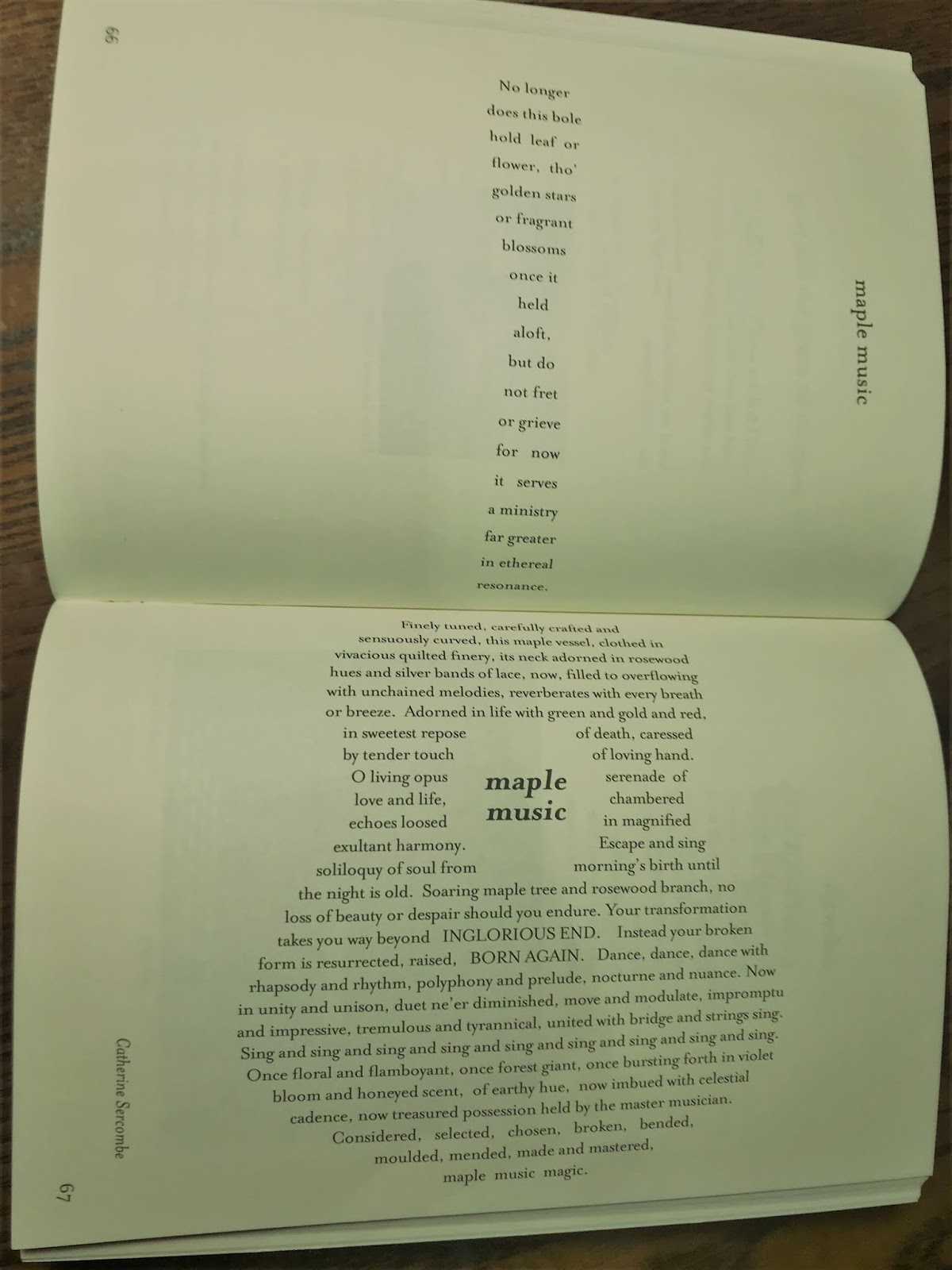
Photo above: My shape poem, Maple Music,was listed as chosen by the judge in the 2013 Poetica Christi Press Poetry competition and published in their 2014 Anthology, A Lightness of Being

Where do I come from?

I’m Queensland born and bred and, after a five year dalliance with Northern Beaches Sydney, New South Wales, my husband and I settled in Toowoomba to raise our three amazing children (I look at them and marvel). I’ve also been blessed with three wonderful grandchildren. Currently, I help my Maths/Science genius husband support my writing habit by working as a creative and academic writing tutor and manager in our Education Consultancy.

Question 2: Tell us about your writing (or editing/illustrating etc).  What do you write and why?

What do I write?

I’m a PAGE—Poet, Author, Genre non-conformist, and Encourager—or Essayist if you prefer. At times, I’m PAGES, either because I’m writing Spiritual devotions, or I’m being long-winded, at which time the E stands for Editing and the S stands for Strike that/Slash and burn/Stalking typos and grammar gremlins or Scratching my head and tearing my hair out.

I've also written a New Adult Thriller. (Throw Ludlum’s Jason Bourne into a bowl with a biblical worldview. Sprinkle with quirky acronyms and gospel allegory. Add a dash of Calvin and Hobbes’ Homicidal Psycho Jungle Cat’s philosophical humour. Bake with a fertile imagination. Enjoy.)

Despite my concerns, the suspense of writing the novel didn’t kill me so I expect I’ll survive the Indie Publishing learning curve. Then, Licence to Die will be a living, breathing, deadly intriguing debut novel available in paperback and e-book—before 2019 expires.

Why do I write?

Because I can. And because I can’t not write. The urge to collate words with intention and purpose has become both a passion and a divine commission. And it’s FUN! (Yeah, even when I’m tearing my hair out.)

Question 3: Who has read your work? Who would you like to read it?

Readers of the dozen Australian, US, International print and online anthologies in which my poetry, CNF, short fiction and devotions have been published.


Also, my compassionate, encouraging, and helpful Quirky Quills writing companions. Several Beta Readers and my Editor have read the novel as a WIP.

While my children were young, I managed to woo and entertain enthusiastic audiences with my drama sketches and puppet plays (especially during the lolly meteor showers and dust storms), but technically they were hearers and viewers, not readers.

Who are my target readers for Licence to Die (and other works-in-progress I’m percolating)?

That mysterious and wondrous group recently recognised in their own right as New Adults; 16-25ish, they’ll have conquered—or be in the process of conquering—the trials and tribulations of senior schooling, university study, earning a living, or generally nailing Introductory Adulting—or giving it a good bash. Also, Advanced Adulting students (25-106ish) who remember what it was like to be a young adult, and can cope with adulting being used as a noun and a verb, not just an adjective (You’ll be relieved to know I haven’t nouned or verbed the word ‘adulting’ in the novel).

Question 4: Tell us something about your process. What challenges do you face? What helps you the most?

Process? It usually starts with a couple of words, a line of poetry, or a sentence that intrudes upon my everyday activities or my attempts to go to sleep, and gives me no rest until I’ve written it down. Many of my published pieces (and my novel) began life as ‘quick writing exercises’ for my Creative Writing degree. I focus on the ideas that have promise and those that are downright demanding till I give in and write them, like Licence to Die. I either go with the flow, or formulate a plan which I modify, as flow and coherency directs.  

Challenges? The poet in me likes to slip ‘writerly’ masterpieces into the mouths and minds of my characters, which I then have to delete for POV authenticity. Sigh! Like so many writers, balancing the financial budget also creates challenges.

I am most helped by the assurance (and reassurance) (and re-reassurance) of the Holy Spirit that this is what he wants me to do. Frequently, he uses other Christian Writers as his mouthpiece in this regard.

Question 5: What is your favourite Writing Craft Book and why?

I found Manuscript Makeover by Elizabeth Lyon invaluable in managing and simplifying the complex structure of my novel. I also appreciate the wealth of quality wisdom and advice available online. In terms of influence, I found Janice Elsheimer’s The Creative Call helped me realise the hand of God had written ‘writer’ into my DNA long before I learned how to read his writing.


Question 6: If you were to give a shout-out to a CWD author, writer, editor or illustrator – who would they be?

Absolutely, Nola Passmore—writer, editor, Quirky Quill and my most significant influencer. Some people won’t let you down, or won’t let you let yourself down. Nola is one of these rare and precious friends.
.
Also, Iola Goulton—not only for her recent, excellent work as copy editor for my novel, and her informative blogs, newsletters and social media links to all things writing, editing, publishing and marketing, but as a significant early influencer who, along with Anusha Atukorala, sent me out from my first Christian Writers Conference believing I had writer’s stuffing inside me—and it wasn’t all fluff. (Now you’re singing, ‘Winnie the Pooh, Winnie the Pooh, funny little tubby all stuffed with fluff’, aren’t you?)

Question 7: What are your writing goals for 2019? How will you achieve them?

Indie Publish Licence to Die, acquiring new and necessary skills in the process. Start pushing up the word count for the next novel. I hope to achieve this one step and one day at a time.

Question 8: How does your faith impact and shape your writing?

I’ve been a Christian believer from my childhood. I survived life’s wild, stormy weather long enough to become a writer because Jesus Christ is my anchor. We’re tethered together in love and trust. Just as nothing can separate me from the love of God in Christ Jesus, so nothing can separate Christ in me from the words that I write. Sometimes that connection is overt and obvious. Sometimes it is as inconspicuous and deeply layered as the rock beneath the ocean’s currents.

As Galatians 2:20 says, ‘I have been crucified with Christ and I no longer live, but Christ lives in me. The life I now live in the body, I live by faith in the Son of God, who loved me and gave himself for me.’ Holy Bible, New International Version®, NIV® Copyright ©1973, 1978, 1984, 2011 by Biblica, Inc.® Used by permission. All rights reserved worldwide.

That sounds like a licence to die, don't you think? And also freedom to live (the ultimate sequel). 


Mazzy Adams is a published author of poetry, fiction and creative non-fiction. She has a passion for words, pictures and the positive potential in people.

Website: www.mazzyadams.com 
Email: maz@mazzyadams.com

Thursday, 21 June 2018

Meet Our Members: Jeanette O'Hagan


Each Thursday in 2018 we will be interviewing one of the members of Christian Writers Downunder – to find out a little bit more about them and their writing/editing goals.
Today's interview – Jeanette O’Hagan

Question 1: Tells us three things about who you are and where you come from.


I was born in Mt Isa and spent my childhood in Mt Isa, Sydney, Kitwe (Africa), Melbourne and Hamilton (Victoria) – but mainly in Mt Isa and Kitwe, before coming to Brisbane to start Uni.

With my dad (1928-2018) and two brothers


My forbears were adventurers and immigrants; my grandparents came from three continents (Europe, Africa, Australia) and four countries (Ireland, South Africa, England, Australia). Nevertheless, after moving round so often, I am now firmly planted in Brisbane with my husband and two children.

My brother used to joke that I’m getting better by degrees (medicine, arts, theology, TESOL and now MA writing). I love to learn facts, knowledge, all sorts of titbits across the arts and sciences, but I’m abysmal at trivia about music and sports.

Question 2: Tell us about your writing.  What do you write and why?


I mostly write fantasy (with a dash of sci-fi), poetry and blog posts. I fell in love with books early on and was a voracious reader as a child. About fourth or fifth grade I began telling myself stories, and these extended daydreams grew into a world (Nardva), with characters I loved having thrilling adventures. I write to bring that world and the characters and adventures to life.  It’s exhilarating, fun, a wild ride. I also hope God’s love and grace shines through my world and words.


With the poetry, it’s more an expression of life as I experience it — moments, strong emotions, reflections, cameos, events. While blogging is a way of musing about stuff and passing on the things I’ve learned along the way.

Question 3: Who has read your work? Who would you like to read it?


Who has read my work — my family, other writers and reviewers, and some keen readers – in Australia, New Zealand, USA, Canada, UK, maybe even France and Germany — still a fairly small and select circle at this stage, but I’m hopeful it will continue to expand.  I was thrilled at Gold Coast Supernova earlier this year when a couple of times, strangers stopped by to enthuse about reading my books and wanting more stories.  But even more special was when my mum asked me to read to Dad a couple of poems I’d written from experiences growing up – Thunderstorm & Floating (in Inner Child, Poetica Christi).

As to who would I like to read my books – I write for the general market, in the hope my books might seed the imagination with divine possibilities, to inspire faith, hope and love in my readers.  


Question 4: Tell us something about your process. What challenges do you face? What helps you the most?


Each story is different. My first novel started from a lucid dream and was completely pantsed (Finding Elene – yet to be published). Some I’ve daydreamed for months and years, allowing the characters a lot of freedom, before I’ve set out to write their stories (Akrad’s Children).  Other stories have I written from a theme, with the characters and plot emerging out of the setting or concept (eg Heart of the Mountain). I usually have some idea where I’m going – with major incidents or turning points or the ending in mind, but not always.

Challenges are getting time to write (not getting distracted) and sorting out the structure, especially with books that are part of a series.

What helps me most is writing consistently. I’m much more creative and in the flow if I write every day (or every other day). And second, getting feedback from critique partners, beta-readers and editors.

Question 5: What is your favourite Writing Craft Book and why?


It’s hard to keep it to one. I think two of the most helpful and freeing has been Stephen James’ Story Trumps Structure and Stephen King’s On Writing.  I do appreciate the more prescriptive books and the insights they give, but I find it hard to be creative with strict formulas, I am suspicious of ‘one size fits all’ approaches (especially when touted as revolutionary) and I like to understand the why behind the rules so I know when I can bend them 😊 .


Question 6: If you were to give a shout-out to a CWD author, writer, editor or illustrator – who would they be?


Without a doubt Nola Passmore (our illustrious former CWD coordinator) who has been a huge encouragement and who has wrangled me along to courses like Year of the Novel and Margie Lawson immersion, as well as been a great beta reader and editor. Plus, she is an amazing writer and I love her work. Though of course there are so many others, Paula Vince, Anusha Atukorala, Lynne Stringer, Adele Jones, Adam Collings, and many, many others. 


Question 7: What are your writing goals for 2018? How will you achieve them?


My goals for 2018 is to finish writing the last two novellas in the Under the Mountain series, edit the first draft of Rasel’s Song (sequel of Akrad’s Children), and start on a dragon novel (Dragonspite) and/or my cyborg trilogy (The Chameleon Protocols). I’ll achieve this by making time to write, keeping focus, and a big dose of God’s grace.


Question 8: How does your faith impact and shape your writing?


My faith is the bedrock and source of my writing. I believe God has given me the desire, the passion, the abilities, and this time, this moment, to write. I trust that He will continue to provide those opportunities, though He is sovereign, and I commit my plans and the outcomes to Him. Because I write for the general market and because I write fantasy, my stories aren’t usually ‘in your face’ Christian. But I believe they are consciously written from a Christian worldview, informed by Christian values, and threaded through with Christian themes and references, though perhaps subtly at times as in many of the parables. I’m grateful to my Maker in whose steps I attempt to follow.


Jeanette O’Hagan first spun tales in the world of Nardva at the age of eight or nine. She enjoys writing secondary world fantasy, science fiction, poetry, blogging and editing. Her Nardvan stories include a mixture of courtly intrigue, adventure, romance, and/or shapeshifters.

Recent publications include Akrad's Children—a Young Adult kingdom fantasy; Heart of the Mountain and Blood Crystal— the first two novellas from the Under the Mountain series; plus Ruhanna’s Flight and Other Stories. She has stories and poems in seventeen other anthologies, including The Quantum Soul, Tales From the Underground, Like a Woman and Futurevision.

Jeanette has practised medicine, studied communication, history, theology and a Master of Arts (Writing). She loves reading, painting, travel, catching up for coffee with friends, pondering the meaning of life. She lives in Brisbane with her husband and children.


Links:

Sign up to my Newsletter http://eepurl.com/bbLJKT and receive a copy of Ruhanna’s Flight: a short story.


Monday, 4 December 2017

Exploring Genre 2017

by Jeanette O'Hagan


This year, the cross posts between Christian Writers Downunder and Australasian Christian Writers are focusing on genre. I've found it an interesting series and some more in depth look at different sub-genres in more depth. So just to recap -

Why Genre?


Iola Goulton started off the year asking the question - why genre?  She reminded us that genre's are useful for managing reader expectations and in helping to target promotion and marketing.

Then over the next several months we've looked at specific subgenres - or some broader categories - in fiction, non-fiction and poetry.

Fiction


Fiction has a number of broad categories such as romance, speculative fiction (science fiction and fantasy), crime and detective fiction, historical dramas, thrillers, military, women's fiction and literary - among others.  Fiction can also be aimed at children (picture books, chapter books, middle-grade), young adult (teens), new adults (teen-early twenties) or adults.

Romance


While romance can often be a subplot or theme in a range of other genres, in category romance the focus is on the relationship and the obstacles to a romantic relationship between the hero and heroine or romantic couple.  Category romance is hugely popular and generally has some firm expectations. It can also range from sweet to steamy (or blend into erotica, which is really another category).

There are a wide range of sub-genres with romance.

Carolyn Miller introduced us to historical romance (romance set before the present day) and in particular regency romance - romance inspired by Jane Austen and set in or around the regency period - eg. early 19th century.  You can find her delightful post here.

Nicky Edwards took us on a tour of rural romance (set in the country) and medical romance (with nurses or doctors as protagonists and which includes medical drama), usually set in contemporary times. You can read more here.

Speculative Fiction


Speculative Fiction images a different reality - whether that be a variation of earth as we know it or different world altogether. It is generally divided into Science Fiction (where science or a imagined science explains the world) or Fantasy (in which a non-scientific - often super-natural - explanation is given), though these can cross-overs such as science fantasy and mixtures. There is easily over 100 sub-genres within this field - including crazy mash-ups like gaslamp fantasy or weird west.

Adam Collings  introduced us to Space Opera - epic Science Fiction set in space with a focus more on the story than a detailed or hard science - think Star Trek or Doctor Who.  And, also the Superhero sub-genre which can used a scientific (Superman) or a supernatural (eg Thor) explanation for the special powers.  Read more here.

Jeanette O'Hagan introduced Secondary World and Portal fantasy - both of which are set on an alternative (non-earth) world. In the first the world exists without reference to earth, whereas in the second, the protagonist travels through a door or portal to the other world. Read more here.

Ian Acheson introduced us to Supernatural Fiction - which focuses on supernatural beings such angels, demons and/or ghosts (and is related to paranormal and urban fantasy). It can have a faith or Christina focus or be more 'secular' in its approach. Read more here.

Shorts


We also looked at 'short fiction' from flash to novellas (though it could also be non-fiction). Read more here.

Poetry


Poetry can be non-fiction or fiction, it can be strongly narrative (ballads, for instance) or focus on a moment or a feeling or be metaphorical.

Valerie Volk gave a wonderful introduction to Poetry (here)  while the following week we explored Free Verse (poetry without a set rhyme) and Verse Novels (telling a narrative in verse)  (read more here).

Non-Fiction


And finally, Nola Passmore introduced us to creative non-fiction (and how that differs from reportage). Read more here.


It can be tempting to see genre as a straitjacket or a way of pigeon-holing our fiction.  It can be seen as restrictive or reducing writing to formula (the HEA, the red herrings and clues, etc).  Some genres have stricter guidelines  - the category romance, the cozy mystery - while others almost by their nature tend to push the boundaries  or like cross-overs with a meld of different genres (speculative fiction, Young Adult).

Writing within a genre still allows amazing variety and ingenuity, especially when there are so many.

ACW & CWD are thinking of extending this dip into genres and subgenres next year. With that in mind,

Have  your found the series helpful? How?
What did you learn (if anything)?
And are there any particular genres you'd love to find more about?

List of posts (chronological order)

Genre  
Creative Non-Fiction


Spaceship image courtesy of digitalart at FreeDigitalPhotos.net
Cover Image Valerie Volk In Due Season
Other images copyright Jeanette O'Hagan

...............


Jeanette started spinning tales in the world of Nardva at the age of eight or nine. She enjoys writing secondary world fiction, poetry, blogging and editing. Her Nardvan stories span continents, time and cultures. They involve a mixture of courtly intrigue, adventure, romance and/or shapeshifters and magic users. She has published numerous short stories, poems, two novellas and her debut novel, Akrad's Children. Find her on Facebook or at her webpages Jeanette O'Hagan Writes or Jenny's Thread.