Monday, 13 June 2016

My Love Of Serials (not Cereals)

Today I’m spreading my love for writing serials, and not just because I’m currently publishing one. That just happens to be an added bonus.

Serials, unlike series, are the TV of fiction. Each episode is a nice, neat story that takes the reader through the usual ups and downs, and leaves them with some feeling of completeness. However, each episode is part of a larger overarching plotline - the season if you will. 

Being an avid TV and movie watcher myself, I understand the subtle difference between those times when you want to curl up and spend an evening meeting new people and finding out all about them, and those when you just want to have a quick chat with friends, catch up on what's happening in their lives, and still get to bed early. This is when you want a serial.

I hear you asking some questions, well let me answer them for you.

Isn't it just a novel that's been broken up? 

Golden rule of serials:

All serials can become novels, but not all novels can become serials

Imagine Lord of the Rings as episodes. Now imagine those few where Sam and Frodo are walking across the marshes. In the next episode: they are still walking across the marshes. And the next? Yup, still walking. It takes very specific pacing to make a serial episode work, and not all novels have it.


But why would someone want to read one when they could read a novel?

We are busy. 
Everyone is busy. 
How much of the general public have a two hour block to sit down and read? In part that's why chapters are now being shaped around the 20 minute read - the train journey to work. But something that gives closure in the space of a TV episode has appeal for a lot of readers. 

Why would I want to write one?
The answer to this is simple - it's amazing fun. Yes, it's much harder to plot out the pacing than a novel, but the advantages make up for this. Two of these include:

Quality time. Have you ever finished writing a book and felt a small part of you die because you're not travelling any further with your main character? Serials put that off for a very long time. 

Subplots, it's all about the subplots! With a single novel, you really have to restrict how much you diverge and how many characters you have. In a serial, as long as you can handle all the reigns and wrap them all up by the end, you can go to town on the fun. 

But what about as an author - someone who wants to sell books? 

People are more likely to buy it. One episode is a low investment for a reader, both in money and in time.

Sad but true: very few people like spending money on new authors, but giving a book away for free is painful, and not very economically viable in the long run. However, giving away a complete episode for free, when there are 10 more, isn't such a hardship. This gives you a way to win them over before they have to fork out.

Starting a new book is a large commitment, one that often doesn’t payoff. Over the years I've lost my faith in humanity/new authors. I'll start a book saying I'll give the author a chance. The next night I'm still giving them a chance. Eventually I realise it's not going to get any better, and I'm never going to get back those hours of my life. In comparison, I'm always happy to watch the first episode of a new TV show, and if it doesn't grab me, no harm done. 

What's your serial about?

Why thank you for asking, so kind! I wanted to have fun and I wanted something that was really suited to the episodic format. So I chose a Christian Chic-lit about online dating - nicely tying into one of my non-fiction works on how to write an online dating profile. Laurie is an example of how not to. 

Laurie Barker is 29, single, unpublished, overworked, and underpaid. But she doesn't mind. Really she doesn't, she's sure God's got it all worked out. But when Yannie, her younger sister, announces she's getting married ... in seven weeks, everything changes. Laurie has less than two months to find a boyfriend and make her life perfect. Oh, and work out how to break it to her family that she's not sure why they think she's dating famous author Timothy Farren, but she hasn't actually even met him. It's time for a Laurie Master Plan. 

One of the things I loved about writing this as a serial was the chance to really play with her faith. In my own Christian experience, I've found that God likes the long-game. Each episode is our perception of time, that God needs to get it all fixed up now. The full arc of the story is more how God likes to roll: giving you a lesson, waiting to see if you'll learn it, and then giving it to you again if you didn't. 

Episodes 1-3 of Virtually Ideal are now out on Amazon Kindle. Episode 4 will be coming out in a week or two, if students stop asking me to proof-read their essays. And just you guys, I'm making Virtually Ideal Episode 1: Date or Die free online at Amazon.com.au tomorrow. (It's listed for the 13th, but that's US time.) But don’t stress if you miss it, or want to offer a few free copies on your blog; send me an email and I'll give you the epub.


So, tempted to try your hand at serialising?

Buffy Greentree
b_greentr@yahoo.com
Check out my author page on Amazon


Thursday, 9 June 2016

CHESTNUTS by Rita Stella Galieh

Winter time is chestnut time.  Who can resist these delicious potato tasting nuts once they're baked?

And I wonder why they say an old joke or story is a chestnut?

But they have another side to them. The sweet inside nuts, besides their brown shell, are covered with nasty, large prickles. Pity the growers having to remove these but it must be done.

I couldn't resist this parable similar to the whole area of Writing. I'm sure every one of us who desires to write has to suffer many trials before cracking the actual kernel. Besides the numerous steps of getting your story into shape before you can hope for publication, then begins the tricky hunt for an agent or publisher.

Many of us have felt the discouragement of disinterest, or outright rejections. Worse still the acknowledgement the story is great, but perhaps your platform is minimal or non existent. Or that particular genre is not the trend right now. So what's the next step? Give it up as being too hard?

Most of us are very aware that before finding success, we have to wade through a pond of failures. The inventor's attitude is, 'These are just ways of not doing it' and they persist until they find the way that works. Mind you, we writers have all all the rules set out beforehand and supposedly we know what we shouldn't do. Then ... some author writes a best seller that seems to break all the rules. It helps if they have published before as they have already won the confidence of the publishers.

Now this is the time to step back and work out what's really important to you. And never give up!

To quote my Canadian writer friend, Christine Lindsay:
'When life happens
Admit you can only do so much.
Do what you can and leave the rest to the Lord.
Trust God that your writing career is in His Hands.

Don't let life happen and growl that it is hampering your writing career. But instead rest in the Lord and you just might be amazed at how he takes your efforts during your weary times and blesses you.

EMBRACE your life, the good and the bad.
REST physically and mentally.
TRUST God for the outcome.'

So when you're on the point of tearing out your hair, (as I've been at times) grasp the advice and promise of Proverbs 3:5 and 6.
 
Rita Stella Galieh is enjoying the challenges and rewards of Independent Publishing.

The 2nd edition of her Victoriana Trilogy  has seen her dream realised. As an art student at her convict built college, she wondered about its history. Research revealed the famous actress Sarah Bernhardt had visited there. One of the jailers joked about the local cat, meaning the cruel cat'o nine tails.

The Bloody Code was an all encompassing method of punishment for any offence deemed illegal. Often felons were sent to the gallows or faced transportation to England's brutal prisons in the Southern Hemisphere. After tracing the life of one innocent woman, on whom she based her story, this became the theme of her novel ... Signed Sealed Delivered. Book 2: The Tie that Binds, Book 3: A Parcel of Promises.

See ritastellapress.com     for information on both print and ebooks.

Monday, 6 June 2016

Launching Your Book Baby

Image courtesy of digitalart at FreeDigitalPhotos.net

CWD/ACW Cross-Post

Christenings, twenty-first birthday parties, weddings, ship launchings, bridge openings, house warmings—all ways to celebrate new beginnings.

Having a book launch provides a great opportunity to celebrate your book, make a splash, spark initial visibility, and it may be the one time people don’t mind if you raving about your book.

So what makes a successful launch?


Be clear about your goals.

What do you hope to achieve with your launch. Is it primarily to celebrate your achievement and/or to bring your book to attention of potential readers and fans and/or to make some initial sales?

 Who is your target audience?

A family history may (or may not) be targeted more at the extended family rather than history buffs or members of the historical society.  An e-launch of a book aimed at techno-challenged seniors may not be the best choice.

Be prepared

  • Make sure your book is properly edited, critiqued, formatted and ready to publish in time for the launch.
  • Talk to your publisher (if traditional published) to work out what they offer & what they expect from you.
  • Start planning well before hand— the type of launch, who you’ll invite, giveaways etc.
  • Have a budget— this might be small or large but you don’t necessarily have to spend big to have a successful launch.
  • Maybe form a ‘street team’ —a group of people who are enthusiastic about your book and who are prepared to review and promote it via word of mouth, sharing links etc. and therefore create a buzz early on.
  • Make sure you have enough books on hand (if physical launch)—allow leeway for delays or mistakes in printing/sending.
  • Reviews—arrange reader reviews (through advanced reader copies) several weeks before the launch.
  • Announce your launch—through social media, your website, email list etc (your platform).


Decide on what kind of launch

Most people, when they think of a launch, think of a physical one—with a physical venue and physical (print) books but you can also have an e-launch (or maybe combine it with another event).

Physical launch

  • You need to arrange a time and date, venue, decorations, suitable refreshments and activities or entertainment.
  • Send out invitations to friends and family, fans and readers, and other interested parties.
  • Advertise—on Facebook (unpaid & paid), announcements of new releases (e.g. ACW), other social media, blogs, among groups that might be interested in your book, local media etc
  • Make sure you have enough books for people to purchase on the day.
  • Have activities, giveways—maybe takeaway items with your brand or book title such as bookmarks, T-shirts or coffee mugs.
  • You could have a launch theme (does your book have pirates, horses or dragons in it; or maybe it’s set in an exotic location or celebrates a certain kind of cuisine.)
  • Unless you are big name author or celeb—it’s probably best not to charge entry. If you do charge, include a signed copy of the book in the price.


Pros of a physical launch— a sense of connection, you have the books there to sell and they can be a lot of fun. Besides, not everyone is on social media.

Cons—not everyone can attend especially if they live at a distance and it can be more expensive and take greater organisation.

E-launches

It is possible to have a virtual-launch (eg Facebook or Twitter) and these (depending on your target audience) can be quite successful.

While I’ve heard of Twitter-parties, my experience has been with Facebook launches.

  • Set up the event (date and time) on Facebook & invite interested parties to (virtually) attend and suggest inviting friends who may be interested.
  • With an anthology—different authors can have 5 min intro and then each offer giveaways, prizes etc —which can result in a very fast-paced exciting launch with lots of offers and interactions.
  • If you are the only author—you can invite other authors will similar book/readership to participate and/or just do it yourself. Make sure you have a list of questions for competitions or discussion:
    •    About you as author & the writing process
    •    About the book or book series, its characters and or narrative world
    •    Related to the setting, the themes or issues
    •    About the reader—their favourite book or genre, tastes, or opinions
  • Tie in the giveaway into some activity—signing up to email list, liking author page or twitter account, Giveaways can be vouchers, or free books/short stories/illustrations or services (editing, providing a graphic) or inclusion in next book (ie they can name a character)


Combo:

Have an event on Facebook & with posts leading up to the physical launch.

Tie the launch in with other promotional activities.


A launch works best if you tie it in with other (ongoing) promotional activity.
  • Blog tour— a ‘tour’ of participating blogs in which your new book (and you) are showcased, you can have giveaways for each blog and/or one big one at end of tour. Treasure hunts (with questions or comments on each blog needed to win). You may want to look at ways at keeping the different blogposts fresh and interesting—a different set of questions to answer, an excerpt from the book, or an interview with one of the main characters in the book (if fiction) or some interesting titbits of research about the culture, setting or period.
  • Giveaways— leading up to the launch maybe set up a Rafflecopter giveaway or other giveaways on your blog. You could also do a Goodreads giveway or Amazon promotion.


Follow-up:


The launch is just the start. It takes time to build traction in the market, to get visibility— so you should continue to promote your books (without putting everyone off by a constant, annoying ‘buy my book, buy my book’ drone).

Look for opportunities:

Encourage reviews if you can, guest blogs, book signings, visits to groups connected to your target audience (schools, family history groups, women’s groups).

Don’t despair—remember the long-tail of publishing:


In the past books had a definite (and short) shelf-live. Unless a genuine best seller, a book often had a 6 week turnaround in the bookstores. So it was important to make a big splash at the beginning.

These days, with e-books, online buying and print-on-demand (POD), a book effectively never goes out of print. It remains available for purchase long after the launch. So even if your launch rates barely a blimp on the radar and you don’t make any Amazon best-seller lists, if you continue to promote your book/s, it’s possible to build up a visibility over time. This works best if you have more than one book, so keeping writing is also important (and because, after all, that why you are a writer in the first place).

And when all is said and done, while we can plant and water, it is God who 'gives the growth'. (cf 1 Cor 3:5-9)

Have you launched a book or participated in the launch? What things would you recommend as part of a successful launch? 


This post was also published on Australasian Christian Writers on 6 June 2016

Jeanette O’Hagan enjoys writing fiction, poetry, blogging and editing. She is writing her Akrad’s Legacy Series—a Young Adult secondary world fantasy fiction with adventure, courtly intrigue and romantic elements. Her short stories and poems are published in a number of anthologies including Glimpses of Light, Another Time Another Place and Like a Girl.

Jeanette has practised medicine, studied communication, history, theology and, more recently, a Master’s in writing. She loves reading, painting, travel, catching up for coffee with friends, pondering the meaning of life and communicating God’s great love. She lives in Brisbane with her husband and children.

You can find her at her Facebook Page or at Goodreads or on Amazon or on her websites  JennysThread.com or Jeanette O'Hagan Writes .

Thursday, 2 June 2016

Emerging from the Rubble


For every creative soul there comes times of discouragement and confusion; perhaps even that horrid question: ‘Should I just give up?’
Well, should I? I’ve been published for twenty years, and enjoyed huge success—relatively speaking—in the Australian Christian market. I couldn’t write fast enough, and the re-prints kept rolling in. I didn’t realise that I was riding a wave, and that somewhere around 2007, the wave began to beach. Things didn’t immediately collapse at that time, but with the introduction of the wonder medium, the eBook, the Australian Christian market began to stutter, then cough, then choke.

Concurrently, with this change, Australian Christian writers began to emerge. Writing groups, like Christian Writers Downunder and Omega Writers, began to form and gain momentum. We had conferences where we could listen to some excellent advice on just about anything writing (including how we should avoid using the word ‘just’). Groups like Wombat Books and Even Before Publishing got legs and started to walk. 

But unfortunately, none of us seem to have got to the running pace in the Australian Christian Market.
From my own experience of small independent publishing, I’ve seen the huge support of the Christian Booksellling Association of Australia (CBAA) dwindle by degrees. Part of it has been because of the digital changeover, and some of it (in my case at least) has been because a good part of my audience and support base of twenty years ago were people 60+. Twenty years on, and these people have gone on to the Lord.

So where does that leave me? Where does that leave any of us who have been educating ourselves in the art of writing? Australian Christian writers are more abundant now than when I first started, and the quality of writing is improving all the time. And yet, the better we get, and the more of us there are, the less the opportunities to get that piece of work into the hands of readers.
Sometimes I feel as if the whole thing has collapsed into a heap of rubble, and we are left, picking over the ruins, looking for signs of life.

At a recent conference, I was chatting with a pastor’s wife, and she told me the story of her son. He is a young man who has a music degree, made it to the finals of one of the television singing competitions, had been leading their church music team and is a competent worship leader. He made the choice to go to Nashville in the US to see where else God would take him. This young man and his wife found themselves in a church in Nashville—ironically, it was a church run by a well-known Australian worship leader. This church has exploded, and there are a lot of Australians gathering together there. One morning, the worship leader asked for anyone in the congregation who was a worship leader to stand. No less than fifty people stood up. The young man could see that his chances of becoming a worship leader in this church were not high, and yet he had committed himself to serve in the carpark team.
As I listened to this story I thought, wow! There’s nothing apparent there for him to hope for in terms of his gift, and yet still he chooses to serve.

Then, last week, I caught up with a movie producer friend of mine, and we sat and talked the Australian film industry, which shares many similar frustrations to the Australian Christian book industry. He told me a story from a documentary he saw. The film team were in a Hollywood producer’s office and the camera zoomed in on one corner of the office. Piled up to waist height on both walls in the corner were manuscripts waiting to be reviewed—from the last week! AND apparently these were only the scripts that had a catchy log line and pitch. The rest had been discarded. Wow!

So, in this day and age where everyone can write, and write quickly; anyone can set a manuscript, and put together a cover, and publish online; how does my work or your work find an opportunity to bless others? The competition is ridiculous.

Actually, I don’t have a definitive answer. I’m still troubling through the variables myself. Should I give up?
One thing I do know, if I am picking through the rubble of a collapsed industry, then I must find the survivors, and give them nourishment, however that might be. If I am serving the Lord, and that comes in the guise of cooking a meal for a sick neighbour, or giving courage when I have opportunity to do so, then that is what it is. After all, I do believe the Word of God when it says:

“5 Trust in the Lord with all your heart
    and lean not on your own understanding;
6 in all your ways submit to him,
    and he will make your paths straight.”
Proverbs 3:5-7New International Version (NIV)

Meredith Resce is author of 17 published titles, including The Heart of Green Valley series, and Mellington Hall. 


 Please connect with Meredith on her facebook page or website


Monday, 30 May 2016

Those little glitches

Jo-Anne Berthelsen

Have any of you ever experienced those times when you are sure you have remembered everything, yet, at the last moment, someone points out something you have done wrong or something you have omitted to do altogether? Sadly, I have—more than once.

Take the time some of you may remember at our Christian writers’ conference when I arrived early at the site, specifically to check that my laptop would work with the data projector there. Yes, it seemed fine. Then I arrived early the next day for my actual workshop to check again. Yes, everything looked fine on my laptop—I heaved a sigh of relief. However, I omitted to check whether my lovely presentation actually showed up on the big screen behind me. Imagine my horror when the participants pointed out it was blank! For some time after, this experience shook my confidence in using power point presentations. Yet it also taught me not to hinge my entire input on them and to be able to ad lib better at a moment’s notice.

Or take the time I arrived to speak at a meeting of what I thought would be a small group of women and with only a few of my books, only to find over a hundred men and women present in equal numbers. I quickly revised the illustrations I had planned to use, in order to relate better to the men, but there was nothing I could do about my books. From then on, I have always made sure I can relate to both men and women, if necessary—and that I carry some extra books in my car!

Or take the day I turned up to speak at another group to find the meeting well under way. I had not realised that the time I had been given to arrive was the very moment I was expected to start speaking. I have never set out my books and organised my power point presentation so quickly in my life. This experience taught me to enquire more closely when given arrival times—and then to allow another thirty or more minutes on top of that!

Now I am in the throes of that final check through my latest manuscript for any little glitches I might have overlooked. I am sure it is perfect. After all, I have read it through so many times. Imagine my chagrin then, when one of my proofreaders points out a typo on the very first page—then another in the middle of a key Bible quotation that changes its meaning entirely. Worse, she questions some facts I have included early on in the book. Heart in mouth, I check them out again in the sources I used. Hmm, she could be right. Far better to leave the whole section out than to be incorrect.

These little glitches might well be embarrassing at the time. Yet God has used each one, I believe, to teach me more about humility and to give me strength and wisdom for the next part of my journey. Things might go wrong. Things might take us aback. But God is there through it all—and I am so grateful for that.

How about you? Have you ever experienced any little glitches like mine?


Jo-Anne Berthelsen lives in Sydney but grew up in Brisbane. She holds degrees in Arts and Theology and has worked as a high school teacher, editor and secretary, as well as in local church ministry. Jo-Anne is passionate about touching hearts and lives through both the written and spoken word. She is the author of six published novels and one non-fiction work, Soul Friend: the story of a shared spiritual journey. Jo-Anne is married to a retired minister and has three grown-up children and four grandchildren. For more information, please visit www.jo-anneberthelsen.com.

Thursday, 26 May 2016

What an eel showed me


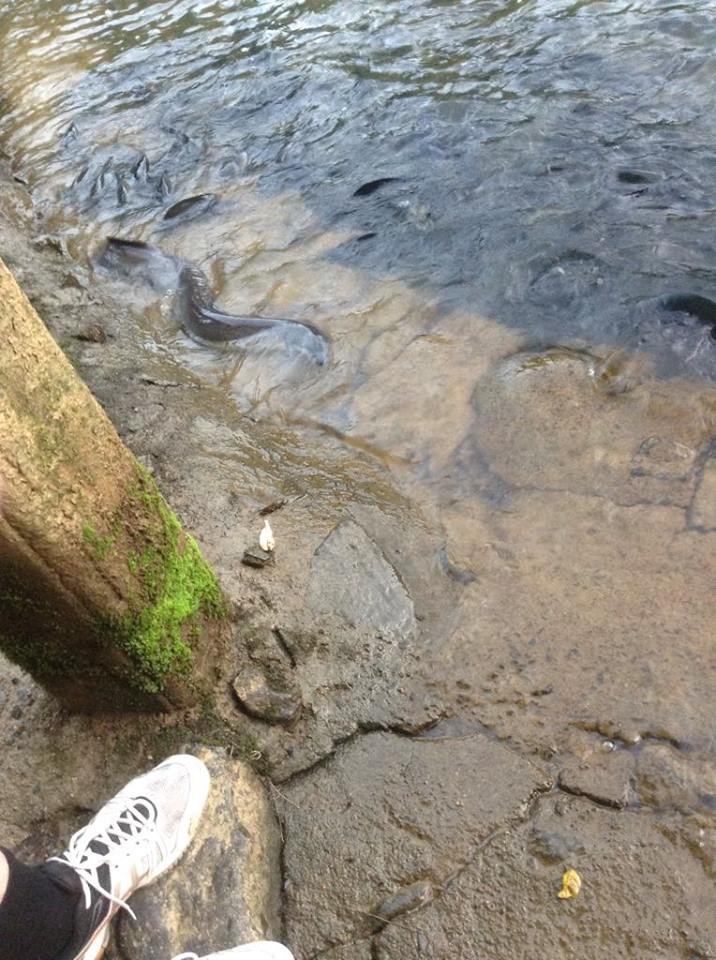
We've recently returned from week in far north Queensland, where we saw many great attractions. At Paronella Park the kids were given food to feed the fish on the property as part of the entry fee. The water turned out to be teeming with big, eager fish, crowding over each other to get closer to the front. Several of them had to flip onto their sides when it got too shallow to keep swimming. Then suddenly, there was a great, healthy eel in the race, slithering her way through and waiting for the next throw, just like all the fish. She even slipped right across my toes. At that moment, I changed the idea I'd always had about eels. Without much evidence, I'd imagined them to be brainless, slimy creatures which some people like to eat. This one was more like a cute little girl begging, 'Choose me, choose me!' (Our tour guide told us that all the eels on the property are female, and the males can be found further out to sea.) Her skin was sleek and glossy and her reflexes were finely tuned.

As a race, we humans make judgments and stereotypes so automatically. It's not our fault, but partly how the human brain is wired. I remember learning in Psychology that we make sense of the world by mentally storing things in boxes, even when the things we think we believe aren't necessarily true. For example, I neatly tucked eels away in the same category as the creepy, slime-dripping jellyfish I used to strike when swimming. This tendency can be useful, especially during our early years when we're making sense of the world. However, it has the potential to severely limit us if we let it keep going unchecked for the rest of our lives. It can be bad for the people, places and things we're unconsciously judging, as there's nothing more frustrating than trying to change minds which are set like concrete. It's also really sad for us to live in the narrow, rigid parameters we set for ourselves.

I believe we can open up new vistas of thought for ourselves, when we make a point of remembering that it's not an entirely predictable world, but one in which people and critters have the potential to surprise us all the time. That's where good writing may play its part. The type of books I enjoy reading are those which are fresh enough to challenge the opinions we've already made. The pens of the authors also turn out to be tools which help us hammer and chisel cracks into our discrimination, prejudice and automatic assumptions.

The people of first century Jerusalem had their fixed notions challenged. They believed that everyone who had his life shortened by the sentence of crucifixion was a no-good menace whose name would sink into obscurity, never to be heard of again. Were they wrong!

I've come across people who have told me, 'I never read fiction, because it's a waste of time, when you can be reading so much better material which is actually true.' They don't realise they've adopted the mindset that fiction cannot possibly hold its own sort of truth. Then they deprive themselves of a whole wealth of literature which might have the potential to move them deeply.

The man who built Paronella Park was a visionary who ignored stereotypes himself. Jose Paronella was a Spanish migrant and baker by trade, who fulfilled his childhood dream of building a fairytale castle on his property. His pragmatic neighbours told him, 'It's just weird to do something like that here in Australia,' but he didn't listen to them. I'm glad those fish and eels are finding it such a fertile place to live so many years after his death.


I want to keep training myself to watch out for extreme reactions which cause an emotional response to rise in me, and ask myself, 'Have I really got the facts right this time, or is it another eel?'

Have you noticed any eel reactions over the years, in yourselves or others?


Paula Vince is a South Australian author of contemporary, inspirational fiction. She lives in the beautiful Adelaide Hills, with its four distinct seasons, and loves to use her environment as settings for her stories. Her novel, 'Picking up the Pieces' won the religious fiction section of the International Book Awards in 2011, and 'Best Forgotten' was winner of the CALEB prize the same year. She is also one of the four authors of 'The Greenfield Legacy', Australia's first and only collaborated Christian novel. Her most recent novel, 'Imogen's Chance' was published April 2014. For more of Paula's reflections, you may like to visit her book review blog, The Vince Review.

Thursday, 19 May 2016

Tips from Meet the Publishers Day

A couple of weeks ago, I attended the Meet the Publishers Day at the State Library of Victoria. It was a wonderful day, full of catching up with friends, talking about writing, and hearing from publishers about what they are looking for in manuscripts.


While the focus was on publishing children's books, there was still a lot of advice that applies to everyone.

I came back with pages and pages of notes. Some of the tips include:


  • Different publishers have different personalities, they are looking for different things. A rejection from a publisher could be that you've submitted to the wrong publisher. Do your research as submitting to the right publisher will increase your chances of getting published.
  • Write the story you want to write rather than following trends in writing. If the story you want to write is on trend, still write it. Don't write a story that is on trend because you think it will be published. There is always room for a great story regardless of trends.
  • Every story needs a hook. There are a lot of sweet stories written that don't have a hook. They don't get picked up.
  • Publishing is a business. They need to know how they are going to sell your book.
  • Publishers are happy to see multiple manuscripts at once, just not too many! They want to know you have more than one story in you.
  • Find your writing DNA - if writing romance is your thing, then write it. Don't force writing a different genre because you think you should.
  • Don't be disheartened by closed doors, keep going to find an open one
  • Spend a lot of time on the opening of the manuscript
This is just a short summary of my notes.

Along with listing to panels of publishers, I also had the opportunity for a three minute pitch to a publisher. Some of the tips I have for these pitches are:

  • Write your pitch before the event, don't make it up on the spot
  • Time your pitch and make sure it is shorter than your time. When I practiced my pitch it was 1.5 minutes
  • Leave plenty of time for questions and discussion with the publisher
  • Take a relevant prop. I took a Rubik's cube as that is what my book was about. It helped to break the ice with the publisher and gave something to talk about, it also helped me feel less nervous
I really hope they run this event again next year. There were so many amazing people there and I learned so much from the publishers who were generous with their time and advice. The weekend also gave me renewed confidence in writing and submitting to publishers.


Melissa Gijsbers lives in Melbourne with her two sons and pet blue tongue lizard. During the day she works as business manager in the family business.

Follow her writing journey at www.melissawrites.com.au and www.melissagijsbers.com

Monday, 16 May 2016

Emotionally Invested

Recently, it’s been pointed out to me that I have skipped some of the most important parts while writing my children’s book.

I have been writing a junior fiction novel for about three years now. The story is an account of a young girl's journey with alopecia areata. Alopecia areata is a condition that causes the immune system to attack hair follicles so that the hair falls out and in some cases doesn’t re-grow.

The parts I skipped were where the girl first discovers that there is a problem with her hair and is diagnosed with alopecia.
I have had alopecia my whole life, so I know the process. Why did I leave this part out?

Two very experienced writers have suggested that I describe this process to help readers connect with my main character emotionally and get a better understanding of what alopecia is.

This sounds very logical to me.

Unfortunately, the whole process of discovering that your hair is going to fall out--and there is nothing that can be done about it--is not pleasant. It’s heart breaking.
For me this means that I have to rewind my memories to times I have purposefully tried to forget. I have to relive those emotions to be able to how to write them in a way that will touch my readers.

My question now is: How does one unlock painful memories and emotions in order to write about things honestly?
How do you tap into those emotions so that you can reach out to your readers and connect on that deeper level?
How do you sift through those emotional deep waters to know what is important for the story and what is not?

I realise these are big questions and I am discovering some of the answers as I dive into these oceans. One of the most amazing outcomes from all of this intense work is that I am finally emotionally investing in my story. Which was what I wanted to do all along. It's only now that I have had the missing pieces pointed out to me that I can delve into those subconsciously blocked memories.


Linsey Painter loves to write stories that draw on her rich heritage of growing up overseas. She and her husband work with Mission Aviation Fellowship (MAF) and live in Cairns with their two rambunctious boys. Linsey grew up in Indonesia and is an expert at rolling her ‘r’s and eating nasi goreng. She has since lived and worked in Papua New Guinea— yes she has seen a bird of paradise and Arnhem Land— no she didn’t encounter any crocodiles. She has had a series of short fiction stories published in Thrive Connection online magazine for women in missions as well as non-fiction stories about living and working in remote communities with MAF. Linsey is now enjoying writing for children. Linsey blogs at linseysusanne@blogspot.com.

Thursday, 12 May 2016

I CHALLENGE YOU TO READ THIS.

Over the years I have had the opportunity of speaking to many different audiences. Remembering these opportunities is sobering, humbling and inspiring for communicating effectively into the future through my writing. Whether it is speaking to a stadium full of teenagers, or chatting with a group of ladies at a CWA morning tea; preaching to an innumerable number of citizens in an outreach in a city square in Cambodia, or conversing beside a fire in central Australia with Indigenous elders, whenever I have the opportunity to speak I take the opportunity to leave everyone a little challenge to inspire some follow through.
It is this tenet that I take into all of my writing. Leaving people challenged in simple or profound ways.

When speaking, these challenges are often laid out in a fun and encouraging format so that the people I am talking to are empowered to choose and enter in to a self-determined contract of sorts. So, for example at a recent assembly of year 7’s at the school where I am Chaplain I spoke about how important reading was and is for me, and how important it is for them. I was an average student in primary school, and with the simple encouragement from my Grandfather to read and to understand words (I went to the dictionary for every word I did not know) I jumped academically in a year to be dux of my school (year 7). Then this pattern continued through highschool and ultimately laid the platform for me being the first person in my family to go to University (and just recently I was awarded a Masters in Ministry). Hundreds of thousands of words. Thousands of sentences. Hundreds of topics, themes, characters, nuances, engagements, and practical applications. My Grandfather’s challenge to me to learn the words I didn’t know inspired me, and set me on a path that changed my life positively forever.  Sharing that story with the year 7 cohort helped stir many students into taking up the challenge to read, and begin loving words that they may never had engaged with before.

In a world of political correctness, tolerance, pluralism and “mind-your-own-business-isms” challenging people is perhaps a forgotten art that has been vital to us as a species and is equally important for our individual development. I am glad some caring people challenged me to rise to the challenge of becoming better when I was younger, and I am thankful for friends and family that lovingly challenge me now to “keep going for it” when times are tough. I am inspired but my wife and writing friends who keep gently prodding me to keep writing even though the journey seems long and often arduous.

In our writing we have the opportunity (perhaps the responsibility) to challenge people. We challenge people not to judge them, but to empower them. The next time you have the chance to communicate to a particular audience, challenge yourself. Stop. Take a deep breathe. Ask, is there something I can inspire, challenge, equip, empower others to consider? Is this something I can learn or grow into? The next time you recognise that you can help someone by a little encouraging challenge, do it.
Humbly. Supportingly. Caringly.
Maybe the best way for us to be true through our writing is to do the journey with people we trust who can challenge us to be all we can be as writers. This challenge should be mutual, and its action overflowing to our readers to enthuse self-determined contracts that lead to positive transformation.