Showing posts with label prejudice. Show all posts

Thursday, 26 May 2016

What an eel showed me


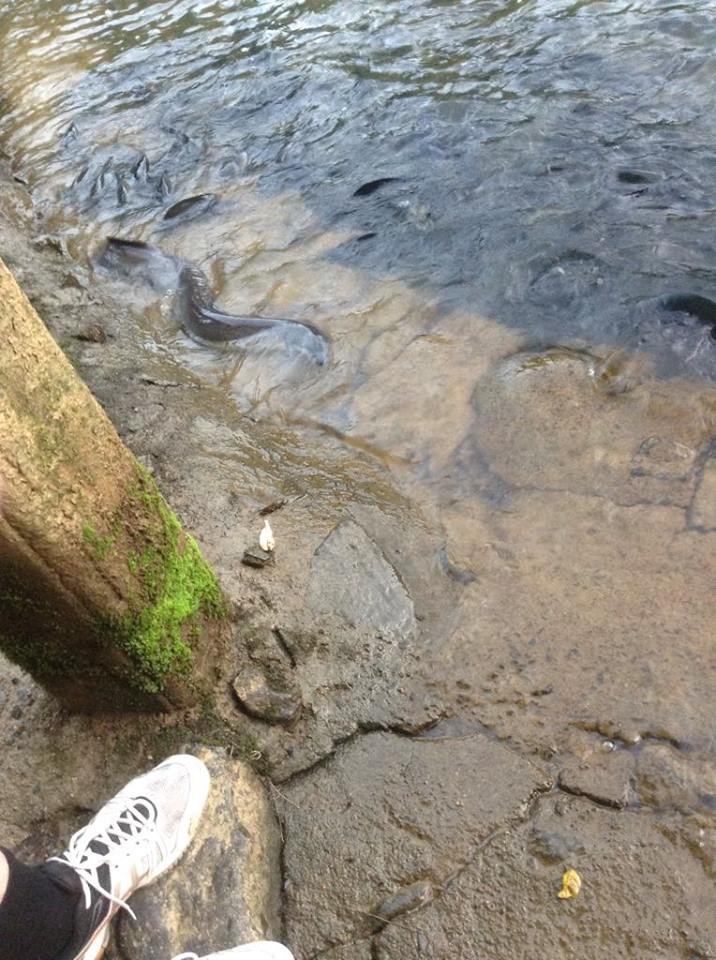
We've recently returned from week in far north Queensland, where we saw many great attractions. At Paronella Park the kids were given food to feed the fish on the property as part of the entry fee. The water turned out to be teeming with big, eager fish, crowding over each other to get closer to the front. Several of them had to flip onto their sides when it got too shallow to keep swimming. Then suddenly, there was a great, healthy eel in the race, slithering her way through and waiting for the next throw, just like all the fish. She even slipped right across my toes. At that moment, I changed the idea I'd always had about eels. Without much evidence, I'd imagined them to be brainless, slimy creatures which some people like to eat. This one was more like a cute little girl begging, 'Choose me, choose me!' (Our tour guide told us that all the eels on the property are female, and the males can be found further out to sea.) Her skin was sleek and glossy and her reflexes were finely tuned.

As a race, we humans make judgments and stereotypes so automatically. It's not our fault, but partly how the human brain is wired. I remember learning in Psychology that we make sense of the world by mentally storing things in boxes, even when the things we think we believe aren't necessarily true. For example, I neatly tucked eels away in the same category as the creepy, slime-dripping jellyfish I used to strike when swimming. This tendency can be useful, especially during our early years when we're making sense of the world. However, it has the potential to severely limit us if we let it keep going unchecked for the rest of our lives. It can be bad for the people, places and things we're unconsciously judging, as there's nothing more frustrating than trying to change minds which are set like concrete. It's also really sad for us to live in the narrow, rigid parameters we set for ourselves.

I believe we can open up new vistas of thought for ourselves, when we make a point of remembering that it's not an entirely predictable world, but one in which people and critters have the potential to surprise us all the time. That's where good writing may play its part. The type of books I enjoy reading are those which are fresh enough to challenge the opinions we've already made. The pens of the authors also turn out to be tools which help us hammer and chisel cracks into our discrimination, prejudice and automatic assumptions.

The people of first century Jerusalem had their fixed notions challenged. They believed that everyone who had his life shortened by the sentence of crucifixion was a no-good menace whose name would sink into obscurity, never to be heard of again. Were they wrong!

I've come across people who have told me, 'I never read fiction, because it's a waste of time, when you can be reading so much better material which is actually true.' They don't realise they've adopted the mindset that fiction cannot possibly hold its own sort of truth. Then they deprive themselves of a whole wealth of literature which might have the potential to move them deeply.

The man who built Paronella Park was a visionary who ignored stereotypes himself. Jose Paronella was a Spanish migrant and baker by trade, who fulfilled his childhood dream of building a fairytale castle on his property. His pragmatic neighbours told him, 'It's just weird to do something like that here in Australia,' but he didn't listen to them. I'm glad those fish and eels are finding it such a fertile place to live so many years after his death.


I want to keep training myself to watch out for extreme reactions which cause an emotional response to rise in me, and ask myself, 'Have I really got the facts right this time, or is it another eel?'

Have you noticed any eel reactions over the years, in yourselves or others?


Paula Vince is a South Australian author of contemporary, inspirational fiction. She lives in the beautiful Adelaide Hills, with its four distinct seasons, and loves to use her environment as settings for her stories. Her novel, 'Picking up the Pieces' won the religious fiction section of the International Book Awards in 2011, and 'Best Forgotten' was winner of the CALEB prize the same year. She is also one of the four authors of 'The Greenfield Legacy', Australia's first and only collaborated Christian novel. Her most recent novel, 'Imogen's Chance' was published April 2014. For more of Paula's reflections, you may like to visit her book review blog, The Vince Review.

Thursday, 14 May 2015

All One in Australia?


It’s my pleasure to introduce my new novel, Next of Kin, which has just been published by the recently formed Rhiza Press.

It’s always exciting to get to the end of project and see something that was once just an idea, a dream or goal, completed. A finished novel, printed and published, is an especially satisfying project because it has a life of its own; the potential to challenge, inspire, educate and entertain others for a very long time.  I feel very privileged and grateful to be able to participate in such a project. It’s been my pleasure to do so now with nine novels and I hope I can go on writing for many years.

Next of Kin has taken me on a journey through the lives of some of my ancestors, as have all my  novels, so I owe a debt of gratitude to those earlier Australians who survived the challenges of making a new life in a land on the other side of their world, and raised their children to continue the quest to make Australia what it is today. Through each life I have learned so much as I’ve explored the environment in which they lived, the political scene at the time, the cultural developments, the historical events. It’s been a great educational journey for me, as well as an affirmation that human beings can and do survive the most dreadful of circumstances and are capable of overcoming amazing challenges.  

While I know very little about the spiritual lives of my ancestors, their stories have given me a window through which to reflect on the ways that God can be involved in the human journey. It’s not hard to see the need for a God who directs, comforts, enables, rescues and leads, when you consider the challenges faced by people of any generation and culture. I can only hope that at least some of my ancestors really experienced the faith, hope and love which I have invested in their stories.

With my earlier novels I had the opportunity to learn much about the first white Australians, particularly convicts who arrived here in the late 1700s, and the first-born Australians who were their children, often known as ‘currency’ kids. With Next of Kin, I was led into a whole new area of learning, as I explored the coming of migrants to Australia in the mid to late 1800s, specifically those who came from Germany to work in the towns of the Northern Rivers area of New South Wales, and were often called 'continentals'. The experience of families attempting to assimilate into a culture with a different language, different traditions and backgrounds, is an ongoing challenge for all of us in Australia. It is a battle for many already here and definitely for those arriving. It was fascinating for me to delve into how this might have been experienced over 150 years ago.

I suppose when all is said and done, it is true that nothing is new under the sun, that human beings have difficulty accepting and cherishing what is different or unfamiliar, that we are more prone to prejudice and discrimination that we’d like to think, and that we are all on a journey of becoming more human in the best sense of the word; more Christ-like and open to growing through all the challenges we face in relating to others.  

I hope Next of Kin takes some readers on this journey, that it inspires or challenges people to be more tolerant, accepting and loving, regardless of creed, colour, socio-economic status or sex. I’d like to believe that as Christians we can honestly say with Paul that … “There is neither Jew nor Greek, slave nor free, male nor female, for you are all one in Christ Jesus.” (Galations 3:28).  In the case of Next of Kin it might have been said, “There is neither English nor German, black nor white, male nor female, rich nor poor, for you are all equal in Australia.” 


Carol writes historical novels based on her family ancestry in Australia and include the Turning the Tide series; Mary’s Guardian, Charlotte’s Angel, Tangled Secrets and Truly Free. Her earlier novels Suzannah’s Gold and Rebecca’s Dream have been re-released by EBP. You can see more about Carol and her novels on her website or her FB author page.


www.amazon.com/author/carolpreston

www.facebook.com/writingtoreach