Monday, 28 May 2018

Confessions of a Genre Butterfly - Susan J Bruce


Photo copyright Susan J Bruce


The author platform. Do these words fill you with confidence? Do you say ‘I know who I am as an author and I know who I want to reach? I know what my brand is?’

Or do you think, ‘Eerk!’

Earlier this year I realised as I belonged to the second category, I really should do something about it. So I enrolled in Iola Goulton’s appropriately titled course, Kick-start your Author Platform Marketing Challenge. The first few days were fun and I was filled with a sense of purpose. They led me to rethink my author name (that’s another story for another time) and gave me confidence that I was going to succeed. I would make a good website. I would build a social media platform around my brand as an author.

But then we came to the question of genre.

We were given an exercise where we had to identify our genre and find websites of authors who write the same kind of books. The idea was to see what website elements (images, fonts, etc.) are consistent with our genre. If we write romance we want the reader to get a romancey vibe when they visit our website or look for us on social media. If we are a science fiction aficionado we might depict spaceships soaring through nebulae, boldly going where no one has gone before. It makes sense. People should see our name and associate it with our brand so they can know if they will like the kind of books we write.

But what if we don’t write in just one genre?

I know. All the publishers and marketing gurus have crashed to the floor in a dead faint at my words. It makes absolute marketing sense to write in one genre, at least initially. But what if our writing doesn’t fit this pattern?

What if we are a ‘genre butterfly’? What if we flutter from genre to genre like a butterfly flits from flower to flower, collecting all kinds of nectar as it goes on its way.

Our group discussions showed that I was not the only one with this particular affliction, but that didn’t solve our problem. How do we develop an author brand if our writing doesn’t naturally fit one genre?

It must be possible.

Tim Winton comes to mind as a brilliant proponent of literary fiction: stories that are generally more serious and have deep artistic merit. Then there is general fiction. General fiction tends to be more accessible than literary fiction. Some general fiction authors are, I suspect, latent genre butterflies. They gather nectar from different genres and meld it into a new story. The success of a huge number of general fiction authors means that those of us who like variety need not despair. And then there are age-defined categories like young adult (YA) and children’s literature, which can contain multiple genres.

But what if we like to write different types of genre fiction? What if we want to write a cozy mystery followed by a science fiction novel and a love story between two dragons? Can we do that and build our brand as an author? What do we do? There are several options:

1.                  Embrace our eclectic nature. Write what we like, when we like. The catch is that we will probably find it hard to build a brand and to sell books unless we are so prolific that we quickly build up a backlist of several books in each genre.

2.                 Become a genre blender. You like three different genres? Mix ‘em together! I recently read Kerry Nietz’s, Amish Vampires in Space. This science fiction author blended Amish fiction, science fiction, vampire fiction and Christian fiction together to create an excellent space opera with great characters. In his case, merging genres made for excellent marketing. It led me (and many others) to read the book and because I liked it, I bought the sequel (which was great too).

3.                 Establish a unique brand of our own. Genre is a handy way of categorising our writing but it isn’t the only way. We can look at the heart of what we write, find the common themes and build our brand around those themes. 

I wish I wrote contemporary romance or cute cozy mysteries set in a bookstore. Branding would be simpler. But just because branding isn’t simple it doesn’t mean it’s not doable. I’ve chosen to take the third route above. Just about all of my stories, short or long, have themes of overcoming. Many have strong romantic elements, or themes of belonging, and are set in an environment of adventure or danger. Nearly all my work contains animals. Some stories contain deep issues. After a lot of thought I developed my working tagline: Stories of the human spirit – and sometimes other species. If I can write stories that fulfil that promise to the reader, and promote my books accordingly, I’ll be doing well. And should my writing evolve and take on a more speculative bent, I can always change it to Stories of the human spirit – and sometimes alien species J.

My name is Susan J. Bruce and I’m a genre butterfly. How about you?

Go on. Confess in the comments. You know you want to! How do you approach branding as an author?

Edit: Since writing this article I've added some mystery to the mix. The mystery novel is going to happen after all. Check out my website by clicking this link.


Susan J. Bruce, aka Sue Jeffrey, spent her childhood reading, drawing, and collecting stray animals. Now she’s grown up she does the same kinds of things. Sue works part time as a veterinarian, writes stories filled with themes of overcoming, adventure and belonging, and loves to paint animals. Sue won the Short section of the inaugural Stories of Life writing competition and her stories and poems have appeared in various anthologies including Tales of the Upper Room, Something in the Blood: Vampire Stories With a Christian Bite and Glimpses of Light. Her e-book Ruthless The Killer: A Short Story is available on Amazon.com.  You can check out Sue’s animal art on Facebook.

Thursday, 24 May 2018

Meet Our Members: Charis Joy Jackson


Each Thursday in 2018 we will be interviewing one of the members of Christian Writers Downunder
– to find out a little bit more about them and their writing/editing goals. 

Today's interview Charis Joy Jackson

Question 1: Tells us three things about who you are and where you come from.

I am a missionary filmmaker, author, and actress. I am from the US and grew up in several places, but have lived in Australia for ten years - which is actually the longest I’ve lived in one place my entire life.

Question 2: Tell us about your writing (or editing/illustrating etc). What do you write and why?

I love to write anything in the speculative genre. My novel, The Rose Of Admirias, is a fantasy. But I also have several sci-fi and dystopian books in the works too.

I've also started a little blog called The Dreamcatcher's Journal, where I capture all the crazy adventurous dreams I've had. I started it because I used to show up to work and tell everyone about my dreams. They couldn't believe how well told the stories were - like full novels or movies, so I thought, I've got to start keeping these written down somewhere. 


Question 3: Who has read your work? Who would you like to read it?
 
Friends and family that I know of, but my novel was just released at the beginning of this month as part of a limited release of 22 novels in an ebook box set called On The Horizon. Besides the fact that I’d love EVERYONE to read my novel ;) I’d love for two of my favorite authors to read it. Robin Hobb and Stephen R. Lawhead. These two have really inspired my own work and I’d love to get their feedback on my writing because I want to keep growing as an author.

Question 4: Tell us something about your process. What challenges do you face? What helps you the most?
 
I’m the worst when it comes to having a process. Each story I write seems to have a process of its own. Most of my stories I know where I want my characters to end up, but I don’t often write out a whole process of how they’re gonna get there. I have a vague idea of where I’m going, but there are a lot of things that happen along the way that surprise me and that’s my favorite. If I can surprise myself, then hopefully I can surprise the audience.

Because I am one of those writers who doesn’t plan a lot this can sometimes be an obstacle I need to overcome. I’ve written myself into holes I don’t know how to get out of, but thankfully I’ve always been able to find a way out in the end. I think a big reason for that is that I am co-creating my story with the Creator or story. With God there’s no such thing as writer's block - instead, they are the adventures we get to find our way out of. 

I think it was C.S. Lewis and Tolkien who said they wrote what they wanted to read. I’m the same, I write what I want to read and that is the thing that helps me the most. It keeps the passion of the story alive and I hope that translates better to the reader too.

Question 5: What is your favorite Writing Craft Book and why?

I really enjoyed Stephen King’s On Writing. While it didn’t cover as much story craft as I thought, it actually opened my mind up to more stories and possible adventures in the future. It taught me a lot about living the life of a novelist and not just dreaming about being one.

Question 6: If you were to give a shout-out to a CWD author, writer, editor or illustrator – who
would they be?

 
There’s several I’d like to give a shout out to - but Jeanette O’Hagan is definitely someone I want the world to know about. Her books are phenomenal. Excellent storytelling and amazing world building. She’s a huge inspiration to my own writing and has been one of my champions. My novel wouldn’t be published yet if it hadn’t been for her. It was because of her encouragement that I finally finished The Rose Of Admirias after writing it for four years! Please read her books. You won’t regret it!

Buy all her books!!!

Question 7: What are your writing goals for 2018? How will you achieve them?
 
My writing goals for the rest of 2018 are to publish The Rose Of Admirias as a paperback. I’d love to write the sequel this year and also finish up the novel I’ve been writing based on the film I produced in 2016 called Out Of The Woods.


Question 8: How does your faith impact and shape your writing?
 
As I mentioned earlier it’s a huge factor. I consider every story I’ve written to be co-written by the ultimate Creator. When I get stuck, I talk to God about how to get the character out of a situation. Sometimes, the best ideas come to me during a time of worship, so I often bring a journal so I can write them out. My passion, tenacity, and creativity are a gift from the Lord and I want to honor him by using it to the best of my abilities.


KEEP UP TO DATE ON WHAT CHARIS IS WRITING. SIGN UP TO HER NEWSLETTER NOW & RECEIVE A NEVER BEFORE SEEN SHORT STORY - FOR FREE!


Charis Joy Jackson is working as a missionary with Youth With a Mission (YWAM) a non-profit organization & is part of The Initiative Production Company. She loves creating stories & her first novel, The Rose Of Admirias, was released this May in a limited release box set called On The Horizon - 22 authors, 22 novels.

Here's to a life lived in awe & wonder.
Welcome to the adventure.

www.charisjoyjackson.com

Monday, 21 May 2018

Called to be Different

by Anusha Atukorala

Thank you Lord for our Dream Home


In May 2017, I thought it would be brilliant if I could sleep for a year, waking up to find our house sold and the three of us settled comfortably in a new home. And guess what! The miracle happened—I did wake up today in my new abode. Yay! However, I must whisper in your ears that those twelve months were not spent in sweet slumber. They involved plenty of hard work and plenty of stress. Thankfully as we look back, my beloved and I agree that it was all worth it. Every bit of it—the stress, the slog, the wondering if it would all work out.


Our gracious God has now brought us to our promised land and our cup of joy has over-flowed. What an awesome God He is! Being a nature lover, I’ve been delighted to see flowers of different varieties in our new surrounds. Delicate white roses adorn our front yard. More rose bushes grow in the little garden patch outside our kitchen window. For a long while there were no signs of blooms on those shrubs. My husband watered our new garden often to make sure it would remain green and lush in spite of the hot weather.


One morning we discovered that the extra watering had woken up the sleeping rose bushes. A gorgeous yellow rose beamed at us. Every time I looked out of my kitchen window, I was enthralled. Before long we had the pleasure of basking in an abundance of yellow roses. The bush in the middle though had not yielded any flowers. Shan watered it some more.

And then it happened. One day we spotted a little bud starting out on that middle rose bush. Exciting! BUT … surprise, surprise. It wasn’t yellow. It’s petals were painted a bright joyful red, with streaks of perky yellow creating a beautiful contrast. Wow! A queen of roses it was and it bloomed for weeks on end. With boldness it declared: 
‘I’m different and I’m glad to be different’. 
It brought joy to my heart in a way no yellow rose had done.

That striking red rose pointed me to a God of wonder; a God of beauty; a God of surprises. And more. It prodded me with a call to be different. God asks you and me as Christian writers not to merge with the world—but to stand out. To be as conspicuous as that enchanting rose in a manner that will glorify our Creator. 

But what does different mean?

 I believe that most importantly it has to be the inner me that’s different as I grow in intimacy with God. I am called to a life of purity and integrity, reflecting the beauty of Jesus. We Christian writers are called to write from the depths our walk with God, leaning on the Holy Spirit to guide us. Not necessarily doing what brings in material benefits but primarily being obedient to Him. The world’s way is to squash one’s competitors. The acronym CALEB (as used in the prize offered in our annual Omega Writer’s competition) stands for something unique: “Christian Authors Lifting Each other’s Books”. Isn’t that beautiful? What a contrast to doing life  according to the world’s modus operandi! I love it.


Jesus calls us not just to entertain our readers but also to help them to reflect on the deeper issues of life. He calls us not just to thrill and enthral but also to bless and build. We Christian writers need be different by standing up for the downtrodden and the weak, by giving a voice  to those who don’t have one. We are called to be salt and light. To flavour the world with our writing. To point to the Saviour.

Some of us write only hints of the reality of God and the reality of heaven. Others of us are more explicit. Whatever we write, we can be different to the world in the way we approach our craft. By praying before we write. By saturating whatever we do with His presence. By listening to the nudge of the Holy Spirit. By giving away a free book to someone who needs it, even if it means that we don’t make as much money.


We are called to be different because what propels our writing is not self-ambition and self-interest but the love of Jesus. We are called to be evangelists even if our writing is not explicitly so. The stamp of our Creator needs to be on each book we write—a stamp that may be invisible, true—but one that bears His heart within.

We are called to be different because the reward of our hard work might not always be obvious. Instead of world’s understanding of ‘success’, it’s in the joy of being obedient to God, the thrill of finding our writing has reached a reader’s heart, the knowledge that our words have encouraged someone and given her hope, the wonder of leading a stranger to Jesus. Being different might often cost us. But oh the joy of walking close to Him and writing as he leads. After all ... we are called to be different so we can make a difference in the world. 

But then ... I am preaching the choir aren't I? Celebrating each of you today knowing you have chosen to be a red rose amidst a hundred yellow roses today. Well done fellow-writers on your faithful writing. Cheering you on and joining hands with you. Let’s continue to saturate the world with books inspired by the Holy Spirit so we will fill the earth with books stamped by the cross of Christ, and are whispers of God’s heart to His world. 


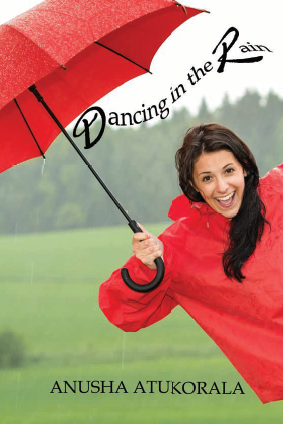
Anusha’s been on many interesting detours in life, as a lab technician, a computer programmer, a full time Mum, a full time volunteer, a charity director, a full time job chaser, until one golden day (or was it a dark moonless night?) God tapped her on her shoulder and called her to write for Him. She has never recovered from the joy it brought her. She loves to see others enjoying life with Jesus and does her mite to hurry the process in her world through her writing and through her life. The goodness of God is her theme song through each season, as she dances in the rain with Jesus. Please stop by at her website Dancing in the Rain to say G’day. 
At the launch of Dancing in the Rain - 12th May 2018

Her first book Enjoying the Journey contains 75 little God stories that will bring you closer to your Creator. 


Her second book  Dancing in the Rain was released in March 2018  by Armour Books and launched recently on the 12th of May. It offers you hope and comfort for life’s rainy seasons. 


Available from:


Thursday, 17 May 2018

Meet Our Members: Melissa Gijsbers


Each Thursday in 2018 we will be interviewing one of the members of Christian Writers Downunder – to find out a little bit more about them and their writing/editing goals.

Today interview Melissa Gijsbers

Question 1: Tells us three things about who you are and where you come from.

I was born in Melbourne, Australia. My dad was a forester, so we moved around quite a bit when I was a kid, including spending three years in Nepal. My parents would joke that they finally stopped moving so they wouldn't have any other kids! (I'm the oldest of 4 kids, each born in a different place).

My dad is dutch and my mum is Australian. My dad came to Australia when he was 3, and the way my surname is spelled is thanks to the people in immigration!

I am currently a single mum with two teenage boys, both with chronic health conditions. They are a constant source of inspiration for my writing, even if they don't mean to be!

Question 2: Tell us about your writing (or editing/illustrating etc).  What do you write and why?

Writing is something I have always done. I won a couple of awards in high school, including enough money to buy a dictaphone! Most recently, I started writing picture books before discovering chapter books. I've found that I can write chapter books much easier than picture books! I have also been playing around with writing some novels for grown ups.

For the why... it's just something I do. Words and books have always been something I'm interested in and there are times I get quite restless if I can't write.


Question 3: Who has read your work? Who would you like to read it?

So many people have read my books. It amazes me when I see a photo or a review of someone reading one of my books and I didn't know they had even bought a copy!

Most of the people who have read them so far are kids, but there are also a lot of parents, teachers, and others who have read them too.

For the books that I've published, I would love to reach more kids. Especially for my first two books, both 'issues books', to show kids that there are others who deal with the same issues they do. I also want to reach anyone who would like to read a good story.

Question 4: Tell us something about your process. What challenges do you face? What helps you the most?

I find that I work best with a deadline, as well as someone working with me, usually an editor. This extra person is someone I'm accountable who will say 'where's that next draft you promised me?'

My biggest challenges is time. With a day job and two kids, writing time is precious. Different things work at different times. It could be working at my favourite cafe, or writing during my lunch break, or any other strange times I can get a few minutes.

Question 5: What is your favourite Writing Craft Book and why?

One of my favourite writing craft books is Writing Hannah: On Writing for Children by Libby Gleeson. In this book, Libby Gleeson (one of my favourite authors when I was a teenager) shares the process of writing one of her books based on her diaries and notes during this time.


I like how it's not giving a formula on how to write that may or may not work for everyone, instead, she shares her process, including the times when she couldn't work out what the next part of the story was and when things needed changing. Her process is something that is closer to my own process in that the whole book isn't planned to every detail, instead she starts with an idea and writes to see where it goes.

Question 6: If you were to give a shout-out to a CWD author, writer, editor or illustrator – who would they be?

Lately, I have really enjoyed the books by Nicki Edwards. They are great books to read and I have them all!

I also have a general shout out to the CWD team. They have been really supportive of me and my writing goals while I've been caring for two sick children.

Question 7: What are your writing goals for 2018? How will you achieve them?

One goal I have is to publish another book this year, although the more realistic one is to get one ready to publish early in 2019! I also want to publish some more 'how to' ebooks for authors with small business tips. I currently have one published, I just need to edit and polish some that I have sitting on my hard drive.

Question 8: How does your faith impact and shape your writing?

This is always a hard question for me to answer. I write stories that are more for the general market, however my faith colours the issues that I write about. Many of my stories are based on my own journey and characters will attend church, mostly because it's just part of what we do! I also write stories and take part in promotions that line up with my values.


Melissa Gijsbers lives in Melbourne with her two teenage sons. During the day she works in the family business and by night she writes stories for kids and adults. She has three middle grade books published.

You can find her at www.melissagijsbers.com and on Facebook or Twitter.

Thursday, 10 May 2018

Meet Our Members: Christine Dillon


Each Thursday in 2018 we will be interviewing one of the members of Christian Writers Downunder – to find out a little bit more about them and their writing/editing goals.


Today interview Christine Dillon


Question 1: Tell us three things about who you are and where you come from.


Although born in Australia, I went off to Asia when I was two months old. My parents worked in Taiwan until I was seventeen. I did most of my schooling in Malaysia and the Philippines and returned to Sydney for my final two years.

After studying physiotherapy and working for a few years I attended Sydney Missionary and Bible College. Those were two of the best years of my life. In 1999, I returned to Taiwan with OMF where I have the best job in the world as a Bible storyteller and part of a church planting team.

Question 2: Tell us about your writing.  What do you write and why?


The non-fiction came out of my daily life and training of others. 1-2-1 discipleship (Christian Focus, 2009) and then Telling the Gospel Through Story: Evangelism that keeps hearers wanting more (IVP, 2012). I wrote about discipleship because people kept preaching the ‘make disciples’ passage (Matthew 28:16-20) but didn’t tell me how to get started in a way I could understand. The storytelling book was written out of an excitement at what an amazing tool it is. Both books were written to allow me to reach a wider audience with what I was learning.


I never expected to write fiction and God really had to force me to do it. I knew it was going to be a hard slog and I was right. My first novel took me four and a half years. Fiction allows me to deal with issues that those I disciple struggle with but in a different format - a story package that challenges the way they see the world. I hope it is ‘life changing’ and inspires them to follow Jesus more.


Question 3: Who has read your work? Who would you like to read it?


The non-fiction has been read by anyone who wants to meet up with another believer one to one in order to grow in a maturity or for anyone wishing they knew how to tell their friends about Jesus. Storytelling is a method that increases the likelihood that non-Christians will become hungry for more. Of course, it also challenges and teaches believers. It is no surprise that ‘Jesus never said anything without a story’ (Mark 4:34).


Officially my novel is ‘women’s fiction’ which means that the book is focussed on the daily issues that women face and that romance isn’t the primary focus. Think Francine Rivers and Deborah Raney. However, I have been greatly encouraged at the number of men and teenagers (from age twelve) who have read it and enjoyed it.

Grace in Strange Disguise looks at the issue of ‘what is God there for?’ We know people disappoint us but what happens when God does too?

Question 4: Tell us something about your process. What challenges do you face? What helps you the most?


Non-fiction is relatively easy for me because I’m an ISTJ and so organisation is my middle name. I brainstorm all the topics I want to cover in the book and then organise them into a logical flow. Then I just start writing. I’m helped too that most of the content of my non-fiction has been taught to others first.

With the novel, I started with the ‘Snowflake Method’. It was something I found online that made sense and broke the planning process into small bites. Good for a beginner. But towards the end of the editing process I was introduced to Story Genius by Lisa Cron. I went back immediately and did her planning writing segments. Some of them made it into the finished book. I now always start with the four scenes she suggests you write for each character.

The rest of the process? For novel two I had two main characters so I bought two sets of index cards (small) in pink and green. On each card I’d write an idea for a scene. Then I got a cork board and worked out a logical flow and added any missing cards. Then I wrote (not always in order), using Scrivener. Scrivener has some marvellous features including a daily word count that you can set the target. Eventually I increased that to five thousand words as that was possible in a day if I’d done some thinking beforehand (which I did while swimming).

Once the draft is finished I let it sit and have a few weeks break. Then on to edits. Edits happen over and over but the most useful one is the read through out loud. I record each chapter, as this forces me to keep doing it out loud. My ear is able to catch un-natural dialogue (a weakness of mine) and many other mis-rhythms.

Then beta readers and more edits and finally to the paid editor (s) once it is the best I can make it. The editors have taught me so much (thanks Cecily and Iola). Yes, having two is expensive but I want my books to be the best possible.

Finalising title and cover and proofreading and then on to pre-marketing. It has been so much to learn, especially after I made the decision to go with independent publishing.


Question 5: What is your favourite Writing Craft Book and why?


At the moment it is Understanding show not tell by Janice Hardy. Cecily recommended it (so I listened). You might not understand all the details but if you simply search for all her ‘red flag’ words like thought, realised, felt, considered, hoped … you can eliminate them. In the process you decrease the narrative distance between the reader and your character (thus increasing deep point of view and allowing the reader to go on the ride with the characters). It was the best $6 I’ve spent so far as immediately afterwards it saved me $1000 on the editing quote I’d had!

Question 6: If you were to give a shout-out to a CWD author, writer, editor or illustrator – who would they be?


A tough question but it has to be the editors because without them I’d be sunk (and Joy Lankshear, my cover designer isn’t in CWD). Cecily Paterson, as well as being an excellent YA general market author, also has a speciality in ramping up emotion (or telling you to do so) and writing natural dialogue. She forces me to know my characters and makes sure they’re all distinct. These are my areas of weakness and as almost the completely opposite personality type to me she is always saying, “Stop thinking! Your character should be feeling.”

Iola Goulton is a master of structure and copy editing and many other things. Both these women somehow get me to write much better than I believe is possible.

Question 7: What are your writing goals for 2018? How will you achieve them?


I have a very full-time job and so this year I’ve set aside Saturdays to write and kept myself to it. I turn off the internet and listen to suitable music (classical or Lord of the Rings). My goal is to get the sequel to Grace in Strange Disguise published. I’d also like to complete the planning for book three and even start writing.

Question 8: How does your faith impact and shape your writing?


Without it I wouldn’t be writing. The non-fiction directly flows out of my daily ministry and what God has taught me along the way.


I was only willing to write fiction if it was aiming to be ‘life changing’. That means that God first ministers to me through the research and writing process. There have been many, many times when I’ve wanted to quit because writing is painfully difficult. Without Jesus it would be impossible.

My faith also informs my marketing and promotion … the values behind what I am happy to do and why. The Holy Spirit is great at yanking me back into line.


Christine Dillon was born in Australia but grew up in Asia. She now works in Taiwan as a Bible storyteller. Her book 'Telling the Gospel Through Story' was voted 2013 Outreach Magazine's Resource of the Year in Evangelism and continues to inspire innovative and engaging Bible storytelling. Believing in the beauty and power of story prompted her jump into fiction. Grace in Strange Disguise was runner-up in the Athanatos Christian Writing Contest. Christine loves reading and keeps sane by cycling, swimming and hiking.

Website | Facebook (Page) | Facebook (Group) | Pinterest

Monday, 7 May 2018

Exploring Genres - Crime Mystery

by Donna Fletcher Crow


The Mystery of Writing Mysteries—
Or Why Would an Author Kill Her Characters?
Saint Cuthbert made me do it.

I started out as a romance writer. I wrote wonderful, dreamy stories, historical or contemporary, set in lush locations that I loved researching and then living in in my mind. (Settings have always been one of the most important story elements to me.) I published several books and even won a few awards. Then one day I realized I couldn’t read another romance.

If you can’t read them, you can’t write them. So I concentrated on my lifetime love of English history and wrote a number of historical novels, including my Arthurian epic Glastonbury, The Novel of Christian England, still my best-known work.

Then I met Saint Cuthbert. Not in any mystical sense, but the way I meet most of my characters: researching another project. At Durham Cathedral I heard the story of this soldier-turned-monk who transformed the north of England by his holiness. I knew I wanted to tell his story. But what could I do with a character whose claim to fame was his sanctity?


My greatest challenge in writing had always been plotting. My family knew my struggles so well that when my writing flagged, my young daughter would say, “Mama, you don’t have enough conflict.” I seldom did. I had once mentioned my struggle to an editor who advised, “You need to read thrillers.” He promptly sent me a box of mystery novels he edited. I was hooked.

My love of history took me back to the Golden Age. I devoured Dorothy L. Sayers, Josephine Tey, Margery Allingham and, of course, Agatha Christie. I saw that mystery writing incorporated not only the rich backgrounds and alive characters that I loved, but also kept me involved with that all-important strong story question that must be developed early in the story and solved at the end.

That was it—what I needed for Saint Cuthbert was a story question strong enough to keep the pages turning. I needed to involve my reader with strong characters in interesting settings so they would care enough about what was happening to be willing to read about an ancient saint whose beliefs are still valid for our day and can transform our world as they did his own.

The Monastery Murders were born. I had understood the story question idea from the early days of my writing—I had some great teachers, especially Lee Roddy. But I had never applied the story question principle with blood before. Let’s face it—nothing keeps the pages turning like a dead body.

In this third permutation of my writing career I author three mystery series: The Lord Danvers Investigates, Victorian true-crime mysteries; The Elizabeth and Richard Literary Suspense series; and The Monastery Murders. In each of these I try to develop the rich backgrounds, vital characters and historical elements that have always driven my writing, but now I also concentrate on keeping the story question moving forward to what I hope will be a satisfyingly surprising conclusion.


Once I plant my story question—which may or may not be an explicit query followed by a question mark, but must raise a question in the reader’s mind—I then develop my chapters by focusing on small elements of the over-arching question. A clue or red herring leads my sleuths (in my books, all amateurs) to explorations, evaluations and then a new question to be explored in the next chapter. This is a mystery-writing application of the classic scene and sequel structure which I discovered many years ago in the classic Techniques of the Selling Writer by Dwight V. Swain. I highly recommend it—there’s nothing better for understanding the bones of fiction writing.

This question and answer method, which I first applied to A Very Private Grave, Saint Cuthbert’s story,  has carried me through the writing of  fourteen more mystery novels. I’ve never been bored for a minute—and I hope my readers haven’t either.


Donna Fletcher Crow is passionate about English history and loves telling the stories of the men and women who have shaped the world we live in. She is the author of some 50 books--all available on her website along with pictures from her research trips--something else she is passionate about. Her newest release is A Lethal Spectre, Lord Danvers Investigates 

Thursday, 3 May 2018

Meet our Members: Paula Vince


Each Thursday in 2018 we will be interviewing one of the members of Christian Writers Downunder – to find out a little bit more about them and their writing/editing goals.
Today's interview: Paula Vince

Question 1: Tells us three things about who you are and where you come from.

I'm descended from several families who migrated to South Australia to escape bad conditions in their homelands in the mid 1800s. That makes me a 7th generation South Aussie, so I like to think living in Adelaide is deep in my blood. I've lived in the Adelaide Hills since I was a teenager, but we've recently moved to a beach suburb. We are still getting used to the figurative and literal sea change. And I've homeschooled my three children since 2003, but it finishes at the end of this year, since my youngest son is 14 and will begin High School subjects in 2019.


Question 2: Tell us about your writing (or editing/illustrating etc).  What do you write and why?

I've written 9 novels altogether. Six are inspirational dramas for the New Adult market with elements of romance and suspense. I also challenged myself to write a young adults' fantasy adventure trilogy, just to see if I could. It was great fun, but really stretched me. I also love writing blog posts about books and all things literary. And I've started a fictionalised account of the life of my grandfather, who was a war hero, boxing champion and South Australian celebrity of his generation. It's a bit of an unusual and close-to-home project for me, so I'm progressing fairly slowly with that one. I had to sit on it when my Dad, who was his only surviving child, passed away at the start of last year, because I felt too emotional to continue. But stopping for the short term doesn't mean forever.

Question 3: Who has read your work? Who would you like to read it?

I really don't know the full answer to that, but it would be great to find out. My novels have been sold in the Australian Christian fiction market and some school catalogues, along with Amazon and the usual modern channels. Although it doesn't happen with regularity, I love to hear from readers, and find out where they're from. Not knowing the full extent of our audiences is a mystery we authors always have to deal with.

Question 4: Tell us something about your process. What challenges do you face? What helps you the most?

It always involves jotting thoughts down with a notepad and pen to start with. That's an old habit from schooldays which has stuck, because the flow dries up if I try to type straight from my head onto computer. I like it that way though, because I consider the first computer draft my initial edit. My brain is used to regarding the process in these separate steps, and I think it helps stop any inhibitions about the messiness and disorganisation at the start. Because it knows it's allowed to be messy then.


Question 5: What is your favourite Writing Craft Book and why? 

I love Elizabeth Gilbert's 'Big Magic', but it's probably more of a book about forming a resilient attitude than actual craft. So to cover both bases, I'll add 'The Sound of Paper' by Julia Cameron. It's full of wisdom and helpful hints about everything from getting ideas to dealing with all kinds of feedback, not to mention actually getting things on paper in between.

Question 6: If you were to give a shout-out to a CWD author, writer, editor or illustrator – who would they be?

Wow, there are so many, that's a hard pick as I'd like to give shout-outs to several, but I'll mention a couple that spring to mind right now.

Anusha Atukorala, since I'm looking forward to attending her book launch in a couple of weeks, and am already enjoying her beautiful, encouraging book. It's just the sort of read we all need to help keep our spirits up.

Rose Dee, because I love occasional visits to far north Queensland in the real, and she has such a colourful, descriptive way of bringing that part of our country to life whenever I dip into her stories at home, I might as well be straight back.

Jeanette Grant-Thomson, because she's highlighted such a variety of interesting, topical issues and people in her fiction and non-fiction. It's just what what we need in Australia, where so often people with interesting tales just slide under the radar, without a chance to tell them.

And I'd also like to highlight the work of 'Belinda Peoples Writer' who has a passion for encouraging normal, average people in our daily lives, and giving us encouragement to keep going, in her 'Belle of the Bell Curve' reflections. It's something not many people think to do, and is much appreciated.

Question 7: What are your writing goals for 2018? How will you achieve them?

For this stage, I seem to be focused more on reading than writing, at least for the time being. So I'm concentrating on studying the writing techniques of authors from way back, including the great classics. I also love to keep track of modern new releases, to compare changes and styles over time. Just soaking them in gives me lots of satisfaction.

Question 8: How does your faith impact and shape your writing?

My faith always affects my writing because expressing my impressions on the page is always how I've processed things. So in a way, writing shapes my faith as much as my faith shapes my writing. I love that sort of feedback loop, and the record it leaves as a bonus.


Paula Vince is a South Australian author of contemporary, inspirational fiction. She lives in the beautiful Adelaide Hills, with its four distinct seasons, and loves to use her environment as settings for her stories. Her novel, 'Picking up the Pieces' won the religious fiction section of the International Book Awards in 2011, and 'Best Forgotten' was winner of the CALEB prize the same year. She is also one of the four authors of 'The Greenfield Legacy', Australia's first and only collaborated Christian novel. Her most recent novel, 'Imogen's Chance' was published April 2014. For more of Paula's reflections, you may like to visit her book review blog, The Vince Review.