Monday, 12 December 2022

Shining Light into Darkness – by Ruth Bonetti

Last Sunday, the third Advent candle was lit in churches to speak of joy. But have you ever wondered at candles on Christmas cards? How can Australians relate to the  light without living through a northern hemisphere winter? During interminable long winters, where the sun straggles out for a few hours before retreating, we learned the significance of solstice light. 

We first celebrated St Lucia Day in Sweden. Scandinavian countries, including Swedish speaking Finland, celebrate St Lucia day on 13 December, drawing on the Italian St Lucia.  Hear my own memories in a narration of Burn my Letters:


St. Lucia was killed by the Romans in 304AD because of her Christian beliefs. It’s told that she secretly brought food to the persecuted Christians in Rome, who hid in catacombs under the city. She wore candles on her head so that she could keep both of her hands free to carry food. It is also from the Italian Lucia that the Scandinavian Lucia gets her red satin belt from portraying Saint Lucia’s blood, and representing her sacrifice.


On my first European tour, we members of Queensland Youth Orchestra arrived in Rome. After a tantalising glimpse of the Coliseum, we visited catacombs. Did I tread similar paths on St Lucia's beat? 


I hoped to replicate St Lucia Day celebrations for my grandchildren (especially lovely Luca whose name means light and who is fascinated by light. As am I. My first name, Helen, means light.) I was rather relieved when the family pleaded December=BUSY! Wake up at 4am to usher in the sun and guests with coffee, fresh baked saffron buns and mulled wine? Get real. 


Solution:

Attend a celebration on the Saturday night before, hosted by Swedes Downunder.


Back in 1995

We drove three young sons through the arctic winter in a campervan. (Crazy brave, non?) Its heating expired at the first snowfall but we were warmed by interludes in snug beds, enjoying hospitality from friends and family across Europe. Rarely did a Jingle Bell jar.  (My allergy to Jingle Bells abated when playing it with Noosa Orchestra and the sassy Kitty Kats vocal trio.)


Along the way we enjoyed many Advent music concerts, especially a sung Christmas Eve mass in Oberammergau. There, my spirit craved a Bavarian wood carving, despite our straightened budget. 


While living near the Arctic Circle, I collected wood-carved nativity scenes, birch bark stars and angels.


Another tantalising thought:

Was my grandfather, WA Back, drawn to develop a sizeable part of the Brisbane suburb, St Lucia, because of his childhood memories? Read all about that in The Art Deco Mansion in St Lucia


Hanukkah, the Jewish Festival of Light, begins an eight-day celebration on 18 December. Whatever your faith, consider:


What light can you shed on this Christmas season?


How will you bring the Light of the World into your writing this Christ-mass season? 


Ruth BONETTI lived seven years in Europe, two in Sweden. There she imbibed her Finland-Swede heritage and was blessed with a treasure trove of letters, parish records and stories. One planned book grew into the Midnight Sun to Southern Cross trilogy. In this, she weaves discoveries of her forbears with her own journey in life and music. 

Email Ruth for information about her January Writing Life Stories webinar and for mentoring. 

Website for autographed copies (books sure beat sox for Christmas gifts!)

Blog

Audio book: Speak Out–Don't Freak Out


Monday, 5 December 2022

Creativity's Path

 
Creativity—reflecting and embodying our destiny as made in the image of our Creator triune God, author, artist, designer, engineer, composer extraordinaire.

Creativity - a torch lit within and fanned by others.

One of the highlights of my childhood was winning the first prize  in an art competition (in  Grade 3). I loved to draw and paint as a child. I also had a passion for reading inspired by my parents reading the the Chronicles of Narnia to my brothers and me each night.

Lewis’ imaginative stories transported me to another world, their strong symbolism and courage an inspiration. Shortly after, I discovered the school library. Reading books especially by Lewis and Patricia St John helped me understand my faith. Stories gave flesh and blood and motions to the biblical truths I’d learnt from the cradle. They helped me understand grace and God’s great love and power. They encouraged me to appreciate other people, their perspectives and motivations.

I was nine when my family uprooted and travelled to Africa – a process that took four months from leaving Mt Isa and arriving by train in Kitwe. Around this time, I began daydreaming characters and adventures in my own world. I was inspired by Narnia, Last of the Mohicans, and later, by Tolkien’s Lord of the Rings, and the many other books I read. My own inner storytelling grew and expanded from one small island and a handful of characters, to continents and peoples and various nations. It was some years before I told anyone about it, though I did draw pictures, make notes and maps and genealogies, invented an alphabet and language.


While in Zambia, one of the missionaries took an interest in my world-building and encouraged me to write my stories down. I did make a series of paintings based on my world and write a short story set in it, but it wasn’t until my late teens, early twenties that wrote my first attempt at a novel.

Creativity can have twists and turns and lay-bys

Over the next couple of years, I rewrote and edited the novel, got a nibble from a publisher, wrote some short stories, but put it all one side when my life took a different tack. Over the next fifteen years, I put all my energy into post-graduate study, lecturing, church, husband and children and the challenges along the way. Writing, apart from lecture notes, student handbooks, promotional brochures, research papers, course outlines, newsletters and articles, was decidedly on the backburner. 

I invested many years of my life, my heart and soul into theological study and lecturing. Yet, due to restructuring, other people’s decisions, health challenges, and family demands, I came to the point where I had to let it go, and I was shattered. A combination of burn-out and loss of a long held and cherished dream left me empty, depressed and my faith shaken. Always before this, troubles had thrown me closer to God. Now I felt abandoned, left on the shelf, shunned. I struggled through dark days, but in midst of that darkness, God whispered to me. At a woman's camp, He whispered ‘I have a new dream for you.’ It took me three years and an amazing God-encounter in one of my darkest moments before I could hear His words, and more to the point, accept them.

But then, one day, God had other plans.

God had called me to ‘feeding his sheep’ and opened the doors to lecturing in a theological college. Then he was called me to write the stories He’d given me. I enrolled in a Master of Creative writing and, through a writers’ conference, connected with other Christian writers. I dusted off my old novel and began writing new stories and poetry. I learned new ways of writing (styles change over time) and gained a greater understanding of how story works. Gradually, my poems and shorts stories were accepted for publication and I launched out as an Indie author. I have a half-shelf of books - anthologies and sole-authored books.


Being an author is hard work. Sometimes it feels like shouting into the abyss, desperate to hear even the faintest echo return - a sale, a review, someone inspired or comforted or entertained by what one has written. Don't get me wrong, I've had many sales, reviews and people excited about my stories - but also long periods of silence in which it is easy to allow doubts to flourish.

As an introvert (as so many of us are), the constant effort to be seen and noticed can become wearying to the soul. It's easy to lose the original motivation to write, especially when life and friends and family also brings more hard knocks and disappointments. 

I write in a genre many Christians don’t understand (despite the greats like C. S. Lewis, J. R. R. Tolkien, Madeleine D’Engle or even John Bunyan). These were stories captured my imagination as a child, that strengthened and enlivened my faith. And these are the stories I believe God has given me to write.

Being creative, being a story-teller, (or an artist or musician), pointing to the light in the darkness, are these not reflections of God, at least part of what it means to be made in His image?


Jeanette O'Hagan has spun tales in the world of Nardva from the age of eight. She enjoys writing fantasy, sci-fi, poetry, and editing. Her Nardvan stories span continents, millennia and cultures. Some involve shapeshifters and magic. Others include space stations and cyborgs.

She has published over forty stories and poems, including the Under the Mountain Series (5 books), Ruhanna's Flight and Other Stories, Akrad's Children and Rasel's Song, the first two books in the Akrad's Legacy series - and new short story in the Starlit Realms: Fantasy anthology.


Jeanette has practised medicine, studied communication, history, theology and a Master of Arts (Writing). She loves reading, painting, travel, catching up for coffee with friends, pondering the meaning of life.


Thursday, 1 December 2022

The future of social media: small, private gardens

by Elizabeth Tai 

Have you heard? Twitter is imploding and may disappear.

A couple of weeks ago, the idea of Twitter collapsing didn’t even occur to me. However, thanks to the wild managerial decisions of one over-entitled billionaire, advertisers are fleeing Twitter and the platform is slowly breaking down because the people that used to maintain it have been fired. 


There's a real possibility that Twitter may cease to exist in a matter of weeks.


(If you’re wondering what in the world is going on, you can read my essays Twitter Meltdown Part 1 and Part 2)


For authors, Twitter was a way to promote their books and connect with readers, authors and industry players. Where can they go if Twitter collapses?


That’s the question you should ponder soon but let me first steer you to a quiet, barely-noticed movement that is changing social media.


In the last few months, I’ve been stumbling on more and more writers who are moving away from their blogs to write elsewhere. Many say that they just “want to write more freely”. 


Once upon a time, that place was blogs. I'm sure you've heard about the oft-dished-out advice: Don't build your home on rented land. A website is "owned land". But many have come to realise that Google is increasingly prioritising advertising dollars. Writers have to write a certain way or risk being penalised and buried in Google search. And there's nothing more creativity-sapping than to abide by rigid rules on how content should be.  


People are getting tired of having their distribution channels dictated by the rules of the few.  So, they are now moving on to platforms that enable them to take more control of how they can reach their followers and readers.


So there's a move from corporation-controlled platforms to walled, private gardens or networks.  The main appeal of these tools is that they are not algorithm-driven. Meaning, whether your content gets seen or not does not depend on the platform’s distribution rules of the day. Because, there are no rules.


Of all the tools like that out there, Substack appeals to writers and artists the most. 


Substack's rise


Substack is a popular online tool used by millions of creators to send newsletters. But that oversimplifying it. If a blog and an email marketing tool had a baby, the result will be Substack. 


Substack appealed to many writers because they get to own  their mailing lists and yet are provided tools to build a community. Unlike other social media channels, it didn't have an algorithm-driven discovery engine. Instead, writers recommend Substacks to each other.


For almost a year, I used Substack as a glorified mailing list to notify people of new posts on my blog. My main motivation then was to move out of Mailerlite's clunky interface. Also, it appealed to my frugal heart: I could send out newsletters to my readers free.


But I have since realised that I’ve been woefully underutilising Substack’s capabilities. In the last few weeks, I've pivoted, turning my newsletter, now named Tai Tales, into a hub where people can interact with me and get my fiction, essays and updates about my work. It's also a place where I can find other writers and finally be a part of a community.


Yes, I'm actually publishing my fiction there! To my delight, there's a growing number of fiction writers sharing their novels chapter by chapter. I'm planning to do the same. 


Writers like Elle Griffin, for example, shared chapters of her novel Obscurity weekly. After the novel ended its run, she released it as an ebook and also mailed a beautiful hardcover version to top tier subscribers. I love this personalised approach to novel creation.


Recently, I've re-published my horror short story, Blood of Nanking, in time for Halloween. I plan to publish many of the short stories that have stayed neglected in my hard drive. Finally, they can get out there into the world.


I’ve never felt freer as a writer, more energised. For so long, blogging or writing my novel, felt like shouting into the void. It was such a lonely, demotivating experience and I almost wanted to just quit. Here, I get to organically build my audience, interact with fellow writers while getting feedback on my writing.


And as a reader? Boy, I’m really thrilled by the content I’ve been reading from fellow writers. I realised how much effort it was to find content like this on Google search.  Why? Because this content did not fit into the rigid SEO framework set out by Google, so they are buried under heaps of marketing material.


Like so many creatives, I’ve come to the conclusion that the world wide web no longer belongs to the common people — especially artists. It has not been for a long while. The latest Google update only cements the fact that corporations and ad dollars will continue to dominate search engine results.


Aren't you tired of listicles and marketing-slanted content? Don't you long for out-of-the-box, human, raw writing? I miss the words of ordinary Joes and Janes. Don't you wish you didn't have to do all the things to reach even one reader? Substack is giving me this opportunity to write and savour them once more. 


I believe we’ve reached a crossroads in the social media/Internet space. What I call the “fed up” point. The Twitter meltdown is probably the last straw for many. Users want alternatives. They want more control over their data. They want to be free of the domination of billionaires and corporations. They want  to stop wading through a algorithm-manipulated feed to find content they want to read. And they want freedom to create spaces where they can reach their audiences without jumping through hoops. 


More than ever, there’s an urgent need for a service or a platform that is free of “algorithmically curated feeds” that won’t reduce our visibility.  


So the question you need to answer is this: Are you ready for the change?


Elizabeth writes Tai Tales, a Substack where she shares essays, flash fiction and short stories. She will be serialising her three-novel series, Distant Stars, in 2023.

Monday, 28 November 2022

An Advent Creed for Writers


It is hard to believe we have almost come to the end of another year. It is beginning to look a lot like Christmas at my house. As Advent begins, I love to plan my reading and writing for the month ahead, for that is partly what Advent is all about. A season of preparation for the Nativity of Christ at Christmas. It always begins on the fourth Sunday before Christmas, to my family's surprise. They sometimes assume that it starts on December 1st to coincide with the first day of the chocolate Advent calendars. But no, this year it started yesterday, Sunday November 27th. As the weeks of Advent stretch before us, there is perhaps no better time to prayerfully ponder the writing plans we wish to commit to.   

I was reading Matthew 13: 10-17 in The Message version of the Bible. The apostles asked Jesus, "Why tell stories?" I paid close attention to his reply because I've often been asked the same question and come up with nothing better than, "I enjoy it" which seems too self-indulgent to justify.

Here is what our Lord and Saviour said.

"You've been given insight into God's kingdom. You know how it works. Not everybody has this gift, this insight; it hasn't been given to them. Whenever somebody has a ready heart for this, the insights and understandings flow freely. But if there is no readiness, any trace of receptivity soon disappears. That's why I tell stories; to create readiness, to nudge the people toward receptive insight. In their present state they can stare till doomsday and not see it, listen till they're blue in the face and not get it."

That's a wonderful way of putting it. All my life I'd always loved reading fiction but used to put it aside as a treat for my spare time when more 'important' work was finished. When I started writing fiction, I assumed that of course others would be approaching my books the same way. I spent years trying to get into the habit of acknowledging that just because my work is targeted for people's leisure moments, it does not follow that said work is "light-weight" or frivolous. In fact, our leisure moments may be the ideal time when we are most receptive to those things of depth and significance.

Knowing that a 'Creed' is a written set of beliefs or aims which guide or form our actions, I searched around to see if I could find a fiction writer's creed. When I couldn't, I decided to write my own. For all you friends who love to write, you are welcome to share mine with me. It doesn't have to be fiction either. Since I first wrote this over ten years ago, my writing has taken many different forms across various platforms. 


A WRITER'S CREED

1) I will do all I can to stir readers' hearts, to create fertile ground for insights and understandings to flow freely to them from God.

2) I will study and ponder God through His Word and prayer, to keep a clean heart toward Him and stay sensitive to what I believe He would have me write.

3) I will offer my very best to make people smile, cry, laugh and enjoy every moment of time they've put aside to read my books, articles, blog posts or social media thoughts.

4) I will re-write and edit to make the finished result as polished as it can be. I will accept the sacrifice of hard work and time involved.

5) I will continue to study the craft of writing, willing to learn more.

6) I will not focus on praise, money or recognition as a gauge of how I'm going. I will be content to be a spark of light where God has placed me, trusting Him to open doors.

7) Having said that, I will look out, being ever vigilant for opportunities to introduce my work to people through speaking events such as talks and workshops, or written words such as articles or guest blogs.

8) I will take setbacks in my stride as an inevitable part of the journey but I will not let them turn me away from my chosen path or cause me to give up.

Paula Vince is the author of nine fiction novels set in her home state, South Australia. She also writes articles, blog posts, reflections, book reviews and creative non-fiction. She loves to dig into old classic novels and consider their relevance for our 21st century era. Follow her musing at www.vincereview.blogspot.com 


Thursday, 24 November 2022

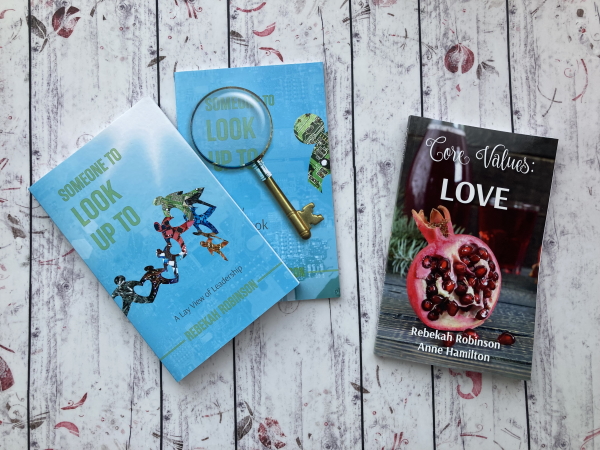
Behind the Scenes Core Values: Love by Rebekah Robinson & Anne Hamilton


Today we go 'behind the scenes' as Jeanette (Jenny) O'Hagan interviews the fabulous Rebekah Robinson, co-author of Core Values: Love with Annie Hamilton.


Jenny: Congratulations on the new release Core Values: Love. Is having a new release as exciting as it was the first time?


Rebekah: Yes, absolutely! There’s nothing like holding your new book in your hands. With your first book there’s a sort of impostor sensation – ‘Wow, I’m an author now!’ and with the second it’s more of an eyebrow-waggling, ‘Now there are TWO, and I’m a SERIOUS author now!’


Jenny: It's a joy that doesn't get old. Tell us more about Core Values: Love. What is it about, who do you think will read it, and impact do you hope it will have?


Rebekah: Core Values: Love was born out of one of those revelations that seems momentous and blindingly obvious at the same time. If the Bible talks about the fruit of the Spirit … then the fruit must come from the Spirit … which would mean that the fruit is part of His nature, the way an apple comes from an apple tree! So this volume explores what it must mean for God to be Love, and how that works itself out in His children.


I think this book will appeal to people who want to go a little deeper in their understanding of what God is like. We’ve made it lovely to look through, as well as (I hope) intriguing to read. I’m a graphic designer by trade, so I’m a big fan of diagrams and infographics, and making things beautiful as well as functional. I hope that readers will find their spirits lifting in worship to the Lord as they read.


Jenny:  Wow, that sounds awesome. I believe understanding the heart of God's love is transformative and foundational. You co-authorised this book with Annie Hamilton, a prolific award-winning author with a strong following. How did the idea of working together come about? What have been the joys and challenges of the process.


Rebekah: My mother in New Zealand recommended The Singing Silence, and when I read it I was blown away and wrote to tell Annie so. It turned out we lived on the same side of town, so we ended up meeting for coffee and becoming friends. She hired me (in my graphic design hat) to work on her books. Since they touch on similar subjects, I asked if she would be willing to chime in on mine, and she generously agreed. Annie is a joy to work with. She’s walked me through the industry and helped me look at things from completely new angles and find treasures in the Word. I’ve found it a challenge to have to ‘kill off’ the occasional ‘darling’ phrase, of course, but it’s made my writing stronger.


Jenny: It sounds like God's timing. Your first published book, Someone to Look Up To, is also a non-fiction Christian book. Can you tell us what it is about and what inspired you to write it?


Rebekah: It’s about Christian leadership, written from the point of view of a non-leader. So much leadership theory comes to us from people who are providing it, rather than those of us who are living under it. It’s a friendly and helpful look at how some of these practices and teachings impact the church, and what we might then take into consideration. Since it’s geared toward students and fans of leadership, it also has a Study Notebook for use in classes or small groups.


Jenny: An interesting and helpful perspective. Who are your favourite authors and genres to read and why?


Rebekah: I rip through novels like there’s no tomorrow, but non-fiction takes me a great deal longer, because you have to really chew it as you go. I love speculative fiction & fantasy. My favourite secular author is Lois McMaster Bujold. I adore her space opera series because the characters are so deep and round that it’s hard to believe they aren’t real people, flying around out there. And I love Stephen Lawhead’s fantasy books because the cultural worldbuilding and storytelling is so immersive. Patrick Carr’s books are absolutely brilliant. These are just three names from a huge field of talented realms people.


My favourite Christian writer is Adrian Plass. I find his books an emotional workout, from laughing hysterically to crying unashamedly. They help me un-knot myself when I’m overthinking, and get me back in touch with my Saviour’s love in a complicated world. And I’m a big fan of Michael Frost. He thinks outside the box, and challenges me to live a truer Christianity.


Jenny: Some great authors. I concur, Michael Frost is a modern day prophet as in forth-telling. And as a big spec fic fan, I also love Lawhead and have enjoy Carr's books. I'll have to check out Lois McMaster Bujold.


So far your books have been expositional non-fiction aimed at encouraging people in aspects of the faith and ministry. Have you ever felt the urge to write fiction? And if so what would genre would you explore.


Rebekah: I wrote nothing but fiction and free verse in my youth, but got distracted by songwriting for several decades. I started my first novel years ago with a strong theme but gave up when the plot didn’t come and the characters were all ME! Recently I’ve seen a gap in Christian fiction – or an unmet thirst, if you like – and I think maybe I’m being called to fill that gap myself. So, currently I have three fantasy novel outlines percolating in my head & hard drive. It’s a steep learning curve, because every writing field involves the development of niche skills. My blog and non-fiction books have all been about answering questions, and they come more easily because all you do is explore the Word with God and share your heart in a structured manner.


Jenny: Novel writing is a great deal more complicated than most people realise. I look forward to reading your fantasy fiction in due course :) The hyphenated title of the Core Values: Love suggests that this is book 1 in a series on Core Values? Am I right and if so, what other books can we expect in the future? Do you have any other book ideas bubbling away? 


Rebekah: Core Values: Love is the first volume in an 8-part series on the fruit of the Spirit as the DNA of God. So, there are seven more volumes all at various stages of completion. Originally it was going to be one book, but it became too unwieldy. There are two other books I’m percolating for the Someone series – one on marriage and one on the music ministry – and, of course, the three nascent fantasy novels, which will be very loosely linked and will take some time.


Jenny. So many great title to anticipate. Thank you, Rebekah for taking the time to share about your books and experiences. We wish you and Annie God’s blessing on your new release.


Rebekah: Thank you so much!


Rebekah Robinson loves God and people, and writes about Christian living. A missionaries’ daughter, she was born in Christchurch, New Zealand, and lives in Brisbane, Australia with her husband and two young adult children. Freelancing as a graphic designer, she enjoys singing, songwriting and worship leading, and may have a slight digital scrapbooking addiction.

Rebhekah's Website & Facebook Author Page

You can purchase her books here:

Core Values: Love

Someone to Look Up To

Some to Look Up To - Study Notebook


Monday, 21 November 2022

What's New from Omega Writers | November 2022


Ever wanted to write for the US market?

The USA is the biggest market for Christian fiction, and the home of well-known Christian publishers such as Bethany House, Tyndale, and Thomas Nelson. Carolyn Miller lead an excellent session on writing for the US market at the recent Omega Writers Conference. If you missed out, you have another opportunity, as Carolyn will be presenting an encore session of the class as a webinar.

Here are the details:

Date: 28 November 2022 Time: 7:30 to 8:30 AEST Online via Zoom
Cost: $20 for Omega members, and $30 for non-members.

Click here to reserve your space.

Carolyn Miller

Carolyn Miller is the author of over 25 traditionally and independently published novels. She shares her tops and practical considerations for authors wanting to the writing for the US Christian market.

Introducing Nicole Partridge


Omega Writers have recently published an interview with Australian journalist, speaker, literary agent, writing coach, mentor, co-author of several bestselling books, and CALEB sponsor. 

Click here to read the interview.

2023 Zoom Conference

Omega Writers are planning a one-day online conference in late 2023 (similar to the 2021 conference).

Watch this space for details!

Thursday, 10 November 2022

Writing the ‘Feels’: Creating stories that readers love—by Susan J Bruce

Photo by Eleonora Albasi on Unsplash


I recently took myself off to my mother-in-law’s small seaside shack for a writing retreat. Problem was, when I took time out of my busy life I realised how tired I was. It wasn’t just weariness from my day job. A lot has been happening in the Jeffrey/ Bruce household lately and I found it hard to push myself. I needed long walks and relaxation as well as quality writing time. 


I still got about 10K good words written, which is okay, but we always want more, don’t we?


One evening when I needed some TV downtime, I flicked through the different TV streaming services and saw that Timeless was available on 7plus


I first watched Timeless in the middle of lockdown in 2020 and I wonder if that’s why I liked it so much. Things were tough in my life then, too, and it gave light to my shade. Not only were we shut in at home, but I was in the middle of a long, difficult freelance writing job. Each evening for a couple of weeks, Marc and I would sit and watch Lucy, Wyatt and Rufus jump through time to save history and battle with conspiracies that were more than just a theory. It’s a crime the show was cancelled after two seasons and a TV movie.


Incidentally, if you like trivia, the showrunners gave Lucy and Wyatt the surnames Preston and Logan, respectively. If you’ve ever watched Bill and Ted’s Excellent Adventure, all those names, including Rufus, will be familiar to you 😀


Timeless is fun and doesn’t take itself too seriously. It gives lots of delicious fan service, with characters caught in difficult spots often calling themselves by the names of pop culture heroes, as they try and survive and bring down the bad guys and gals. 


But it takes more than in-jokes to make me like a story. As I rewatched the episodes I found myself reflecting on why I’d chosen this show. What made me want to binge it again? 


In addition to the fun, Timeless has lots of poignant moments and more than a touch of romantic adventure, which is probably my favourite genre. But still, why was I so invested?


There have been other stories…


Many years ago, before my husband and I got together, my go-to ‘comfort film’ was Sabrina—the Julia Ormond and Harrison Ford remake of the 1954 movie starring Humphrey Bogart and Audrey Hepburn.


This version never rated as highly as the original, but for some reason I loved it. I’d sit back on a rainy Sunday afternoon with a hot chocolate or a glass of wine and watch this hilarious romantic comedy play out. 


I knew the ending and I knew the characters back to front, but I still loved watching it. I’d feel with Sabrina, trapped in unrequited love, sitting up in the tree gazing from ‘outside’ at the opulent Larrabee family party lights (Sabrina’s dad was the Larrabee family chauffeur). Then I’d revel in how her ugly-duckling-to-beautiful-swan transformation led her to find real love, not the faux infatuation kind.


There have been other movies and TV shows I’ve watched again and again. Some of my faves include: The Princess Bride, Regarding Henry, and Star Wars episodes 4,5 and 6. Throw in certain episodes of Doctor Who and Star Trek, too.  


LOL! I've just realised how often Harrison Ford features in my list 😎. 


There are many, many more, but these are the stories I go to when my heart needs cheering up. I think The Princess Bride is one of the most quoted movies of all time. It’s hilarious, profound, and more than a little prophetic. 


When it comes to books, my comfort reads when I was growing up included anything by Mary Stewart (Moon Spinners, My Brother Michael, etc). I still have these books and read them occasionally, although it’s hard to find time as my current to-read list is of Mount Everest proportions. I also read and reread The Narnia Chronicles and the Outlander books.


My taste is eclectic, as you can see—and Outlander isn't PG rated, so I hesitate to mention it here—but it's a powerful story that draws me back again and again. Why?


You will have your own list of stories you read or watch on repeat. What is it about those stories that you love? 


It strikes me that if we could work out the ‘why’, we could imbibe that essence into our own writing. I’d love to write the kind of book or screenplay a reader/ viewer devours again and again. 


I recently read a book on fiction writing that asks these kinds of questions.


In  7 Figure Fiction, Theodora Taylor says there are elements at the base of the stories we love that trigger something deep inside us. Taylor calls these elements 'Universal Fantasy' or UF. 


Taylor calls UFs the ‘butter’ that gives a story flavour. The more butter you can fold into a story, the more flavour you have, and the more people will want to feast on those tales. 


She uses several fairy tales to highlight this. One of her favourites, Beauty and the Beast, has an abundance of UFs. The list is long, but here are some examples: 

  • Provincial life call. Belle is pulled from provincial life into another life full of discovery and adventure. This is a favourite of mine and I see it with Lucy in Timeless, Luke Skywalker in Star Wars, Claire in Outlander, Peter, Lucy and Edmund in The Lion, the Witch, and the Wardrobe. Provincial life call is the basis of a lot of Hero’s Journey  stories.
  • Fixer-upperer: The Beast needs transforming but only Belle’s love can make him human again. Lots of stories I like have this idea. In Timeless, Lucy transforms not just Wyatt but Flynn (a complex antagonist initially). In Sabrina, Linus Larrabee (the beast), is transformed by Sabrina’s love.
  • Servants who love to serve: In the Disney version of Beauty and the Beast, the cup and saucer delight in serving and dance around while doing so. Think R2D2 and C3PO in Star Wars movies, or Alfred in Batman.


My first thought with some of these examples was: Aren’t these just tropes? Common types of story ideas that can be overused? But Taylor is saying that the buttery goodness is the feeling behind the trope.
 

Most of us write books rather than screenplays, but that just means we have more responsibility to help readers ‘feel’ these aspects of the story. We don’t have actors, directors, video editors and music maestros to help us build the mood. 


I’ve read books with favourite tropes, but they’ve left me flat as there has been very little butter. If we can write in a way that’s rich and fresh, that brings out the story goodness, then people will want to devour our books. As with a deliciously warmed croissant, the more butter our books have, the more readers will want to devour them.


It seems to have worked for Theodora Taylor. She’s pretty successful.


Could it work for you and me?


I hope I haven’t confused you—I’ve just touched on this topic. There are many more examples in Taylor’s book and you probably need to read 7 Figure Fiction to truly understand this concept. She can explain it much better than I can. 


One caveat. Some Christians have avoided 7 Figure Fiction, because later in the book Taylor uses examples from her own secular romance books to illustrate her UFs. But I’m a big believer in taking the best ideas from ‘the world’ and throwing out what doesn’t fit with my faith.


Whether you read Taylor’s book or not, if you want to discover some excellent butter, I suggest you: 

  • Write down the stories that comfort and inspire you—the ones you read or watch again and again 
  • Pinpoint the key elements and themes that draw you and consider how the story magnifies the ‘feels’ behind these elements and themes
  • Apply this rich butter to your own writing!

And please let me know some of your favourite stories, elements and themes in the comments below. I’d love to find some new favourites.


Susan J Bruce is an author, artist and animal addict who writes mystery and suspense books—with heart. Susan is a former veterinarian and animals often run, jump, fly or crawl through her tales. Susan's writing group once challenged her to write a story without mentioning any animals—she failed! Susan currently lives in sunny South Australia with her husband and her always-present menagerie. Susan’s first novel, Running Scared, was awarded the 2018 Caleb Prize for an unpublished manuscript.
Visit Susan at www.susanjbruce.com.