Showing posts with label thriller. Show all posts

Thursday, 14 February 2019

CWD Member Interview - Mazzy Adams


Each Thursday we will be interviewing one of the members of Christian Writers Downunder – to find out a little bit more about them and their writing/editing goals.


Today’s interview: Mazzy Adams


 Question 1: Tells us three things about who you are and where you come from.

Who am I?

I’m an evolving story—with a title change along the way. I have poetry, short fiction, creative non-fiction and spiritual devotions published under my real name and as Mazzy Adams, the penname I adopted about four years ago. If you’re curious, you can read more about my evolution into a writer here and about why I chose my penname here

I’m also a word addict. I am totally hooked on those incredible lettered delicacies that pepper pages, tantalise tongues, trip through teeth, evoke a million images and emotions, flood curious minds with knowledge and wisdom and release springs of love, hope, compassion and understanding from responsive hearts. Not to mention, words can be oh so much FUN to play with! 
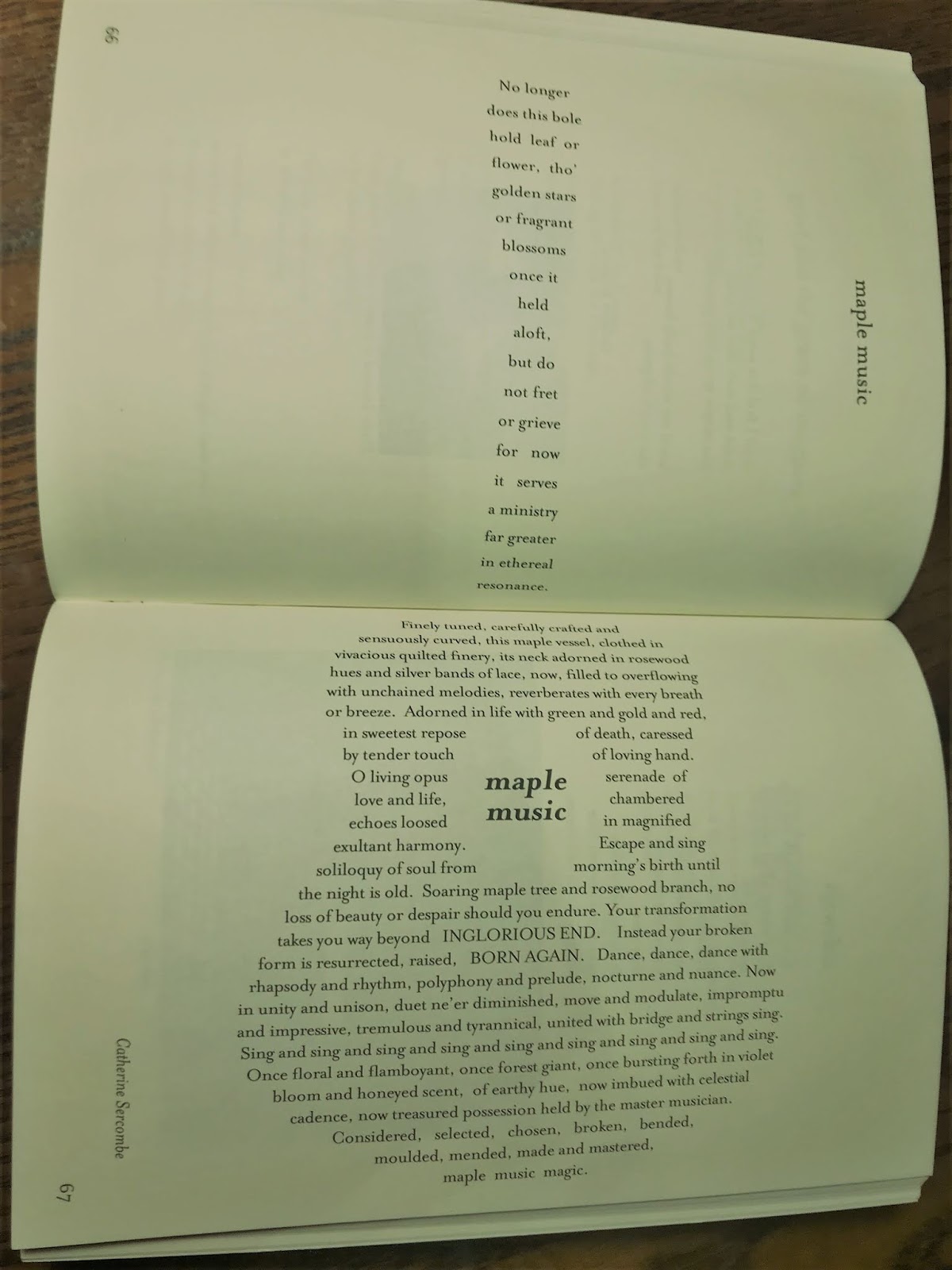

Photo above: My shape poem, Maple Music,was listed as chosen by the judge in the 2013 Poetica Christi Press Poetry competition and published in their 2014 Anthology, A Lightness of Being

Where do I come from?

I’m Queensland born and bred and, after a five year dalliance with Northern Beaches Sydney, New South Wales, my husband and I settled in Toowoomba to raise our three amazing children (I look at them and marvel). I’ve also been blessed with three wonderful grandchildren. Currently, I help my Maths/Science genius husband support my writing habit by working as a creative and academic writing tutor and manager in our Education Consultancy.

Question 2: Tell us about your writing (or editing/illustrating etc).  What do you write and why?

What do I write?

I’m a PAGE—Poet, Author, Genre non-conformist, and Encourager—or Essayist if you prefer. At times, I’m PAGES, either because I’m writing Spiritual devotions, or I’m being long-winded, at which time the E stands for Editing and the S stands for Strike that/Slash and burn/Stalking typos and grammar gremlins or Scratching my head and tearing my hair out.

I've also written a New Adult Thriller. (Throw Ludlum’s Jason Bourne into a bowl with a biblical worldview. Sprinkle with quirky acronyms and gospel allegory. Add a dash of Calvin and Hobbes’ Homicidal Psycho Jungle Cat’s philosophical humour. Bake with a fertile imagination. Enjoy.)

Despite my concerns, the suspense of writing the novel didn’t kill me so I expect I’ll survive the Indie Publishing learning curve. Then, Licence to Die will be a living, breathing, deadly intriguing debut novel available in paperback and e-book—before 2019 expires.

Why do I write?

Because I can. And because I can’t not write. The urge to collate words with intention and purpose has become both a passion and a divine commission. And it’s FUN! (Yeah, even when I’m tearing my hair out.)

Question 3: Who has read your work? Who would you like to read it?

Readers of the dozen Australian, US, International print and online anthologies in which my poetry, CNF, short fiction and devotions have been published.


Also, my compassionate, encouraging, and helpful Quirky Quills writing companions. Several Beta Readers and my Editor have read the novel as a WIP.

While my children were young, I managed to woo and entertain enthusiastic audiences with my drama sketches and puppet plays (especially during the lolly meteor showers and dust storms), but technically they were hearers and viewers, not readers.

Who are my target readers for Licence to Die (and other works-in-progress I’m percolating)?

That mysterious and wondrous group recently recognised in their own right as New Adults; 16-25ish, they’ll have conquered—or be in the process of conquering—the trials and tribulations of senior schooling, university study, earning a living, or generally nailing Introductory Adulting—or giving it a good bash. Also, Advanced Adulting students (25-106ish) who remember what it was like to be a young adult, and can cope with adulting being used as a noun and a verb, not just an adjective (You’ll be relieved to know I haven’t nouned or verbed the word ‘adulting’ in the novel).

Question 4: Tell us something about your process. What challenges do you face? What helps you the most?

Process? It usually starts with a couple of words, a line of poetry, or a sentence that intrudes upon my everyday activities or my attempts to go to sleep, and gives me no rest until I’ve written it down. Many of my published pieces (and my novel) began life as ‘quick writing exercises’ for my Creative Writing degree. I focus on the ideas that have promise and those that are downright demanding till I give in and write them, like Licence to Die. I either go with the flow, or formulate a plan which I modify, as flow and coherency directs.  

Challenges? The poet in me likes to slip ‘writerly’ masterpieces into the mouths and minds of my characters, which I then have to delete for POV authenticity. Sigh! Like so many writers, balancing the financial budget also creates challenges.

I am most helped by the assurance (and reassurance) (and re-reassurance) of the Holy Spirit that this is what he wants me to do. Frequently, he uses other Christian Writers as his mouthpiece in this regard.

Question 5: What is your favourite Writing Craft Book and why?

I found Manuscript Makeover by Elizabeth Lyon invaluable in managing and simplifying the complex structure of my novel. I also appreciate the wealth of quality wisdom and advice available online. In terms of influence, I found Janice Elsheimer’s The Creative Call helped me realise the hand of God had written ‘writer’ into my DNA long before I learned how to read his writing.


Question 6: If you were to give a shout-out to a CWD author, writer, editor or illustrator – who would they be?

Absolutely, Nola Passmore—writer, editor, Quirky Quill and my most significant influencer. Some people won’t let you down, or won’t let you let yourself down. Nola is one of these rare and precious friends.
.
Also, Iola Goulton—not only for her recent, excellent work as copy editor for my novel, and her informative blogs, newsletters and social media links to all things writing, editing, publishing and marketing, but as a significant early influencer who, along with Anusha Atukorala, sent me out from my first Christian Writers Conference believing I had writer’s stuffing inside me—and it wasn’t all fluff. (Now you’re singing, ‘Winnie the Pooh, Winnie the Pooh, funny little tubby all stuffed with fluff’, aren’t you?)

Question 7: What are your writing goals for 2019? How will you achieve them?

Indie Publish Licence to Die, acquiring new and necessary skills in the process. Start pushing up the word count for the next novel. I hope to achieve this one step and one day at a time.

Question 8: How does your faith impact and shape your writing?

I’ve been a Christian believer from my childhood. I survived life’s wild, stormy weather long enough to become a writer because Jesus Christ is my anchor. We’re tethered together in love and trust. Just as nothing can separate me from the love of God in Christ Jesus, so nothing can separate Christ in me from the words that I write. Sometimes that connection is overt and obvious. Sometimes it is as inconspicuous and deeply layered as the rock beneath the ocean’s currents.

As Galatians 2:20 says, ‘I have been crucified with Christ and I no longer live, but Christ lives in me. The life I now live in the body, I live by faith in the Son of God, who loved me and gave himself for me.’ Holy Bible, New International Version®, NIV® Copyright ©1973, 1978, 1984, 2011 by Biblica, Inc.® Used by permission. All rights reserved worldwide.

That sounds like a licence to die, don't you think? And also freedom to live (the ultimate sequel). 


Mazzy Adams is a published author of poetry, fiction and creative non-fiction. She has a passion for words, pictures and the positive potential in people.

Website: www.mazzyadams.com 
Email: maz@mazzyadams.com

Thursday, 19 January 2017

Read Outside the Box by Nola Passmore


Author:      I’ve just written a groundbreaking novel that’s bound to be a bestseller.
Publisher:  What’s so innovative about it?
Author:      There’s this teenage girl who falls in love with a vampire.
Publisher:  Um … it’s been done before.  You’ve heard of the Twilight series?
Author:      Is that a TV show?
Publisher:  It’s a series of young-adult novels that’s sold millions.
Author:      I don’t read much fiction.  Most of it's not to my taste.  But my novel is different.
Publisher:  How do you know it’s different if you’re not reading in the area?
Author:      Just take a look and you’ll see what I mean.  
                  (Author shoves manuscript under publisher’s nose).
Publisher:  Oh it’s an historical novel?
Author:      No, contemporary.
Publisher:  Then why does the teenage girl sound like someone out of an Austen novel?
Author:      I like Pride and Prejudice and I thought I’d do something similar.
Publisher:  With vampires?

I’m going to go out on a limb and assume that if you’re a writer, you ARE reading in your genre.  If you’re not, you may face the pitfalls of our hapless wannabe-novelist. 

Now I’m going to go out on a bigger limb and suggest that you should also be reading OUTSIDE your genre.  If you have eclectic tastes in literature, that won’t be a problem for you.  However, a lot of us tend to stick within the confines of our preferred style.  We only read murder mysteries or romances or Christian biographies or Amish steampunk.  It’s comfortable in our little genre box.  We know what to expect.  We don’t have to do any unwelcome stretching.  We don’t get lumbered with a book we’re not going to enjoy.  Why try the baklava when you can eat the lamington?

But what if you peeked out of your genre box and sampled a different taste?  There are at least three benefits.

It exposes you to other possibilities.  You may find another genre or sub-genre that you enjoy reading.  You may even try writing in that genre and discover you’re good at it.  I spent eight years struggling with watercolours before stepping out and doing an acrylics workshop.  I had instant success and have even sold one of my paintings.  If I’d never looked beyond by watercolour palette, I wouldn’t have discovered that I’m better suited to acrylics and mixed media.  You could make a similar discovery with your writing.

It helps you to engage with a broader readership and learn what sells.  Do you have a Christian message that you want to get out to a mainstream audience?  How are you going to do that if you don’t know what themes and styles are popular in mainstream literature?  Do you want to write a fantasy novel with universal themes?  How are you going to do that if you’ve never read a novel set in a different kind of world than your own? A popular catchphrase at the moment is ‘join the conversation’.  If you read outside your genre, you’ll be able to participate in more of those conversations. 

It can help improve your writing in your preferred genre.  Here are some of the strengths of different genres that we can apply to our own manuscripts.

  • Suspense/thriller – hooks the reader by getting straight into the action; has good pacing that keeps the story moving; ends each chapter with a page-turning sentence or phrase.
  • Romance – develops characters we care about; delves into relationships and family issues; offers hope.
  • Science fiction/fantasy – stretches the imagination and shows what’s possible; builds a world that supports and enhances the story.
  • Literary fiction – uses beautiful language; adds layers to the plot through nuance; explores deeper themes; provokes thought.
  • Historical fiction – uses background research to enhance a story; shows how to use setting to create the story world; explores the past through the eyes of the present; experiments with alternative interpretations of history.
  • Memoir – shows how to take the main character on a journey; connects with the reader emotionally; explores universal themes.
  • Creative non-fiction – shows how to make facts entertaining and accessible.
  • Poetry – reduces ideas to their essence; expertly uses language and imagery for maximum impact; allows for expression and exploration of different forms.
  • Humour – relieves stress and entertains; provides lighter moments for more serious works; can be used to critique and question systems or ideologies (e.g. through satire).
  • Children’s literature – stretches the imagination; shows how visual and textual material work together; helps us to get in touch with our own inner child; explains key concepts simply; explores values.

This list is certainly not exhaustive and many of the strengths cross over into different genres.  Can you think of others?

Set a Goal

You’re more likely to read outside of your genre if you have a specific goal.  You might identity a couple of genres or sub-genres that you would like to try and then set yourself a goal to read a certain number of books in each.  Although you might want to start with something close to your literary home, I’d encourage you to aim a little broader than that – fiction, non-fiction and poetry; contemporary and historical; realist and speculative; Christian and mainstream; bestsellers and award winners; books for adults, young adults and children.

There are also many established reading lists you can use.  For the last two years, I’ve participated in the Popsugar Reading Challenge in which you read books from different categories.  Some are specific (e.g. an espionage thriller), but most of the categories are quite broad (e.g. a book with a red spine), so you have a lot of scope in your selections. I’m part of a Facebook group that discusses books we’re reading and it’s been a great way to learn about different genres and styles. I’ve come across a few duds, but I’ve also discovered many gems I wouldn’t have read otherwise.  If you’d like to try this year’s challenge, you can find the 2017 list here.


Set Boundaries

While it’s good to read widely, it’s also wise to determine the types of books that you’re not going to include.  I don’t read erotica, but I wouldn’t necessarily rule out a book with one or two sex scenes.  It depends how they’re done and their importance to the story.  I don’t read grisly horror or books with strong occult or paranormal themes because I know they affect me negatively.  However, I’m not averse to the odd ghost, werewolf or magical twist. The list will be different for everyone, but you should still be left with dozens of genres and sub-genres that you can happily explore.

Do you read outside your genre?  Has it helped in your writing?  What pearls have you discovered?  I’ll be back later to respond to your comments, but right now I have to check out steampunk titles on Goodreads.  Will I choose Beauty and the Clockwork Beast or stick with a classic like H. G. Wells’ The Time Machine?  Perhaps I’ll read them both.


Nola Passmore is a freelance writer who has had more than 140 short pieces published, including devotionals, true stories, magazine articles, academic papers, poetry and short fiction.  She loves sharing what God has done in her life and encouraging others to do the same.  She and her husband Tim have their own freelance writing and editing business called The Write Flourish.  You can find her writing tips blog at their website:  http://www.thewriteflourish.com.au  

Monday, 26 September 2016

STAY IN BED


Ever wanted to achieve great things while doing nothing for a day? Well, I hope you took your opportunity yesterday!
If you didn’t realise, September 25th was Australia’s ‘Stay in Bed Day’—and not just for any reason. ‘Stay in Bed Day’ is an initiative to raise awareness and fundraise for mitochondrial disease (mito), which is a disease that impacts the mitochondria i.e. powerhouses of our cells. You can find out more on the Australian Mitochondrial Disease Foundation (AMDF) website.
You might be wondering why I’m telling you this. (If you’ve read my books, you’ll already know. :-) ) You see, Blaine Colton, the main protagonist of my young adult trilogy is a mito survivor. And Activate, the final novel in this series, is being released November 1 by Rhiza Press! Blaine credits his survival of this otherwise incurable genetic disorder, to revolutionary gene therapy.

Sounds great, right? But things are seldom as simple as they first appear.
Firstly, my stories are fiction. Although these technical thrillers are based on a scientific framework, extrapolating proposed approaches that could offer a potential treatment for mito sufferers, they are still extensions of reality. This means despite significant advances in the understanding of this disease in the real world, a cure for serious cases, like Blaine’s, is a) invented and b) not likely to be available anytime soon.
Secondly, just like the ethical tangles that thread through my novels, there can be as equally challenging ethical boundaries to navigate for achieving real life cures through appropriate processes that uphold the value of human life at all stages. This takes some pretty big (and long term) thinking to navigate, especially where genetic manipulations are involved, and mito is a more prevalent disease than you might expect.


‘One in 200 people may carry the genetic changes that can cause mito, with one in 5000 people suffering from a life-threatening form, making it the second most commonly diagnosed, serious genetic disease after cystic fibrosis.’ (Stay In Bed Day, 2016)
This is where ‘Stay in Bed Day’ is working hard by putting heads on pillows to raise money for further research. If you missed your chance to sleep on it (ha!) it’s never too late to donate, which we’ve done through the launches for both Integrate and Replicate. You could also get on board for next year. And don’t forget you’ll need a good book to read while you’re snoozing for the cause. There are some topical ones I can recommend. ;-)


Adele Jones is an award winning Queensland author. She writes young adult and historical novels, poems, inspirational non-fiction and fictional short works, along with juggling family responsibilities and a ‘real job’ in the field of science. Her first YA novel Integrate was awarded the 2013 CALEB Prize for unpublished manuscript. Her writing explores issues of social justice, humanity, faith, natural beauty and meaning in life’s journey, and as a speaker she seeks present a practical and encouraging message by drawing on these themes. For more visit www.adelejonesauthor.com or contact@adelejonesauthor.com