Showing posts with label Conflict. Show all posts

Thursday, 6 April 2017

To be right? Or right with God?


Image courtesy of FreeDigitalPhotos.net/Stuart Miles

By Melinda Jensen
Writers are a pedantic lot. We have to be. We spend endless hours not just crossing t's and dotting i's but also meditating on metaphors, being punctilious about punctuation, honing in on history and all manner of tedious activities in the hope of catching the elusive eye of that most pedantic of all creatures – the publisher.


The competition we face is tremendous. It's huge, totally awesome; no competition is bigger than ours - :) If we neglect our perfectionist tendencies, we simply won't be published. Our manuscript will be tossed aside faster than Donald Trump's hair in a wind gust.


And we'd better get our facts straight because somewhere, sometime, our readers will know we got it wrong, and our credibility will slink out the door with our 'tale' between its legs.


I suspect many who nurse a deep-rooted longing to write are born with this predisposition towards perfectionism. After nature has stamped us, nurture follows up with admirable efficiency. We're both blessed and doomed.


When we're wearing our writers' robes, attention to detail is very much a blessing. It's when we swap those robes for our everyday garb that our pedantry can get us into trouble. Because it's such a life-long habit, one we generally view as a virtue, we often miss the damage it can do to relationships.


Does it really matter if our non-writer friends misspell a word or get the punctuation wrong in their posts? When they've expressed an impassioned opinion, does it uplift them to be on the receiving end of criticism? Or would they feel as though we've completely missed their point, and therefore misunderstood them, by focusing on what they perceive as irrelevant detail? What does it say about us as Christians if we're perceived as 'dis'-couragers instead of 'en'-couragers? Will non-Christians assume our dogmatism in one area also translates to dogmatism in our religious beliefs? I suspect they would.


I know how I feel (embarrassed and indignant) when I share a post that has six out of seven facts correct but one is a bit dubious ... and someone simply will not let it go! I'll quite likely be aware of its imperfection before I post it, but expect my friends, especially my Christian friends, to use some discernment in looking for the message; the underlying sentiment.


Courtesy FreeDigitalPhotos.net/StuartMiles
In fact it's my own recent experience with being 'pulled up' abruptly and publicly by someone I respect that led to looking at my own culpability in this area. No matter how long and hard I tried to explain the deeper message, and implore my friend to understand that I don't have time to completely reconstruct a facebook meme copied from someone else's page, her focus remained resolutely on an unimportant detail. It gave the wrong impression, she said. I clearly didn't check my facts, she said. It was fake news, she said. You're wrong, she said! And I, of course, desperately wanted to be right.


I struggled with how to respond in the face of such unnecessary conflict and like to think I stopped short of responding like a petulant child. But my inner child was, indeed, very much wounded.


Yet, at some point in this painful process, I came to understand that my friendship was far more important than continuing to argue over who was right and who was wrong. I stepped back and perceived that my friend was suffering too. She had a deep-seated need to point out the 2% of my post that was inaccurate and no doubt believed she was doing the right thing in revealing my 'error'.

So I conceded her point, telling her I understood now exactly what she meant and appreciated the time and effort she'd put into our conversation. In truth, I understood what she meant from the beginning but was too busy defending myself to notice.


My friend might just as easily have conceded the point first but she was too wrapped up in her own quest for perfection, and the need to be 'right'. One of us had to budge, otherwise our friendship was doomed.


Shortly after, my conscience began to reveal the times I'd been the one to unnecessarily correct another person over trivial issues, and I'm ashamed to say I recalled far too many instances. With that revelation I was confronted with all the pain I'd caused. It wasn't one of my finer moments.

Courtesy FreeDigitalPhotos.net/StuartMiles


The pedantic nature of writers is utterly integral to the writing process and is therefore a gift and a blessing. But like all aspects of human nature, it has a dark side; the negative side that

damages relationships in its egocentric push to be right.


We need to discern whether it's worth risking any ensuing emotional damage; and whether or not our 'correction' really clarifies an issue in any important way.


When we wound each other with our pedantry we use our words in a way God did not intend for His children, especially those children to whom he has given the gift of expressing those very words. We can uplift each other as writers by proofreading and editing one another's work; and feed that pedantic little inner monster inside us to our hearts' content. But outside that context we need to exercise wisdom.


God's own Word is very clear about His expectations regarding the way his people use words.


If one gives an answer before he hears, it is his folly and shame. (Proverbs 18:13)

Let no corrupting talk come out of your mouths, but only such as is good for building up, as fits the occasion, that it may give grace to those who hear.' (Ephesians 4:29)


'Whoever restrains his words has knowledge, and he who has a cool spirit is a man of understanding. (Proverbs 17:27)


As writers, we have a choice to make. Do we want to be merely 'right'? Or right with God?

Melinda writes both fiction and non-fiction, along with the odd poem. She has been published on a modest number of occasions, largely short stories and poetry. She does however, harbour a keen desire to write fantasy with an environmental theme for young readers, and is currently creating two such novels. This year's major project however, is a 'how-to' for adults, written from her own experience.
Image courtesy of FreeDigitalPhotos.net/StuartMiles
 

Monday, 18 May 2015

TEMPTATION BELONGS in OUR STORIES

It hits every one of us. From Lucifer wanting to be like the Most High, to Jesus, the Son of God.

How to describe it and where does it come from?
It has many definitions like; being enticed to do something on the promise of pleasure or gain; the act of being lured to do evil.

It is age old and it is powerful.

It might come from outside, but soon settles itself within our souls if we allow it. It stirs our imaginations to such an extent we see visions of what we most desire. It can even capture the greatest saint. Sadly it plays on those who want to do the right thing. Who doesn't it bother? Those who go ahead and give in to its promises; perhaps even savouring the experience. But only for a while. Consequences always follow. Oh yes, it's a powerful emotion. Who hasn't ever felt its grip? Not I.

Our characters must face conflict in our novels. That's real life. However I believe the greatest conflict is within their very souls. Think long and hard when you were resisting temptation and wrestling against giving in to its promises. Write this into your character's lives. The three greatest temptations of life are these. Money. Sex. And Power. Understanding this will help you write a compelling story with your reader immediately identifying with your protagonist ... or even your antagonist. Write it so your reader can feel the intensity of it in their own heart.

Besides the hook, 'Everything can change in a heartbeat', I have used this theme in my novel, The Tie That Binds. I ached with understanding as I wrote of both Marcus' and Charlotte's pain. But we have a loving God who understands our frailty and gives us an amazing promise.


We have a faithful, loving God who will not let us

be tempted more than we can bear. For when we are tempted and find it hard to resist, He always provides a way of escape for us, so that we can withstand it.
I Corinthians 10: 13


As believers it's a great privilege to share our hope with our readers. Not by giving them the uncomfortable impression we are preaching, but through the struggles of our characters. Jesus 's parables are wonderful examples.

Rita Stella Press is now Indy!

Her passion is historical romances, revealing her characters' struggles. Two have been published.
Signed Sealed Delivered is Book I of a trilogy.

Rita's novel, The Tie That Binds, Book II, is also
a stand-alone story.

Now at the printers, it should be available in the next week or so.


For those interested in pre-ordering in Australia, she will send the book postage free.
She can be contacted at:  ritagal at optusnet dot com dot au

Weekly blog: www.inspirationalromance.blogspot.com  Facebook and Twitter #RitaSGalieh

Friday, 25 May 2012

Playing God and the Devil’s Advocate


I’m odd. My favourite book of the Bible is Job. I think the main reason is the wonderful theology that a foolhardy exegete such as I can eke out of it. However, the book is also a great example of how writers should treat—or rather mistreat—their protagonists.

Job’s normal existence is portrayed as idyllic: gifts from God abound, and Job doesn’t have a care in the world. But that doesn’t last, of course. What a boring read the book would be if it did! Unbeknown to Job, Satan gains permission from God to mete out a progression of blows on the man. Initially, Job’s possessions are taken away and his children die. Then, to kick him while he’s down, Satan inflicts a painful disease on him.

The final problem to befall Job is a lack of understanding from his friends (well-meaning though they be).

These troubles give rise to the conflicts that comprise the bulk of the book. The main conflict is internal: since Job wasn’t privy to the scenes in which Satan communicates with God, he attributes his afflictions to God and this causes him to question his faith. The external conflict involves Job defending himself and his beliefs against the questionable logic of those around him.

As writers, I think we all know what it’s like to play God in the stories we create. We fashion the characters and settings. We shape how events unfold and direct the final outcome.

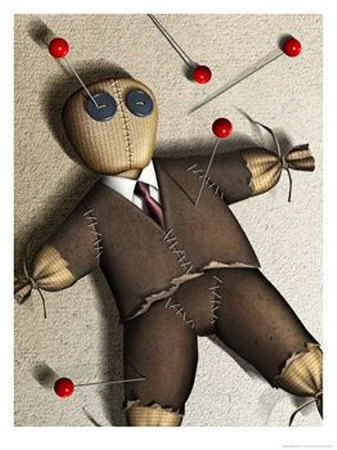
But the bit that interests me is that we should also play Satan. In the same way that Satan seeks and obtains permission from God to inflict travails on Job, we must grant ourselves permission to inflict travails on our beloved protagonists—and preferably several layers of them. If I may be permitted to refer to mystical arts in a Christian blog, it’s like sticking pins into a voodoo doll.

I’ll confess that I derive a perverse sense of satisfaction from inflicting challenges on my protagonists. Perhaps I should be worried about this! Hopefully it’s only because I’m curious to see how they’ll respond.

As writers, it would be a problem for us if we get so attached to our stories’ heroes and heroines that we become unwilling to load them down with obstacles. Without problems, there can be no conflict; with no conflict, there can be no drama, no plot and no story. A hero with no challenges can’t show how heroic he is (and presumably a heroine couldn’t show how heroinic she is).

So next time you’re playing God, don’t forget that you’re also the devil’s advocate.


Peter McLennan writes YA novels. His first novel has just been published on Amazon and Smashwords.

Wednesday, 16 November 2011

Don't you hate conflict?


No one likes conflict, except, of course when it’s in a novel. Then those very things that make our stomach churn or head ache, can draw us in and take us to another world.

As we know each story should have Goal, Motivation and Conflict.

In its simplest forms, conflict is whatever stops our characters from achieving their goals. It doesn’t matter if it’s people, emotional issues, events or things, as long as it stops them from attaining that goal – then it’s a conflict.

In my story, I am Slayer, my heroine saves the lives of Christians. This is her goal. Her motivation? This is a calling, given to generations of her family, by God. The conflict comes from demons in the shape of vampires, and other evil creatures, which try and stop her.

Sounds easy doesn’t it? Well, to a certain extent it is. I’ve just outlined the book’s premise and shown you external, or physical, conflict.

Here’s the more difficult part. In order for Anastasia to become real to my readers, she needs to have internal, or emotional, conflict.

So what could internal, or emotional, conflict be? 

It needs to be something which can be sustained throughout the book. It also has to be something that comes from within the character. 

In my opening chapter, Anastasia searches for a group of Christians hiding in a bunker. She has to get there, and get them back to sanctuary before The Others find them. An external conflict arises, an argument, and they don’t escape in time. In the ensuing battle, she loses one of her charges, a little boy. He’s dragged off to parts unknown by The Others. Anastasia is devastated. Her confidence has taken a battering, and she is now scared to get close to anyone else. She doubts her ability to fulfil her calling. And this affects her decisions for the rest of the book.

Some may think that the internal conflict would be the argument Anastasia had, but it's not. Anything that could be solved with a few well-placed words, doesn't come under that category.

Internal conflicts come from our emotions; so feelings of abandonment, deep distrust of authority figures, a desperate need to fit in; these perceptions shape us and make us who we are. It’s the same with our characters.

Don’t be afraid to dig deep and find out what really makes your characters tick. What the driving force behind their behaviour is. That way you’ll not only make them more believable, you’ll add a depth to your characters that your readers will love.

Here’s an excerpt from I Am Slayer.

Donatella Sabatini was Lucien’s personal handmaid. She had delusional thoughts that Lucien loved her and would protect her from anything. Stupid girl. She irritated me on more than one level.

 ‘Still a servant, Donatella?’ I shook my head, knowing it would annoy her. ‘I have a pair of boots that need cleaning if you’re not busy.’

A low, ugly sound ripped from her throat. She advanced toward me but Lucien held up his hand for her to stop. Like him, she was dressed in ‘ye olde London style.’ 

On anyone else her dress might have been romantic, but the red and black bustier, full skirt and white puffy sleeves reminded me of a black widow spider.  

How apropos. 

‘Now, now, Anastasia,’ said Lucien. ‘Don’t be like that. You have something I want.’ He took two steps forward and plucked at the fingers of a white glove. ‘And I…’ He grinned and my blood chilled. ‘…have something you want. Perhaps we can trade?’

He snapped his fingers again, and the men behind him parted. 

A guard came forward; his bulging arms gripped a struggling figure. My heart plummeted, bile burned my throat, and I swallowed hard. The scene began to fade, and I struggled to clear my head. 

This couldn’t be happening. I kept my gaze neutral, uninterested, even as a silent scream echoed through my mind.

Billy.


Lee Franklin lives on a small property in Western Australia, along with her husband, son, dogs and cows. She loves all things girly, suspense, pink (the colour not the singer), cold grey skies and the smell of rain.