Monday, 3 May 2021

Do you finish every book you read?


There are excellent cases for both sides of this question. I was conditioned not to read every word during my English degree at Uni when we were given way more books in the syllabus than we could possibly read. It became impossible to cram in one per week, when we were talking about novels the size of Little Dorrit, Bleak House or Middlemarch. The staff admittedly knew we'd focus on our essay topics and skim through the rest, and they instructed us to cherry pick. But was it a good habit they were encouraging students to take on board? Here are some pros and cons for both sides.


I Finish Every Book

These are people who grit their teeth and plow through no matter what. They believe being faithful in small commitments makes them more likely to be faithful in larger ones. 

One friend of mine says that she can't count the numbers of times she was bored at the beginning of a novel and wowed by the end. Sticking to a book, in her opinion, is its own reward. She makes a valid point. I can think of numerous times I've loaned books to people who I'm sure would have greatly loved them if they'd only persevered. Instead, they ditched the attempt after a few chapters because it didn't hold their interest. I've no doubt I've done the same, although I may never know. 

J.R.R. Tolkien wrote, 'I've only abandoned three books that I can remember, preferring to soldier on through unmemorable chapters than to let an unfinished plot clutter my thoughts.' He'd probably claim to be aghast by the superficial skimming era we find ourselves in, and perhaps he'd have a point. Nicholas Carr, the author of the book entitled 'Shallows' would surely agree with him. What can be more shallow than making snap judgments about any given book based on first impressions?

I Don't Bother Finishing Every Book

These people may be aware of statistics. Google says there are nearly 130 million books in circulation in the world, and 4500 are published in the USA alone, daily. A person who commits to completing 50 books in a Goodreads challenge each year, would have to read for a century to tap into 0.00004% of them.

As the years are short and fly by so fast, and there are many books we'd enjoy far more just waiting to be discovered, what is the point of slogging on with a book which isn't engaging us? Not every story is to everyone's taste. Doggedly persevering simply wastes the precious time we could be spending on books which could be a far better fit.

Librarian and author Nancy Pearl addresses this in her book entitled, 'Book Lust.' She suggests her 'Rule of Fifty.' If you're 50 years old or younger, why not commit to reading the first 50 pages before deciding whether to read on or give up? If you're over 50, she recommends subtracting your age from 100, and that's the number of determining pages you should read. 

My Point of View

I admit I've reached a certain age which makes me more inclined to side with the non-finishers. I believe in giving books a fair, fifty page, or even 100 page trial, but by then, I've probably developed a fair idea of whether I should keep going. Over the years I've stuck to books I've been forced to study or have committed to review for blogging programs or authors. This has been enough to show me that the first third of any given book is usually a sound indicator of whether or not I'll enjoy the whole.

If it's a novel, and the characters are flat and the plot creeps along like a tortoise, it probably won't get much better. I've read many of books in my lifetime, and generally find that if I'm going to like them, I'll be engaged right from the start ninety percent of the time.

Did you ever complain about having to read books you hated at school, just so you could churn out painstaking essays about them? Some of these school novels left us with bad after-tastes about perfectly good authors for years. Well, the good news is that in most cases, nobody is forcing us stick with unpalatable books any more. I like to encourage readers to appreciate and utilise the freedom of no longer being in school.

If you need somebody to give you permission to quit a book you're finding tedious, maybe I can be that person. Although books may feel like people, it helps to remember they are only books, and won't get offended (although the person who wrote or recommended it might). But in general, leaving a library book unfinished is not as hard as breaking up with somebody you're dating. If you're procrastinating rather than hugely anticipating your next spare moment when you can pick up the book, it might be wiser to drop it. If you don't daydream about it and sense it calling you back at every opportunity, then it probably doesn't matter if you don't finish it.

I don't share Tolkien's experience of unfinished plots cluttering my thoughts. If I'm finding books to be a drag and put them aside, they're more likely to burst like bubbles and disappear from my thoughts. Especially when a better fit comes along.

So take it back to the library, donate it to a Goodwill shop, delete it from your kindle and get on with something good.

Now, I'm aware that this is just me, and perhaps my current DNF exhilaration is the result of many years of having to read books I didn't enjoy. I'd be very interested to know where you stand on the subject. 


Paula Vince is an award-winner author of Australian Christian fiction. She has been a student and homeschooling parent and is always an avid reader. She lives in Adelaide's lovely coastal suburbs, a beautiful place for inspiration.  

Thursday, 29 April 2021

Balance.

by Mazzy Adams.

Having exhausted and discarded several ideas to blog about over recent weeks, and having left it to the last minute to actually pray about a potential subject for today's blog post, I woke about 4:00am yesterday with a single word on my mind. 

~ BALANCE ~


(Image by JackieLou DL from Pixabay)


To be fair, I had no clue how I should expand on this word or topic but, as I reached for my trusty bedside notebook to write it down, a little ditty came to mind—one I’d composed years ago to help my (then) primary school-aged daughter remember a definition for a science exam.

🎶Balance is the process of achieving stability by attempting to equalise the forces that act upon or influence a system.🎶 

Having since studied poetry, I now recognise how the natural rhythms arising from those words and their order created an inherent lyrical quality. Twenty-odd years later, both my daughter and I remember the definition and the melody. But, apart from patting myself on the back and thanking God that I’d remembered the definition, even as I wrote this, I had no clue what came next. It seemed, for the purpose of this blog, I’d joined the annals of the Pantser Brigade—that is, I was writing by the seat of my pants whilst balancing on a flexible moving platform.

(Image by steven arnold from Pixabay)

Now, while going unprepared into an exam is generally a bad idea—hence the creation of the aforementioned ditty—there is a place for spontaneity in writing. Those who regularly journal testify to its therapeutic qualities. When the forces that act upon or influence our systems become overwhelming, sometimes you just gotta toss those racing, warring, wrestling, confusing, unmanageable thoughts outta your brain and onto a page to achieve stability.

Some of my favourite poems have emerged from frazzled attempts to restore my mental equilibrium this way. This one, penned while trying to wrap my head around a tertiary ethics and logic subject, was published in Tales from the Upper Room, 2014.

On the Ethics and Logic of Writing

It’s wrong to write about writing when righting a wrong
is the right kind of writing to write,
But righting a wrong is the right kind of writing to write
when your writing is righting a wrong!
Whether righting a wrong or writing to write
it is right to be writing or righting, alright?
So I’ll write to right wrongs and I’ll write to write right
because writing and righting’s been right all along.
Is that alright? 


(Image by Beverly Buckley from Pixabay) 

As I said to my lecturer at the time, the bees buzzing around my brain had cross-pollinated my subjects. To which comment he graciously replied, ‘I wish I had some of those bees.’ At the time, balancing my need to write an intelligible essay response for an assignment by taking a little time out for creative fun reestablished the equilibrium I needed to achieve desirable results in both. 


(Image by Mazzy Adams)

When one has placed writing—or any other task for that matter—on the scales of personal responsibility, a certain weightiness attaches itself to the task. Like a tightrope walker negotiating a chasm, the gap between handling the task, and being overwhelmed by it can leave us teetering precariously on the brink of a tumble. When life brings unexpected events, responsibilities, or burdens our way—imagine a flock of birds randomly choosing to settle on one side of a tightrope walker’s balancing pole—our best efforts to ‘equalise the forces’ may fail catastrophically.

In my strategic plan for this year, I’d hoped to publish my novel on the 12th of February. After all, for an Aussie author, on paper it looked like a perfectly balanced release date:

12022021

Neither my best intentions, nor my attempts to equalise the forces acting upon or influencing my system came close to achieving the desired result, let alone stability. My initial response was to stress over my failure to achieve according to my plan which, of course, acted like a lead weight dragging me further down into an unproductive cycle. While I can be a positive force for good, I can also allow negativity to gain the upper hand.

But here’s the thing: As a Christian believer who chooses to write in obedience to God’s call, I’m not the only force at work in this equation. At the Holy Spirit’s gentle prompting, I sensed God had other priorities, and processes, and writing tasks, in mind for me over the last few months and, as I’ve attended to them first, I’ve enjoyed the responsive and strengthening input of other believers into my life and I’ve found peace and stability returning to my days and ways.

More than that, I’ve discovered a powerful truth afresh, that God’s strength truly is made perfect in my weakness. He is the ultimate Force who acts upon and influences every system for the good of those who love him and are called according to his purpose, which is to bring everyone who chooses to come, into his family. It is that goal which motivates my efforts to write and publish.

There are certainly forces working to destabilise us—I recently read a timely warning about the dangers of doomscrolling, that is, falling into the trap of scrolling through one bad news report after another under the guise of staying informed. With so many conflicted and destabilising messages poised to weigh us down to the ground, now more than ever we need to seek and write and publish positive messages to counterbalance the doom and gloom. 

(Image by Free-Photos from Pixabay) 

Considering the whole universe pushes and pulls according to laws of physics that God established, it stands to reason that inviting Him to weigh in on our daily activities will go a long way towards creating balance, equilibrium, harmony, and progress in our lives.

What ideas and habits have you discovered that create a place of balance and stability which promotes your creativity and productivity?


Mazzy Adams is a published author of poetry, fiction, and creative non-fiction. She has a passion for words, pictures, and the positive potential in people. 

Website: www.mazzyadams.com

Email: maz@mazzyadams.com

Monday, 26 April 2021

Building Worlds

by Jeanette O'Hagan


In Maps of Fictional Worlds, Austin Kleon says ‘every tale has a setting, every tale creates a world in the reader’s mind.’


All Writers World Build - At Least a Little


Setting and world building is particularly important for fantasy and science fiction writers and other speculative fiction genres. That doesn't mean it's not important for historical novels or even memoir and biography, where the writer recreates an authentic version of the past. Or in detective and mystery novels were the setting adds to the tone and can almost be another protagonist. Even contemporary novels are a mix of the real and the invented, if perhaps on a smaller scale - a neighbourhood or house rather than a universe or planet. 

Most of my stories are set in another world - Nardva - though recently I spent far too much time working on an alternative history scenario set in Africa for a short story.  

Neil Gaiman said ‘Fiction can show you a different world. It can take you somewhere you've never been.’ And sometimes it can show you the place you have lived your whole life with different eyes.


Just as contemporary fiction often needs to invent elements of their fictional world, so too even the most fantastical world draws inspiration from our world. And in that sense, writers walk in the steps of our own Creator who spoke the world into being. 


How do we build worlds?

World Building Principles

Describe not only what the world looks like – but its sounds, textures, smells, tastes, the ambiance, cadences and rhythms. Describe the big features but don’t forget the little things, the everyday things – what people eat, the little rituals and gestures, the graininess of the world.

Beware of dumping huge slabs of description and information (info dumps). Interweave or drip feed world building, the setting and necessary information through the characters' dialogue and their interactions with the world. 

Don’t allow the worldbuilding or setting to overwhelm the plot or the characters. Beware straying off on tangents (things that fascinate the writer - like the sewers of Paris for Victor Hugo in Les Misérables - but don't carry the plot forward. Show the world from the characters' perspective. 

Use telling details - small, succinct references that identify the time, place and purpose. And as Charlie Jane Anders indicates a small descriptive element (Heinlein's ‘the door dilated’) can convey a wealth of knowledge. 


A fictional world should be consistent and coherent – even in a magical world, the magic has rules which the author establishes and must follow. Any exceptions need to be foreshadowed well before they are pulled out of the hat to save the day.

Think beyond the surface to how the world works – what infrastructure and economies support its societies, who does what, what motivates its characters, what are its conflicts and power struggles?

The world is complex, dynamic and interactive. History, geography, ecology, and cultures all interact. Societies are rarely monolithic and are usually in flux. Altering one thing can have significant effects with ongoing ramifications – as our own histories show with say, the introduction of prickly pear in Queensland in mid 18th century, the potato famine in Ireland, or the effect on cultures and commerce of something seemingly so mundane as sugar, tea or coffee.

Remember to research. In historical fiction, one researches the manners, technology, geography and historical events of period of the novel. In contemporary fiction, one might research the place, laws, contemporary events etc. For mystery, maybe police procedures, the legal system, weapons or stages of death. For science fiction, it might be physics, space or the possibilities of technology. 


Research is still important for fantasy - for my books I’ve researched geographical land forms, weather and climate, how far and fast people and horses can travel, the phases of the moon (there are two in Nardva), sailing craft, fighting techniques, architecture, marriage costumes, poisons, underground caverns, and whatever else my various characters and world needs at the time.

Make maps, draw buildings, make notes, keep journals, collect images, facts, artefacts, mine history and other cultures for ideas, ask questions and daydream to your heart’s content. I've used Minecraft to 3D model the Golden Palace in the Akrad's  Legacy series and the Caverns for the Under the Mountain series.  One resource I'm exploring at the moment is World Anvil - a great way to have all the elements of the world in one place.

Remember to avoid stereotypes and clichés,


Don’t forget to have fun.

Where to Start?

Are you a Planner, a Pantser or Tweener?

Some writers spend days, weeks, years determining every planning very detail of their world before writing the first word of their story (a top down approach).  J.R.R Tolkien started by inventing whole languages and took years to write his work. The advantage of this approach is a consistent, rich and rounded world that can feel as real as our own. The disadvantage is that sometimes the world builder never actually writes the story. Or the characters may take second place to the world concept.


Others plunge into the narrative with the details emerging from the story telling (a bottom up approach). The advantage of this approach is that the story gets written and characters are developed. The disadvantage, is that when rules and properties of the world are created on the fly, inconsistences can creep in and cause all sorts of bother. 

Then there's the tweener (in between) approach perhaps establishing some big picture elements at the beginning and then painting in the smaller details as one writes. Or maybe a spiral with drafting some key elements, then with more detail emerging while writing, going back and expanding the world which then inspires more stories. 

Go build!


Fictional worlds, even fantasy ones, are reflections and refractions of our own world. They help us escape for a time into another place, they help us see our own world through other eyes, but they also help us explore the meaning and contingencies of our own lives and selves.


What are your favourite fictional worlds? 

What challenges and joys have you experienced in creating and researching your world or setting?

Images and artwork by Jeanette O'Hagan (All rights reserved)


Jeanette O'Hagan has spun tales in the world of Nardva from the age of eight. She enjoys writing fantasy, sci-fi, poetry, and editing. 


Her Nardvan stories span continents, millennia and cultures. Some involve shapeshifters and magic. Others include space stations and cyborgs. 


She has published over forty stories and poems, including the Under the Mountain Series (5 books), Ruhanna's Flight and Other Stories, Akrad's Children and Rasel's Song (now available on pre-order). 

Jeanette lives in Brisbane with her husband and children.


Sign up to the Jeanette O'Hagan Writes 

and receive a free short story. 


Thursday, 22 April 2021

Behind the Scenes: Down by the Water by Jo-Anne Berthelsen


Today we go 'behind the scenes' as Jeanette (Jenny) O'Hagan interviews Jo-Anne Berthelsen.


Jenny: Congratulations on your new release. What inspired you to write Down by the Water?

Jo-Anne: I often wonder what my maternal grandparents would think about being a large part of the inspiration behind my latest novel, if they were still alive! Down by the Water is set in the early 1900s in various places in south-east Queensland where my grandparents lived. It follows the journey of Meg Porter, whose plans to study art are cut short when a family tragedy occurs. 

I kept my grandparents’ photo in view on my desk to inspire me as I wrote this novel, but it was my own memories of them—their personalities, mannerisms and even the sound of their voices—and also the things my mother and they told me about their lives that helped me shape Meg’s story and add more colour, depth and authenticity to the novel.

But beyond that, I had what I hope was a God-inspired, deep desire to write a novel that would highlight some key themes I believe are so important for us all such as experiencing God’s love and grace, giving and receiving forgiveness, dealing with guilt, coping with grief and using our God-given gifts to build others up. I wanted to highlight too how God calls us and draws us closer in different ways, according to our own unique personalities and temperaments. The more creative, artistic people may come to faith in God in an entirely different way from the more rational and intellectual among us, but their experience of God is real and valid too.


Jenny: It sounds like a treasure trove of family history-inspired story telling and spiritual insight. Fill us in more about the book. Does it fit in with your previous fiction titles or is it stand alone?

Jo-Anne: Down by the Water is a stand-alone novel, although it may end up with another to stand with or alongside it eventually—we’ll see! After I wrote my first novel, Heléna, back in 2004, I vowed and declared I would never write another historical novel because it adds another whole layer of complexity to the writing journey, with so many facts needing to be researched and verified. But then the idea for Down by the Water began to emerge—and soon I was hooked. As it turned out, I loved delving more into the history of Brisbane in particular, where I myself grew up, and also that of towns such as Helidon, Rosewood and Harrisville, where my grandparents lived.


Jenny: Having adopted the city as home since my Uni days, I love books and shows set in Brisbane. Something to look forward to :) What do you enjoy most about writing fiction?

I love the freedom of being able to create my own story and my own little world, so to speak, bringing my characters to life and giving them a voice. So often as I write a novel, I sense God right there beside me, almost whispering in my ear and enabling me to listen to where the story seems to want to go. And that can be such a fulfilling, rewarding experience.

Also, while I love writing non-fiction, I have found I can get away with sharing concepts or challenges in novels that could well be harder for people to consider or accept in a non-fiction work. For example, as one of my characters grapples with forgiving someone, I can show what forgiveness involves and how it can impact our lives so much, hopefully without sounding too ‘preachy’, rather than merely explain about forgiveness to my readers. And that gives me great joy.


Jesus’ own words about why he used parables—or stories—when he taught encourage me too in this regard:

The disciples came and asked, “Why do you tell stories?”

He replied, “You’ve been given insight into God’s kingdom. You know how it works. Not everybody has this gift, this insight; it hasn’t been given to them. Whenever someone has a ready heart for this, the insights and understandings flow freely. But if there is no readiness, any trace of receptivity soon disappears. That’s why I tell stories; to create readiness, to nudge the people toward receptive insight. In their present state they can stare till doomsday and not see it, listen till they’re blue in the face and not get it. Matthew 13:10-13 (The Message)


Jenny: You have written some memoir/non-fiction books. What motivated you to write Soul Friend and Becoming Me?

Jo-Anne: I loved writing Soul Friend because I wanted to inspire others not only to seek out someone to be their spiritual friend or mentor but also to encourage them to be a spiritual friend to someone else. Soul Friend is a personal and quite intimate account of my own journey with my lovely, wise soul friend Joy and the warm, life-giving relationship that developed between us during our fifteen years of meeting together. I wanted to share my struggles with self-doubt and the challenges I faced in this period of my life openly from the heart, so readers could identify with my journey and see the value of having someone help them deal with such issues. I used to call Joy my lifesaver often. Above all, she truly believed in me and encouraged me to become all God had called me to be as a woman in ministry, then as a writer—and this helped me so much.

Then a few years after writing Soul Friend, I sensed God prompting me to write another memoir that would look at my whole life rather than only part of it—and eventually Becoming Me: Finding my true self in God was published. I chose the image of the Russian dolls for the cover to convey how God can gradually remove those things in our lives that restrict us, until we are free to become more of the person God created us to be. And I decided to include questions at the end of each chapter to encourage readers to undertake their own journey of allowing God to remove these layers, as they too experience God’s deep love and grace and wonderful acceptance.


Jenny: You've touched a bit on this already, but how does writing fiction differ from writing non-fiction?

For me, writing fiction is a lot harder and more time-consuming than writing non-fiction, for a start! I think both my non-fiction books took around eight months to complete the first draft, whereas each of my novels has taken at least a year and often much longer, as in the case of Down by the Water, which took around four years.


I remember once how relieved I felt when switching from writing a novel to a non-fiction book. Now I could simply state the truth and get straight to the point. Now I did not have to think about how to build my story or how to develop my characters or how to keep that tension going until the last page. Yet in writing memoir, such things still need to be taken into account to some degree at least. But I cannot let my mind roam free and invent facts about my life or someone is bound to let me know! And I cannot invent anything about my inner journey with God either, as I am accountable to God, I believe, to write with integrity. And the same applies when I write my weekly blogs (see www.joanneberthelsen.wordpress.com).

In writing fiction, in a sense everything I write still has to be ‘true’, in that it needs to present God and those deep spiritual themes I love including in my novels to my readers as best and as truthfully as I can. Yet now I can let my imagination soar. Now I can allow my characters to grapple with these truths in all sorts of ways. Now I can weave a story that will hopefully draw my reader in so that they not only enjoy the story for itself but also are gently drawn closer to God in the process.

So much more I could say here—but perhaps that should be my next book?!


Jenny:  That sounds like a great subject for your next book. :) Do you have any plans for further books? If so, what are they?

Currently, I am considering exploring the journey of one of the other characters in Down by the Water, rather than writing a sequel that continues Meg’s story, which was my original plan. But more and more, I am thinking what fun it might be to write something quite different—perhaps a novel set in a retirement village far, far away from the one in which we live?! Alternately, I have been thinking of reworking some of the over six hundred blogs I have written and shaping them into some sort of themed collection of devotionals. So many possibilities!

 Jenny: Indeed! And some great possibilities for future books. Thanks you, Jo-Anne, for taking the time to share about your books and experiences.


Jo-Anne Berthelsen is a Sydney-based author of seven published novels and two non-fiction works, Soul Friend and Becoming Me. She holds degrees in Arts and Theology and has worked in teaching, editing and local church ministry. Jo-Anne loves encouraging others through both the written and spoken word and is a keen blogger.

www.jo-anneberthelsen.com

www.joanneberthelsen.wordpress.com


Monday, 19 April 2021

The CALEB Awards | Christian Authors Lifting Each other's Books


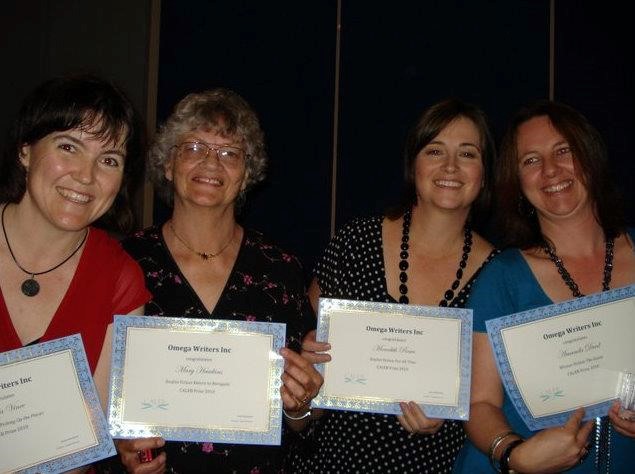
2010 CALEB finalists

Today's post is from Meredith Resce, Author and Publisher, and member of the Omega Writers Management Committee.

Back in 2010, I entered the CALEB awards for the first time. I even flew to Queensland for the gala dinner that, at that time, was a completely separate event to the Omega Conference. I was a finalist in the fiction category along with my good writing friends, Paula Vince, Amanda Deed and Mary Hawkins.

It was great to be with other writers celebrating writing achievements. That year, Amanda Deed won the award with her debut novel ‘The Game’.

From that time to this, CALEB has grown through some learning times, and some times when we didn’t know if the award would continue. But there has always been a handful of people who believe in the concept: Christian Authors Lifting up Each other’s Books.


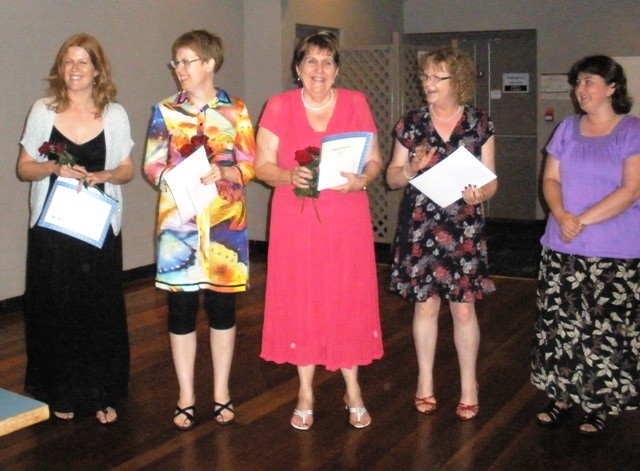
2011 CALEB Finalists

The Omega Writers’ Management Committee strongly believe in the concept of encouragement and celebration. It is true you might win money with other competitions. It is also true that other competitions have a greater reach. But the central concept of CALEB awards is that we recognise other Australasian Christian authors, and celebrate achievements.

We have traditionally featured many Christian fiction works, which is a category that doesn’t receive much recognition in other Australian Christian writing awards. There are many fine Christian fiction authors in our networks.

There has also been a plethora of Children’s picture books published and celebrated in CALEB. These books have been a credit to the small publishing groups that work hard to produce and market these works.

Young adult fiction has been an emerging group in Australasian Christian writing, and I personally have noted the quality of books that have come through in this category. I’m looking forward to reading more.

Non-fiction has also been a feature in our awards, some fine biographies, memoirs, devotionals and inspirational works.

If you have a work published in 2019 or 2020 I encourage you to enter it into our CALEB awards. Your entry not only encourages you, it encourages us. It is a testament to Australian and New Zealand authors at work. We see you. We appreciate you. We celebrate your work.

I look forward to seeing your work soon.

Oh, and by the way, we do have a prize to the value of $400 for each category.

Entries for this years’ CALEB awards have been extended, and now close on 30 April 30 2021.

Click here to find out more and enter.

Thursday, 15 April 2021

Blitzing Blurbs

 by Jeanette O'Hagan


Blurbs, book descriptions, pitches - the art of summarising our carefully crafted novel with all its intricacies, amazing characters and subplots into a few hundred words or less. Easy? Right? Right!

There is a reason authors hate blurbs. It's like squeezing a unicorn into a matchbox. Impossible.

But, here's the thing. Authors need to learn how to write them - whether it's adding a book description on the back cover or the selling page of our ebooks or as a pitch to publishers and agents.  


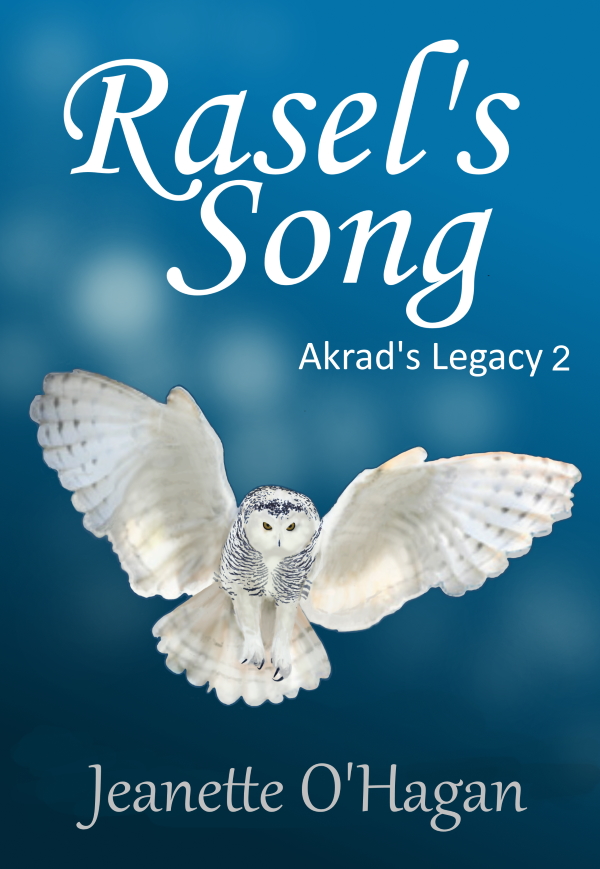
Having written, edited, rewritten and reedited Rasel's Song, the second book in the Akrad's Legacy series, revealed the cover and set up the pre-order - I really need to get my book description nailed down. Not an easy task for the books in my novella series, but even less so for an epic fantasy novel with an intricate plot, an army of characters and four main point-of-view characters. 

I'm also currently taking Bryan Cohen's ad course, getting ready to go to Supernova this weekend with Rendered Realms and part of the committee putting together the details of the Omega Writers Book Fair (Brisbane) on 31 July (more about in a later post). 

Here's my first attempt:

Rasel of the Forest Folk is intrigued by the warrior Tamrin and their dashing young prince, Mannok, despite the tragic and deadly events of the past.
Pressure is mounting for Prince Mannok to marry for the sake of the realm, but following the banishment of his half-sister Ista, he is in no hurry to comply. That is, until he meets a mysterious stranger.
Meanwhile, Dinnis finds the would-be assassins of the Kapok dead in their prison cells, hours after the young men intimate that someone else was behind the plot to destabilise the throne. 
Will Rasel's curiosity spark new possibilities of peace between two opposing peoples or result in further tragedy? Will Prince's Mannok's choices bring stability or chaos to Tamra. Will Dinnis be able to uncover the mastermind behind the assassination attempts before someone else dies?


Hmm ... well, I asked the Omega Writers Sci-Fi and Fantasy group for some feedback and they made some great suggestions, putting more tension and higher stakes at the beginning, adding a tagline, maybe reading Bryan Cohen's How to Write a Sizzling Synopsis. 

And if fact, I had already fired up my kindle to read that exact same book. Byran makes some great points and makes the process seem easy.  Here are some of take-home messages I discovered. 


1. The purpose of a blurb (Bryan calls it a synopsis), is NOT to summarise the plot. It is to entice the reader to buy the book (or the publisher to ask for the full manuscript). This means it needs to be streamlined and easy to understand. In other words, leave out convoluted detail, explanations or subplots. Don't mention too many characters. Be succinct as possible. 

2. The way to engage the reader is to tap into the characters emotions and motivations. What does the main character (or characters) want? What is in the way of their achieving this? What stakes are involved? 

3.  Every sentence should count. The very first sentence should hook the reader's interest. Each sentence should flow into the next. The stakes should ramp up. And end with a bang - on a cliff-hanger. 

Bryan gives some other pointers about making each word count and also some formulas to follow. His book is definitely worth reading. 


Of course, theory is one thing. Putting it into practice is another. 

To be honest, I'm still working on what to include and what to leave out, but here's my latest attempt (hopefully an improvement):. 


A rebellious prince, a mysterious stranger, a realm in turmoil. 


Prince Mannok fumes at his royal parents for exiling his half-sister. He rejects all their suggestions of a suitable bride, even though he knows securing the succession is vital to the stability of Tamra.

Rasel is a young shapeshifter inpatient with the warnings of her elders about the warrior Tamrin and their past betrayals. She longs to restore peace between them so her Kin no longer need to live in the shadows.

When would-be assassins are discovered poisoned in the palace cells, Prince Mannok and his friends face increasing danger. Rasel’s arrival in Tarka causes further turmoil, misunderstandings and peril.

Will Mannok and Rasel bring peace or more conflict to Tamra? Will the elusive assassin be unmasked before someone else dies and the realm put in jeopardy?
Rasel’s Song is the exciting second book in the kingdom fantasy, the Akrad’s Legacy series.  Now available at reduced pre-order price here. 


I've left Dinnis out of this second version (but - rest assured for any Dinnis fans, not out of the book)  and attempted to add more emotion and tension into the blurb. I'll keep tinkering.

Do you have any tips or suggestions with writing blurbs?

BTW I'll be with Lynne Stringer and Adele Jones at the Gold Coast Supernova this weekend - so if you're able, come drop by the Rendered Realms Stand and say hello :) 


Jeanette O'Hagan has spun tales in the world of Nardva from the age of eight. She enjoys writing fantasy, sci-fi, poetry, and editing. Her Nardvan stories span continents, millennia and cultures. Some involve shapeshifters and magic. Others include space stations and cyborgs. She has published over forty stories and poems, including the Under the Mountain Series (5 books), Ruhanna's Flight and Other Stories, Akrad's Children and Rasel's Song (now available on preorder). Jeanette lives in Brisbane with her husband and children.


Facebook |Jeanette O'Hagan Writes | Twitter | Instagram | Pinterest

Sign up to the Jeanette O'Hagan Writes and receive a free short story.


Monday, 12 April 2021

Do We Write on Human Hearts?

 Many of us would be familiar with Exodus 31 and 32 where the Bible talks of the Ten Commandments being inscribed on tablets of stone, by the finger of God. Exodus 32:16 tells us that "the tablets were the work of God; the writing was the writing of God, engraved on the tablets". The purpose of the commandments was to bring life as the Israelites were challenged about their obedience to God.


Image by Jondolar Schnurr, Pixabay


Who else wants their words, their writing to challenge, inspire and bring life, just as God's words do?

 Who else wants their writing to be an extension of who they are, just as God's words are?

2 Corinthians 3:3 tells us that "...you are a letter from Christ...written not with ink, but with the Spirit of the living God, not on tablets of stone but on human hearts". 


Image by Daria Nepriakhina, Pixabay


My desire is that my writing and my life draw others to Christ. 

We all have our own unique styles of writing and are interested in varying genres but the one thing we have in common is that we are Christian writers. Whether we write non-fiction, fantasy, mystery, historical, romance etc our writing leaves a permanent record as do our lives. 

1 Corinthians 10:31 tell us to "do all for the glory of God...not to cause anyone to stumble...not to seek our own good but the good of many so that they may be saved". 

May this be our catch cry as we write.  


Janelle Moore lives in Toowoomba with her family and is a member of the infamous Quirky Quills. She is passionate about the Playgroup she leads, aqua aerobics and mosaicking. 

Monday, 5 April 2021

Words that Build

I’ve often marvelled at what we can create with 26 letters. By combining these little symbols, we can write books, encourage others, set legal agreements in place and convey love and admiration. Conversely, we can also use sets of letters to hurt, pull down and destroy relationships and trust. 


James 3:5 warns us of the dangers of our tongue and the words we speak. “Likewise, the tongue is a small part of the body, but it makes great boasts. Consider what a great forest is set on fire by a small spark. The tongue also is a fire, a world of evil among the parts of the body. It corrupts the whole body, sets the whole course of one’s life on fire, and is itself set on fire by hell.” (NIV)


In some ways, written words can be more powerful than spoken words. Have you ever received a note or report than has left you devastated, a criticism from a teacher or friend, or just a nasty message from someone who doesn’t like you? Those little combinations of words have the potential to ruin lives and having them written down makes the damage greater. We tend to go back to them and read them over and over.


As writers, we should measure our words, assess them and see if they match God’s standards. Would the Lord be happy with the way we construct our stories and articles? Do they inspire, educate and help or do they put down minorities, poke fun at people and use vulgar language? Do we use our words to write positive notes to others and spread hope?


I encourage you today to think of the words that pass your lips and also those that flow through your fingertips to your laptop. With writing, we have the advantage of being able to edit what we’ve written and change words before the readers view them. When we write a paragraph and leave it for a while, we often see errors when we go back to it. Let’s make a decision today to think before we speak and adjust our thoughts before they spill out unedited and cause pain to those around us.


Thursday, 1 April 2021

The fine art of being a fool


For a blog due on April Fools’ Day, how could my mind not turn to some interesting occasions in my writing journey when I have felt so foolish and so far out of my comfort zone? Perhaps you can recall similar times too when all you wanted to do was run away and hide. Yet, as I look back, I’m glad I experienced these challenging situations, because I learnt so much in the process.

I have always thought being an author is one of the most humbling, vulnerable occupations ever. We know we cannot please everyone, yet when those honest but critical editorial comments arrive, we often feel like curling up in a ball in a corner, don’t we? And when we are finally published, then comes the challenge of book promotion. And that can leave us feeling even more foolish, depending on what ventures we tackle.

Soon after my first novel was released, I remember sitting at a writers’ centre book fair behind a table on which I had placed a hopeful number of those lovely, new copies I was so proud of. Beside me was another author with his pile of books. And beside him was another … and another … and another. We looked at one another’s books—and waited for those hordes of interested readers who never came. In the end, after buying my neighbour’s book and selling him mine, we all slunk off home, feeling more than a little foolish.

On another occasion, I sat at my book table in the hot sun for hours at a church fete where no one much turned up—and certainly no one interested in buying books. That day, I went home feeling both foolish and exhausted, vowing never to do anything like that again.

Then there have been those customers at in-store book signings who, when offered a free promotional bookmark, have looked at me as if I were some weird, alien being and bluntly rejected me. And I remember others too who, when I have shown them one of my novels, have turned their noses up and said in a disparaging tone, ‘Oh, I don’t read novels!’

I could go on.

So … what have I learnt through such experiences? I have learnt perseverance. I have learnt patience. I have learnt not to take things too personally. I have learnt to smile and hopefully not judge others so readily. But above all, I have learnt to ask God for the strength I need to tackle such situations. So earlier this year, when faced with the daunting challenge of holding a Facebook Live book launch for my latest novel, Down by the Water, I decided I would try it. After all, what was the worst that could happen? Only that I would look and sound a fool! Besides, there were some decided advantages to an online launch—and perhaps God might be able to use it in ways I could never have imagined. And that is what happened, despite the poor sound quality on the day and despite my not knowing what I was doing.

I’m so glad we have a powerful, loving God who knows our foolish ways and our weaknesses, yet still chooses to speak through those words we write, aren’t you? See 1 Corinthians 1:27-29!

Sunday, 28 March 2021

EAT MY WORDS by Ruth Bonetti

'A verbose writer in need of a good edit.'

So I have described myself. I'm grateful that editors and beta readers amongst this group have rescued me from indulgent door-stopper tomes.

But.
What if, even after thorough editing, we discover that concepts and attributions of an earlier book were misguided? False, even? Pulp the print run? 

May be an image of 1 person
Confession:
My concepts of my grandfather were filtered by my father’s life experience as an overlooked middle son. Even written into book two of my Midnight Sun to Southern Cross trilogy.


Older cousins revered Grandad as a shining light, who could do no wrong in their sight. Innovative, an indefatigable worker, a sharp eye for opportunity.

Yet, I viewed a hard-nosed business man who wrote cutting letters to Dad that I quoted–in my innocence–and indeed adopted as an inner vow. I allowed words directed to my father–rather than to myself–to reinforce insecurities about my own God-given talents.

Grandad’s missives to Dad chastised him for an idealism similar to that of his black sheep uncle Karl Johan 'KJ.' In these, Grandad expressed his forcible view that only a realist could succeed and be happy. Witness the damage wreaked by idealists like Hitler, Mussolini and Peter. 

A week before my birth, one such epistle arrived that stated that ‘the idealist pictures things as he would like them to be, but he can never achieve it, or come any way near his desire.’ 

In print, I wondered if Grandad ('WA') would dismiss my careers of musician and author as fanciful, too. 'Don’t I have a duty to use my gifts, Granddad?' 

I imagined he said:
–You have been blessed with nice talents, yes, but God has given you children to raise, to feed and educate. 

Yet Grandad had expressed pride in my achievements as a musician. I discovered recently, while researching Book 3 The Art Deco Mansion in St Lucia; What drove the man who built it? 

I wish he had told me! I so needed affirmation. 

Move on

After publishing that second book, I shut the door on Finland heritage. When a cousin offered yet more letters, I surprised him with 'No thanks, I’m over family history.'

Gulp. I ate those words.

A new book could focus on Grandad’s part in developing St Lucia Coronation Park Estate and the Art Deco mansion he built. 

I couldn’t just regurgitate the same words from the last book, this needed new material. That wish was granted by Kay Maxwell, who first met Grandad as a week-old baby in hospital. 

A forward thinker

Kay's memories enlarged and revised my own.  Grandad was a well-rounded, cultured man, a patron of the arts. He sponsored his violinist niece to study in Holland, corresponded with luminaries like Doris Lessing. WA was forward thinking to embrace women in the workforce. In the 60s, married women had to resign. Rather than lose his esteemed PA, Kay's mother, Grandad set up an office in their home so she could continue working for him. He worked hard to provide for the family he loved. 


Child Ruth at far right observes family dynamics. This next book has added fresh insights to my family saga. I am grateful that I was prompted to explore these. 

Judge not. Forgive them for we know not...what they really think or believe.

 
May the words of my mouth and through my fingers pecking at the keyboard, the meditation and inner convictions of my spirit be acceptable to you, Lord.

Life is a journey. Writing propels us forward on that path. 

What words have you revised to edited along your way forward?


Methinks this is why we write?

What words have held you back in your life / writing journey?

The best of us must sometimes eat our words.
JK Rowling

What's in a number? 

Closer research reveals errors of dates. Whose voice is valid? Grandad's niece wrote in her memoir that WA arrived in Australia in January 1902. WA compounded this by giving that date on his naturalisation certificate. How could one mistake such an important date? In an interview for a Finnish magazine he gave his wedding date as 1907, not 1908.

My fortes are Words and Music, not numbers.

WA, and even more so his brother KJ, covered tracks in case pursued to the other side of the world by Russian spies. Sounds paranoid? Not surprising if you’ve lived under a Russian regime around 1900. If you were pursued to Suez Canal by Russian military police, as was his brother KJ.

My great grandfather was known as 'Kyrk Back', which translates as Church Hill. Because he lived on the hill near the church, and he was a church warden. As was his son after him but in Australia, in Mullumbimby and in St. Lucia.


WA ate his words in some of his many letters.

I relate to letters from KJ, self-published author, dreamer, philosopher and creative. Grandad wrote about wool clips, droughts and blow flies. Closer inspection shows much wider scope.

We must keep open minds rather that miss essential truths. 


ABOUT Ruth Bonetti
Child Ruth wrote florid essays, a play about Midas called Too Much Gold! and edited a newsletter. After releasing The Art Deco Mansion in St Lucia (late April/May) she looks forward to the freedom of writing fiction after a decade of family heritage/ biography/memoir. 

Order your early bird pre-pub special until April 2, the anniversary of Grandad's death in 1974.


Thursday, 25 March 2021

CWD Highlights - January to March 2021


Christian Writers Downunder is a diverse group of writers, editors, bloggers, illustrators. As a group we support each other through our Facebook page and blog.


Today's blog will highlight some of the achievements of our members from January to March 2021

Awards and Recommendations

Elizabeth Klein

Elizabeth Klein's The Gryphon Key won the ‘Recommended Reads’ Award for 2021 from Author Shout on March 1st, 2021.


Kathy Hoopmann


Kathy Hoopmann's All Cats are on the Autism Spectrum (Jessica Kingsley Publishers 2020) tops The Independent list for World Autism Awareness best books to read!

All Cats Are on the Autism Spectrum is our best buy; it has a universal appeal, is useful as a social story tool, and is a feel-good read." https://www.independent.co.uk/extras/indybest/books/best-books-autism-world-awareness-day-b1817322.html


Touching, humorous and insightful, this book evokes all the joys and challenges of being on the autism spectrum


Link: https://kathyhoopmann.com/all-cats-are-on-the-autism-spectrum/


Kathy has written over twenty books for children and adults, with translations into nineteen languages and is best known for her photo illustrated books dealing with Asperger Syndrome, ADHD and anxiety.


New Releases and Cover Reveals


Jo-Anne Berthelsen


Jo-Anne Berthelsen launched her latest novel, Down by the Water, via Facebook Live in January. The novel is set in south-east Queensland in the early 1900s and follows Meg Porter’s journey, as she deals with the past and comes to understand God’s love and grace, after a family tragedy cuts short her plans to study art. 


For more information or purchase check out  www.jo-anneberthelsen.com


Jo-Anne Berthelsen is a Sydney-based author of seven novels and two non-fiction books, Soul Friend and Becoming Me, has worked in teaching, editing and church ministry and loves encouraging others through both the written and spoken word.


Elizabeth Klein


Elizabeth Klein has released her last book in the Bethloria series called Oracle of the Dragon Book 7 on 22nd January.


Blurb: With insurmountable odds stacked against them, the trio attempt to fulfil ancient prophecies and release Bethloria and Galfane from Morgran’s evil grip. But all hope seems lost when Morgran captures Dougray, and Belle and Robbie are under siege. This powerful, fast-paced fantasy series will leave you aching for more.

Buy Link: https://www.amazon.com/-/e/B07ZBTVVX4

She has also released the second edition of The Gryphon Key with new cover on 16th February.


Blurb: For the traumatised mind of 17-year-old Cody Prince, Spells Meadow becomes a mystifying, alternate reality with disturbing outcomes after he discovers a mysterious key. If you love Neil Gaiman’s amazing fantasy worlds, you’ll enjoy Spells Meadow, a place with a twisted past and a bizarre future.

Buy Link: https://www.amazon.com/-/e/B07ZBTVVX4


In 2015, Elizabeth and her husband left Sydney and now travel in a caravan full time. Besides having written many short stories, articles, plays and poems, she’s also authored YA and junior fiction books, as well as educational books.


Other News

Hazel Barker Interview 


In January, local celebrity Michelle Worthington interviewed Hazel Barker on her latest book, Count Your Blessings. Colin's Story (Armour Books). 


Count Your Blessings. Colin's Story is the memoir of a young Aussie battler who struggles to fulfill his dreams. His mother has mood swings, and his school mates bully him. The Depression Years cast a shadow on his future, and his studies are cut short, but his plucky spirit carries him through one crisis after another and the unexpected turns up.

Hazel's two books, Heaven Tempers the Wind. The Story of a War Child & The Sides of Heaven have been Finalists in the CALEB Competitions of 2017 and 2019 respectively, and her short stories have won awards in competitions.

Check http://hazelmbarker.wordpress.com for details. Signed copies of Count Your Blessings: Colin's Story are available from the author for $20. Contact Hazel Barker at: candhbarker@bigpond.com

CALEB Awards 2021 now open


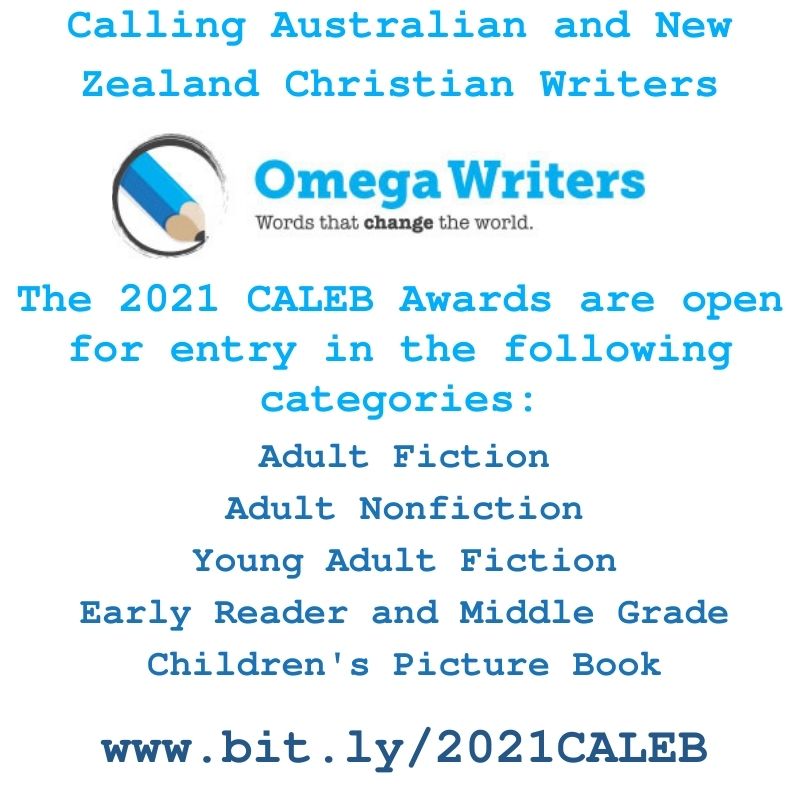
The 2021 CALEB Awards are open for entry in the following categories:

Adult fiction
Adult nonfiction
Young Adult fiction
Children's fiction (early reader and middle grade)
Children's picture books

The contest is open to books by Australian or New Zealand Christian authors, or Christian authors living in Australia or New Zealand. Entries must be written from a Christian world view i.e. they must be consistent with the Omega Writers Statement of Belief and not contain objectionable content (e.g. profanity, sexual situations, or excessive violence.)

The 2021 CALEB Awards are for books published in 2018, 2019, and 2020 (as determined by their copyright date), and which were not entered in the 2019 award (as some 2018 books were eligible to be entered in 2018). Books which have previously been entered in the Unpublished section of the CALEB Awards may be entered.

Entries are open from 15 March (today) to 20 April 2021. Read more here. 


Rendered Realms


Rendered Realms - consisting of Lynne Stringer, Adele Jones and Jeanette O'Hagan will have a table in Artist Alley at the  Supernova, Gold Coat - Saturday to Sunday, 17-18 April 2021. If you love all things fantasy and sci-fi, cosplay and great books & you plan to attend the con- we would love you to drop by, say hello and look at books, including some new releases.  


Omega Writers Book Fair (Brisbane) 2021


Omega Writers Book Fair (Brisbane) will be held on Saturday, 31 July 2021 at Hills Church, Queens Road, Everton Hills.  The Book Fair will have author stalls, workshops, book readings, and prizes. A great opportunity for Christian authors and readers in southeast Queensland to get together and celebrate books and writing. 

Mark you diaries - 31 July 2021


Congratulations to all our members for your milestones and achievements