We all love a good story, whether it’s
Luke Skywalker defeating the forces of darkness or Elizabeth Bennett getting
her man. However, we can sometimes wander off to the land of mesmerising
metaphors or take a detour on the sidetrack of scintillating subplots before
we’ve really come to grips with the essence of our story.
Sometimes we use the terms ‘plot’ and ‘story’ interchangeably, but they’re not the same. Good stories have transformation at their heart. Luke Skywalker realises his destiny as a Jedi knight. Elizabeth Bennett overcomes her prejudice. The plot helps us to show these transformations through a series of actions, circumstances, dialogue, revelations and more.
Entire books have been written on this topic, so I’ll only scratch the surface in this post. However, here are three authors whose methods have helped me to see ‘story’ with clearer eyes.
James Scott Bell’s ‘LOCK’ System
For James Scott Bell, the four components of the LOCK system make a good story.
- L = Lead – A compelling lead character you can sympathise with. This doesn’t mean he/she is perfect. In fact, it’s better if you also incorporate some flaws. However, you need to care what happens to him/her.
- O = Objective – The lead should be trying to get something or get away from something. This needs to be important enough that the reader will care about the protagonist’s journey towards his/her goal.
- C = Confrontation – This could be conflict with other characters or it could be some outside force, such as an avalanche. In any case, it won’t be easy for your protagonist to reach his or her goals. We have to see him/her battling the obstacles.
- K = Knockout ending – Is there a twist? A brilliant tying together of threads? Has the lead changed during the course of his/her journey?

For more information, please see the following book:
Bell, James Scott (2004). Plot and structure: Techniques and exercises for crafting a plot that grips readers from start to finish. Cincinnati, OH: Writer’s Digest Books.
Bell also offers an online course on ‘How to Write Best-Selling Fiction’.
Lisa
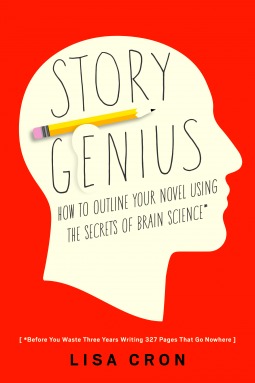
Cron – Story Genius
For Lisa Cron, the story is about the protagonist’s journey.
- What is your main character’s misbelief?
- Dig deep to find the roots of their misbelief.
- What situation are they going to be thrown into that will challenge their misbelief?
- How do they change over the course of the story?
These questions need to be answered before you start plotting. First work out what the character is going to learn over the course of the novel, and then work out what plot will allow them to learn that lesson.
I’ve written another post that fleshes this out a bit more and you can read it here.

You can also find out more in the following book:
Cron, Lisa (2016). Story genius: How to use brain science to go beyond outlining and write a riveting novel. Berkeley, CA: Ten Speed Press.
I also highly recommend her course on www.creativelive.com called ‘Wired for story: How to become a story genius’.
Jessica Brody – Save the Cat Method
Jessica Brody also sees transformation as key. Give the lead character a problem, a want, or a need. The plot is about fixing the problem or striving towards the ‘want’ or ‘need’. Obstacles are thrown at them, and they often learn lessons along the way that they didn’t expect. The plot shows the protagonist’s inner journey as they learn the life lesson they need to learn.
Once you have the main problem that needs to be fixed, you can start structuring a plot that helps the protagonist learn that lesson.
 Using the ‘Save the Cat’ method
popularised by screenwriter Blake Snyder, Brody shows how you can structure
your novel using 15 beats, from opening image to catalyst to dark night of the
soul to a brilliant final image. It’s beyond the scope of this
blog to explain all of the beats, but you can find a full explanation and lots
of examples in her book:
Using the ‘Save the Cat’ method
popularised by screenwriter Blake Snyder, Brody shows how you can structure
your novel using 15 beats, from opening image to catalyst to dark night of the
soul to a brilliant final image. It’s beyond the scope of this
blog to explain all of the beats, but you can find a full explanation and lots
of examples in her book:
Brody, Jessica. (2018). Save the cat! writes a novel: The last book on novel writing you’ll ever need. Berkeley, CA: Ten Speed Press.
Also see her online course on www.udemy.com called ‘Writing a bestselling novel in 15 steps’.
Summary of the Techniques
Although these three writers approach plot in different ways, they all emphasise the importance of the lead character’s change over the course of the story. The plot isn’t just a bunch of things that happen, no matter how interesting or exciting. The plot allows you to show what your lead character has to learn over the course of the novel. Every scene needs to advance that story in some way.
A Few Comments about Transformation in Christian Stories
In the past, a recurring theme in 'Christian' novels was that one of the non-believers would become a Christian by the end of the book. That still happens in some novels, of course, and there's nothing wrong with that. However, just be careful to show well-rounded characters with real struggles. It's seldom as straightforward as one person sharing a gospel message and the other 'praying the prayer'.
Also, Christians can go through the whole gamut of issues, problems and struggles that others go through. It's not always about someone being saved. I remember a dear old gentleman who came along to a missions talk one of my friends gave once. Afterwards, he expressed disappointment that she hadn't given a clear message about what her life was like before she met Christ and what it was like after. He came with very clear expectations, but that wasn't the purpose of her talk. She wasn't giving a personal testimony; she was talking about the mission trip she'd been on. But even if she had been giving a testimony, did it have to include a salvation message? It would have been equally valid for her to talk about one issue God had helped her work through. I think the same is true in fiction. Transformation can take many shapes.
In my historical novel Scattered, for example, my protagonist Maggie has abandonment issues and she needs to learn that God is the one person who will never leave her regardless of what other circumstances come her way.
What examples of transformation have you seen in some of your favourite novels? I'd love to hear your examples.
Author Bio

Nola Lorraine has a passion for faith and social justice issues, and loves weaving words that inspire others with courage and hope. Her inspirational historical novel Scattered was released in October 2020. She also co-edited the Christian charity anthology Glimpses of Light; and has more than 150 short publications, including fiction, poetry, devotions, true stories, magazine articles and academic papers. She and her husband Tim run a freelance writing and editing business, The Write Flourish, from the home they share with their two adorable cavoodles in southeast Queensland, Australia.
She would love to connect with you through her website: https://www.nolalorraine.com.au/
You can also find her on Facebook, Twitter, Pinterest, and Goodreads.
You can purchase Nola's novel 'Scattered' through Amazon, Koorong, and Breath of Fresh Air Press.
N.B. Featured photo by Tumisu on Pixabay. Free for commercial use.